Search This Blog

Tuesday, October 06, 2020

31 DAYS IOF HORROR 2020-Day 6: THE VIRGIN WITCH (1972)

 The lovely packaging image for the DVD. Needless to say, nothing like this occurs in the film.


Shot in 1970 but released two years later after running the gamut of ludicrous British censorship hassles, THE VIRGIN WITCH is less of a horror movie than it is a softcore Euro-sexploitation flick featuring supernatural elements. It tells the story of a pair of sisters (real-life sibs Ann and Vicki Michelle) who end up falling into the clutches of a "white" magic coven, headed by a horny Charles Gray-like high priest and a stereotypical predatory lesbian high priestess who has designs on the older girl, and that setup serves as an excuse for acres of naked female flesh to be put on display. (It's interesting to note that European softcore and porn actresses of the time did not seem to suffer from the Chewbacca-esque and unruly "'70's bush" syndrome that their American counterparts often sported.) 

 Anyway, there's really nothing to the story other than the two coven leaders both wanting to get into the older sister's knickers (which they both succeed at), the older sister getting into the idea of gaining power within the coven and suddenly learning black magic in order to achieve her from-out-of-nowhere evil ends, and the younger sister displaying minor psychic abilities that do zero to advance the thin shred of a plot. The copious amounts of nudity during all of this are the film's sole redeeming feature, but that aspect grows old very fast, especially when one considers how much actual porn is so readily available.

In short, THE VIRGIN WITCH is a curiosity at best, but if you choose to skip it you will miss absolutely nothing.

Poster from the theatrical release.

Monday, October 05, 2020

31 DAYS OF HORROR 2020-Day 5: THE NIGHT STALKER (1972)

When an autopsy turns weird...

"This is the story behind one of the greatest manhunts in history. Maybe you read about it — or what they let you read about it — probably as some minor item buried somewhere on a back page, however what happened in that city between May 16th and May 28th of this year was so incredible that to this day the facts have been suppressed in a massive effort to save certain political careers from disaster, and law enforcement officials from embarrassment. This will be the last time I will ever discuss these events with anyone, so when you have finished this bizarre account, judge for yourself its believability, and then try to tell yourself, wherever you may be, 'It couldn't happen here...'" -Carl Kolchak, dictating to his portable tape recorder in a fleabag motel

In 1972 Las Vegas, a series of bizarre murders of young women takes place, with all of the corpses completely drained of blood. As Carl Kolchak (Darren McGavin), an investigative newspaper reporter for the Daily News, formerly of some NYC paper, who is considered something of a nuisance by the police and others handling the stories he covers,  follows the clues, the weirdness escalates as a local hospital's entire supply of blood is stolen, regardless of blood type and RH factor. More information is garnered at a meeting with local politicians and police officials, including the fact that the bite wounds on the victims' necks were found to contain human saliva. The coroner in attendance, after being asked by Kolchak, verifies that there are historical instances of deranged individuals believing that they are vampires and feasting upon the blood of victims, but that idea is scoffed at by the police. The coroner, on the other hand, advises them not to so readily dismiss Kolchak's theory out of hand. That said, all reporters present are ordered by the mayor to keep a lid on "this vampire stuff" and make no mention of the women having been drained of blood, and Kolchak is in no uncertain terms told to stay clear of the case, as the mayor plans to speak with his boss and have someone else, anyone else, assigned for coverage.

 Investigative reporter Carl KOlchak (Darren McGavin): Soon to be the idol of 1970's monster kids.

Kolchak forges ahead with his investigation anyway, despite his boss angrily telling him "No vampire stories," but the killer strikes again, only this time with a witness, but having a police sketch of his face adorning the front page does not deter the ravening suckface. His next victim is cornered alone, but she releases a large attack dog upon her assailant, only for him to grab the animal, break its neck, and cast its lifeless carcass to the ground before making short work of its owner.


 A hungry member of the undead stalks Sin City.

At this point, Kolchak thinks the murderer is simply a psychopath, but his casino-worker girlfriend (Carol Lynley) gives him a book entitled "Everything You Ever Wanted to Know About Vampires But Were Afraid to Ask," that he pores over for facts on the lore the nosferatu. It's a timely gift, as Kolchak hears a police report of a violent brawl at another of the city's hospitals and rushes to the scene to bear witness. With his own eyes Kolchak watches as the vampire makes off with another haul of blood while tossing around hospital staff and police like they were rag dolls. The killer manages to escape with ease, even while the cops open fire on him, and Kolchak snaps photos of the wild melee. 

 With such proof, the lid is blown off the case and the killer is identified by Scotland Yard and Interpol as Janos Skorzeny, born in Romania in 1899. Skorzeny ended up in England during World War II, under the false identity of Dr. Paul Belasco, a specialist in hematology research whose work involved freshly-killed air raid victims from London's emergency rooms — his home was found to be equipped with a number of sumps, tubs, and a huge frozen meat locker — and after that he turned up in Canada, his path coinciding with incidents of violence marked by dead bodies, and his British citizenship making him an international fugitive. His travels are always accompanied by killings, each of which involved massive loss of blood in the victims. At a press conference outlining all of this, the authorities won't acknowledge that Skorzeny is a vampire — after all, that would be too fantastical — but Kolchak asks pointed questions about the superhuman display that he personally witnessed at the hospital, and puts forth that the only way the police will get this madman is if they proceed under the assumption that they are dealing with an honest-to-god, straight-up, real-deal vampire. Needless to say, this does not go over well with the local law enforcement and politicians, and Kolchak is issued a veiled warning to watch his ass, keep his mouth shut, and not interfere with the police investigation of the matter. With that, police efforts kick into overdrive, with round-the-clock surveillance, choppers deployed, and 650 officers on duty... And Kolchak doggedly continues to sniff out the trail.

Skorzeny soon resurfaces and, with Kolchak present to snap photos at point-blank range, is chased by the police , resulting in another melee punctuated with a hail of impotent gunfire. Any normal human would have been reduced to chutney by all the bullets and shotgun shells, but Skrozeny merely picks himself up, glares daggers at his pursuers, and again escapes into the night. After witnessing that display, Kolchak firmly believes Skorzeny is exactly what he appears to be, so he turns up for a private audience with the authorities, offers his advice on how to handle the vampire in exchange for the exclusive rights to the story, and outlines what should be issued to every man in the filed: a kit containing a crucifix, a mallet, and a wooden stake. His terms are agreed to, but with two conditions: Skorzeny must be taken alive so he can stand trial, and if Kolchak is wrong he must leave Las Vegas within 12 hours. Firm in his conviction, Kolchak takes the deal, overjoyed that the presumed windfall from being the reporter to solve the case will allow him to return to New York City, so he follows a contact's lead to the house where Skorzeny holes up during the day. With that information in hand, it is on...

 This well-crafted made-for-TV movie surprised many with its quality and its success in the ratings, but all of the elements for something memorable were in place. The script by Richard Matheson, he of many classic episode of THE TWILIGHT ZONE, is firmly rooted in a believable reality, which helps sell the presence of a vampire serial killer, and the cast play their parts with totally human gravitas. The success of this effort led to a sequel, THE NIGHT STRANGLER (1973), and then the ongoing weekly ABC series, KOLCHAK: THE NIGHT STALKER (1974-1975), in which Kolchak, now operating in Chicago, would encounter and face off against a new weird threat and situation every week. It was the first primetime show that I, at age nine, discovered on my own that became must-see weekly programming, and I never missed an episode. I sometime watched it while cowering beneath the family room's coffee table, but I would have preferred to cut off one of my limbs than miss an episode. Darren McGavin became a hero to myself and legions of kids (and adults) across the nation, and the series offered a steady parade of monsters for Kolchak to contend with, ranging from the expected werwolves, vampires, and demonic presences to homicidal robots, ghost, zombies, and even Lovecraftian entites, so it was quite an education for monster kids.

I saw THE NIGHT STRANGLER and the TV series before I saw THE NIGHT STALKER itself, and I'm fuzzy on the details but I think I finally saw it when broadcast on NYC's venerable THE 4:30 MOVIE sometime around 1976 or 1977, and I could totally see why the movie inspired an ongoing show. It's quality stuff that retains an edge despite its FCC-approved content, and that same edge carried over to most of the series' episodes. Unfortunately, KOLCHAK: THE NIGHT STALKER only lasted for one season, and I have no idea if its cancellation was due to dwindling ratings or the fact that its "monster of the week" format was a a well that had pretty much run dry after 20 episodes, but its cancellation was a real gut punch. The show returned as reruns on THE CBS LATE MOVIE in the late 1970's and proved a ratings hit, and it remained such whenever it was subsequently brought back in syndication. There was even an attempt at a reboot series in 2005, but without McGavin, there really was no point. Let's just be glad that was got to spend as much time investigating the mysterious and gruesome as we did with Carl Kolchak. I can;t speak for the rest of you, but it was absolutely a formative influence on my fervent love of horror as a genre, and my quality of life during those tender years was definitely improved by its presence.

TV GUIDE ad from 1972.

Sunday, October 04, 2020

31 DAYS OF HORROR 2020-Day 4: WHAT EVER HAPPENED TO BABY JANE?

Shattered lives and slowly-simmering hatred make for a heady, personal cocktail of psychological horror.

After Alfred Hitchcok's landmark PSYCHO (1960) blew open the doors for disturbing psychological horror in American cinema, it was only a matter of time before another work would happen along to creep out the public without the benefit of monsters or the supernatural. That work was Robert Aldritch's WHAT EVER HAPPENED TO BABY JANE?, the grand dame of what was soon to become known as "hag horror," a genre whose foundation was laid with this black-and-white shocker.

In 1917, nauseating, bratty child vaudeville star "Baby" Jane Hudson rakes in the cash for her family with her treacly stage antics, while her parents ignore her sister, Blanche, who also suffers the obnoxious treatment of the pint-sized diva. By 1935, both sisters have careers in the movies, but the spotlight has now shifted to Blanche, who is a genuine talent, while Jane fails to electrify onscreen, but Blanche's contract insists on work for Jane, so the studio is stuck with her. But on a night after a studio party, the sisters, who share a residence, drive home and one of them gets out of their car to open their home's front gate. Both women's features are obscured by shadow, so we do not know who is doing what, but the one behind the wheel pops the clutch and floors it in an attempt to kill her sister...

The calendar skips ahead by 33 years to the present day of 1962, and the Hudson sisters still live together, only now Blanche is confined to a wheelchair after the crash rendered her an invalid — the crash being blamed on Jane — and she now totally relies on her sister for her care. That said, Blanche is kept isolated from the outside world, basically a prisoner in the house, and even its windows are barred to drive that point home. Jane, meanwhile, is now a grotesque alcoholic whose around-the-house look is an unconscious creepy caricature of her stage persona from her long-ago glory days. The boozy Jane never lets her sister forget that her money from her childhood career took care of the family and paid for the house, but Blanche seeks to sell the house and have Jane, who is now quite psychotic and out of her mind and only growing worse every day, put away in a mental hospital. Once Jane gets wind of this, she wages cruel physical and psychological warfare upon her helpless sister, and even the occasional presence of a housekeeper, a nosy neighbor who's a fan of Blanche's old movies, and a would-be musical partner for Jane do not get in the way of Jane's unhinged cruelty. As the household descends into utter madness, Jane becomes more calculated and diabolical, with matters spiraling to a shocking and tragic conclusion...


Sisterly... Well, it sure as hell ain't love.

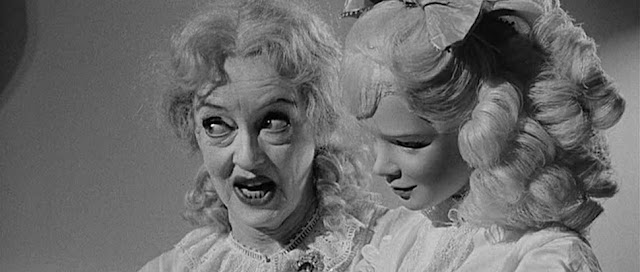
 That's as far as I'll go by way of recap, as the events of this story are best approached with only the basic setup in mind. It's a study of madness, staggering family dysfunction, cruelty, and the slow-burn of alcohol-fueled insanity, and as such it works beautifully. Crawford and Davis, then middle-aged and well past their more bankable days as classic hotties, both play their parts with the expected excellence, especially Davis, who steals the film in an Oscar-nominated performance as Jane. She shuffles around the house in the most from my manner possible, her face garishly made up in what looks like a deranged child's idea of glamor, and her blonde hair sometimes done in the manner of her days as a curly-haired cutie.


Bette Davis as Jane Hudson. Nothing disturbing going on here. Nope. Nosiree...

I'll just leave it at that, other than to state the final reveal is well and truly fucked-up, and to give this a strong recommendation. The two subsequent major hag horror classics, STRAIT-JACKET and
HUSH, HUSH, SWEET CHARLOTTE (both 1964 and starring Joan Crawford and Bette Davis, respectively) are both quite good and a lot of fun (especially CHARLOTTE, its over-length notwithstanding), but if you're going to explore this sub-genre, one is advised to start where it truly began.

Poster from the theatrical release.

Saturday, October 03, 2020

31 DAYS OF HORROR 2020-Day 3: ALIEN (1979)


                                                             Worst trick-or-treat bag EVER.

During the summer of 1979, the hottest ticket for those of us who were too young to believably appear old enough to be able to attend an R-rated movie was director Ridley Scott’s ALIEN. Thanks to the boyfriend of a peer’s mother who sought to curry favor with her son, I found myself one of the lucky few in my junior high to have seen it in the theater, and I’m undyingly grateful that I did because a dark movie theater was the perfect place in which to experience it for the first time.

Basically a high-end mashup of elements cribbed from IT! THE TERROR FROM BEYOND SPACE (1958) and PLANET OF THE VAMPIRES (1965), ALIEN came from out of nowhere to become a genre milestone while also codifying certain of its aspects into the filmic language. Another case of simplicity itself, the narrative follows the ill-fated working class crew of the Nostromo, a long-haul space-tug that’s lugging a fuel refinery, as they contend with an incredibly hostile life form that makes its way onto the ship. The particulars of the story are now quite familiar, as they have become Iconic, but on the off chance that anyone reading this has somehow never the film, I will not spoil anything. What you need to know is that its story is presented with a futuristic-but-grounded sense of realism, and there’s nothing glamorous or “cool” about the crew. They’re basically a pack of truckers who are willing to endure suspended animation over the course of the journey, and they’re there to do their job. No flashy space heroes among them and no “pew-pew” laser guns. (Flamethrowers, however..) Once the alien gets loose, it’s a taut study in claustrophobic terror in which it’s very doubtful that anyone will survive.

The crew of the Nostromo. Suddenly that job masturbating animals for artificial insemination is looking pretty good...

Among the elements that gained ALIEN its immortality are the titular creature, designed by legendary Swiss artist H. R. Giger, and its horrific reproductive cycle. It’s the stuff of nightmares, which is perfect for a previously un-encountered entity that is the unknown of the cosmos personified. The landscape of the inhospitable planet where it is discovered is equally memorable, featuring endless fog and an extra-terrestrial spacecraft of unknown origin that appears to be a fusion of the mechanical and the organic. Access to the ship is provided by orifices that bear a strong resemblance to grossly-oversized vulvas, which immediately makes most audiences uncomfortable, as we recognize what it is, but perhaps at first on a subconscious level. That bit of human anatomy is largely considered something to be kept from view, so by using it as a doorway, our heroes are performing a sort of anti-birth, which is only appropriate when taking into account what awaits them within the depths of the ship.


Ripley (Sigourney Weaver). The humble origins of an icon. 

The other major landmark was the introduction of the now-iconic Ellen Ripley, played to completely believable perfection by a then-unknown Sigourney Weaver. Ripley is quite no-nonsense, and she’s the only member of the crew to demand a thorough quarantining of the life form (and the infected crew member) before letting it onboard. Her terror throughout the experience of dealing with the creature is all too relatable, as her crew is picked off one by one in assorted very gruesome ways.

The final showdown.

Her screen immortality was ensured by the events of the film, and would be topped by the equally exceptional sequel, ALIENS, some seven years later. So much, that when one is asked to provide a short list of characters who rank among cinema’s greatest badasses, Ripley is like to be on the roster, though her real status as such would be earned in the sequel. In ALIEN, she’s is an on-edge mess, but she keeps it together enough to prevail By the time ALIENS rolled around, well, we’ll get to that…

Anyway, ALIEN is a suspenseful, terrifying classic not to be missed, and its “haunted house in space” vibe is palpable. Especially when watching it on mushrooms, which I do NOT recommend. Trust me on that...

Poster from the theatrical release, featuring one of the all-time great tag lines.

Friday, October 02, 2020

31 DAYS OF HORROR 2020-Day 2: HALLOWEEN (1978)

A bad night for babysitting.

John Carpenter’s HALLOWEEN emerged seemingly from nowhere to set the tropes of what we now know as the slasher movie genre in stone, and as it has been written about ad infinitum since its release, I had until now avoided commenting on it in my yearly essays. Now, I only seek to include it because it’s an iconic piece and a game-changer for horror, and also because I want to get around to citing as many of the all-time classics as possible.

In the fictional town of Haddonfield, Illinois, on the night of Halloween in 1963, six-year-old Michael Myers, dressed in a clown costume, stabs his teenaged sister to death with a butcher knife. With no motivation evident, the boy is relegated to a sanitarium for the next fifteen years, eventually escaping in time to get his hands a William Shatner mask and a mechanic’s overalls just in time for an implacable murderous rampage on Halloween night. Silent and seemingly superhumanly powerful, Michael (Nick Castle) makes short work a group of the neighborhood teens, with only virginal bookworm Laurie Strode (Jamie Lee Curtis in the role that would define her career) left to menace. Laurie’s babysitting a pair of kids, so when Michael comes calling she must fight for their lives as well as their own. As the bodies pile up, Michael is pursued by Dr. Loomis (Donald Pleasance), his former institutional psychiatrist, with Loomis bearing a deep understanding of exactly what Michael is: an unstoppable entity of purest, most unbridled evil, in short, Michael is the Boogeyman. That’s all the explanation given and that’s all we really need. Michael Myers is that primal childhood fear of a reasonless monster that exists for no reason other than to kill, and as such he is the essence of terror distilled down to its most basic and potent.

HALLOWEEN is simplicity itself, shot on a shoestring budget and crafted as nothing kore than a massive “BOO!!!” for an eager audience. It’s not deep and it features allegory or social commentary. It’s simply a blank-faced, silent killer stalking and bumping off teens without any hope of a challenge, until he meets Laurie and encounters her equally-dogged will to protect her charges and make sure they all survive. It’s a setup that is all too easy to relate to, even with its weird elements (Michael being apparently unkillable, for one), and that no-nonsense approach made HALLOWEEN one of the most successful independent films ever made, raking in a box office yield of $60-70 million bucks off of a budget of a reported $300-$350,000.

HALLOWEEN’s plot is nothing more than a stripped-down “girl in danger” yarn, but it’s the direction of John Carpenter, his now-iconic score, and its considerable visual artistry and editing that make it rise well above the pack. And its success did not go unnoticed by other filmmakers — most notably those responsible for FRIDAY THE 13th two years later — and in no time studios were churning out slasher films in droves, ripping off many of the tropes established by HALLOWEEN, but bearing little or none of its craft or creativity. HALLOWEEN achieved horror perfection without a trace of gore. It's descendants... Not so much.

Though PSYCHO and PEEPING TOM (both released in 1960), can be considered precursors, HALLOWEEN is the true Ground Zero for the slasher genre. This is where it all started, and after exploding out of the gate with such a genuine work of cinematic art, there was nowhere else for slasher genre to go but down. This was lightning in a bottle and a proving ground for a director who would go on to craft a number of other landmarks of horror. Yes, there are a handful of subsequent slashers that possess merit, but this here is the gold standard.

Poster for the theatrical release.
 
From the 2018 Chiller Theatre Con in Parsipanny, New Jersey. She's a sweetheart and very, very funny.

Thursday, October 01, 2020

31 DAYS OF HORROR 2020-Day 1: FRIDAY THE 13th (1980)


                                                    She axed for it. (I'll show myself out.)

In the summer of 1980, eager movie fans were foaming at the mouth in anticipation of THE EMPIRE STRIKES BACK, the first of the STAR WARS sequels, so when a humble low-budget gore flick quietly landed in the nation’s theaters, pretty much no one expected it to become one of that year’s most lucrative box office draws.

Blatantly biting off of John Carpenter’s seminal HALLOWEEN(1978), FRIDAY THE 13th was made on the cheap and totally eschewed the artistry that made HALLOWEEN the classic that it is, as well as not giving a squirt of rat’s piss if it were actually scary or not (it isn’t). No, this film’s sole raison d’etre was concerned with absolutely nothing but turning the screen into a savage charnel house, accented with titties. In other words, the perfect brainless sex ‘n’ violence exploitationer that the youth audience would devour as celluloid fast food. But what no one foresaw was the film reaping so much money that sequels were inevitable, unintentionally creating a cheapjack franchise that ended up as an iconic horror cinema institution. Most of the films in the series were outright shit, but they were the standard-bearer of what became known as the “slasher” film, a genre that became emblematic of its ‘80’s moment in history.

I was fifteen when FRIDAY THE 13th arrived, and at the time all of us who were about to enter high school at the end of that summer saw gaining entrance to so outrageously gory of movie (for mainstream fare) as something of a rite of passage as we worked our often-confused way through coming of age during the Reagan era and the Cold War, a period in which ongoing fear of a nuclear conflagration was very real indeed. Horror movies were a means for coping, and though I had been a dyed-in-the-wool “horror kid” since age four, I had up to that point mostly been raised on content suitable for broadcast television, with the notable exceptions being DAWN OF THE DEAD (1978) and ALIEN (1978), so I was in no way expecting something so extreme to run outside of a grindhouse. This was the kind of shit that could arouse the ire of censors and parental watchdogs of decency (which in some circles it did), but who gave a fuck what those squares thought? Us kids wanted to see what the big deal was, so we went in droves.

I had already seen HALLOWEEN, albeit in a version censored for broadcast on NBC during primetime, as well as proto-slasher PSYCHO (1960), so I was familiar with the basic tropes as set forth in films of genuine quality and merit, and my serious gore cherry had been popped by DAWN OF THE DEAD, but DAWN’s then-over-the-top gore, while quite shocking, worked perfectly within the apocalyptic context that it presented. It even offset a lot of its visceral nightmare with a blackly comedic sense of humor. FRIDAY THE 13th, on the other hand, served up a bunch of ciphers that barely qualified as characters, and they were there to be chopped up and otherwise massacred for our amusement. At no point do we give a shit about any of them. It’s all about Tom Savini’s groundbreaking gore effects, baby. This sure as shit was Kurosawa by any stretch of the imagination.

When my peers began seeing the movie and disseminating early reports on its content, many, including myself, were quite skeptical. It reminded me of all the times during elementary school when kids would describe details of “grownup” movies or TV shows during recess, and more often than not those details were over-inflated or straight-up lies in order to garner attention. (My go-to example of this phenomenon was a 4th grade schoolyard incident the day after a network TV broadcast of ONCE UPON A MATTRESS, a musical retelling of THE PRINCESS AND THE PEA. Some kid claimed that it climaxed with a lot of farcical running around that saw the princess, who was reportedly hugely pregnant, having a bunch of mattress topple onto her. The kid swore up and down that the pressure of the mattresses forced the baby to comically be fired from her nethers, complete with umbilical chord. Even at that tender age I knew bullshit when I smelled it, and from then on I looked askance at my peers’ “I swear to god this happens” tall tales.) Surely a movie showcasing nothing but repeated stabbings, mutilation, and dismemberment never be allowed to play at Westport’s classy and genteel Fine Arts 1 & 2…

The initial reports all emphasized the violence and gore while making no mention whatsoever of the plot. None of my peers gave a damn about plot or characterization, nor did anyone else in America’s moviegoing throng, apparently, and many times I heard the film earnestly assessed as “the scariest movie ever made.” (Which was also how they described POLTERGEIST a couple of years later.) When I finally saw the film for myself, I found the gore fun, but felt the film lacked in every other aspect. There’s no suspense, none of the characters inspire interest of caring, the script is awful the direction and cinematography are flat and uninspired, the jump scares swiftly become tedious, and when the killer finally revealed, it’s in no way believable because the person in question would not have had the physical strength to perform some of the feats of brute strength depicted. In short, it’s a mindless spook show and nothing else.

But lack of a brain behind a film seldom stopped a movie from being a hit, so FRIDAY THE 13th became the genre’s textbook template for the decade, with its innumerable knockoffs displaying even less creativity and artistry. Yes, there were some decent and entertaining slasher, but for the most part the genre was a cul de sac. That said, I freely admit to being a fan of this series purely because I’m amused by their escalating idiocy. The filmmakers are fully aware of exactly what they are churning out, and the audience is only too happy to turn up for the latest serving of blood sausage. It’s crap and we all know it, and sometimes one is just in the mood for junk food.


Poster from the theatrical release.


31 DAYS IF HORROR 2020 - INTRODUCTION


How does one even write about horror in a year over-saturated with real world horrors?

Unless you have been fortunate enough to have resided under rock at the bottom of the ocean for the past seven months or so, you are no doubt aware of what an utter shit show 2020 has been. A global pandemic, disgraceful international politics, civil/social unrest, the United States standing unashamedly revealed as a racist cesspool (more openly than usual), basically everything but Mama Gorgo showing up in Manhattan. In short, the perfect climate in which to absorb scary movies in order to give our weary minds a respite from the real-life horrors that we endure every day.

This year’s entries will be all over the place in terms of quality and interest, and I hope you all have fun reading this stuff. Little it will be all that deep, but that’s the goal. Entertainment and diversion, so stay strong as we make our way to the 31st, the first year that I can recall without a proper Halloween with the “little dead out in droves.” That truly bums me out, but better to err on the side of caution and common sense. We may love the macabre, but let’s not contribute ourselves and loved ones to the escalating body count, mmm-kay? Keep horror on the screen and the printed page, where belongs and is welcome.


Tuesday, September 22, 2020

THE LEAGUE OF EXTRAORDINARY GENTLEMEN: CENTURY (2009-2012)

Considering the recent mishegoss involving J.K. Rowling, I was inspired to reread THE LEAGUE OF EXTRAORDINARY GENTLEMEN: CENTURY. 
 
The book kicks off with a prologue that reimagines THE THREE PENNY OPERA through the lens of Alan Moore while setting up a thinly-disguised Aleister Crowley's plot to generate the Anti-Christ, a scheme that spans the titular century. The remainder of the narrative skips ahead to the 1969, 1977, and the present day of 2009, and it's the usual festival of Moore's showing off of how much disparate pulp fiction and pop culture he has absorbed (which some find confusing and tiresome, but which I find a lot of fun). The segment in 1969 is awash with the mod psychedelia and excesses of swinging '60's England, the 1977 section conjures up the feel of first wave U.K. punk, and through it all we see the seeds sown for a twisted take on J.K. Rowling's kid-friendly world building (which is pointedly NOT kid-friendly here). It's an admitted hodgepodge but definitely worth reading. A dense work but a deft cocktail of the dark and utterly absurd.


Saturday, September 19, 2020

Sunday, August 30, 2020

BILL & TED FACE THE MUSIC (2020)

Older and no wiser: the long-awaited and most welcome return of Bill S. Preston (Alex Winter) and Ted (Keanu Reevs) Theodore Logan.

Just finished watching BILL & TED FACE THE MUSIC, and I found it to be considerably superior to the second entry in the series, BILL & TED'S BOGUS JOURNEY (1991), a film that is not without its supporters. And before we get to the review, the original BILL & TED'S EXCELLENT ADVENTURE (1989) is still the best of the unintentional but very much a trilogy. This current entry brings everything full circle, and who of us who saw the original when it came out would have expected a return to our heroes some 31 years later?

The film finds our hapless heroes, still brought to life by Alex Winter and Keanu Reeves — who slide back into the roles effortlessly — racing against the clock to simultaneously acquire the song that will unite humanity and save an unraveling universe, while also seeking to prevent their wives — 15th century princess, remember — from leaving them. Meanwhile, their daughters and female doppelgangers, Billie and Thea — they named their daughters after each other — go off on a trans-temporal adventure of their own as they assemble a band to play the song that their fathers are destined to craft, and in the process they set up "Bill & Ted: The Next Generation," should there be more of these.

 Thea (Samara Weaving) and Billie (Brigette Lundy-Paine): the next generation of time travelers?

Winter and Reeves return to their old characters deftly, having not lost a single step, and William Sadler returns as Death, reprising the role that was easily the best thing about BOGUS JOURNEY. Billie and Thea are basically Bill & Ted reborn as girls and they both work as distaff duplicates of their fathers, so they would be welcome if the torch is passed to them. Brigette Lundy-Paine is a standout as Billie, thanks to her nailing everything when it comes to a new embodiment of Reeves's Ted. She nails his manner of speech and his body language to an uncanny degree, and I would love to see more of her in the role. We also get Billie and Thea assembling an eclectic crew to travel through time with, including Jimi Hendrix, Luis Armstrong, Mozart, and others. It's a loony, convoluted mess that's a hoot to sit through, and it ends with quite and unexpected twist, actually...

There are no gags that went nowhere like in the previous film — one word: "Station," though station does briefly return as a nod to what came before — and the whole film is just a much-needed feel-good movie for this dire era. It's amusing on its own, but I think a lot of whether or not the viewer will enjoy it will be based on how much the viewer is already a Bill & Ted fan.

Bottom line: BILL & TED FACE THE MUSIC is just what we need right now, and I feel good for having sat through it. If I had seen it in the theater at full price, I would have exited satisfied and in a good mood.

Lastly, illegal "party favors" are recommended for full enjoyment. Trust me on that one!

Poster for the theatrical release.