Being a window into the thoughts and interests of a self-proclaimed entertainment ronin. Commentary, recipes, pop culture reviews...FUN FOR ALL!!! © All original text copyright Steve Bunche, 2004-2024.
Search This Blog
Showing posts with label IT'S BLACK HISTORY MONTH. Show all posts
Sunday, February 28, 2010
SEE YA NEXT YEAR, BLACK HISTORY MONTH!
And so ends another Black History Month. Round out this less than thirty days of recognition and appreciation by re-watching COFFY, eating an order of Popeye's Chicken, saying "muthafukka" every seventh word, and kicking down a couple of forties before March starts! Do it now! You only have a few hours left!!!
Labels:
IT'S BLACK HISTORY MONTH
MASTER OF FALCONHURST (1964)
And so, Black History Month comes to a close, but not before I review the last book in Kyle Onstott's infamous Falconhurst trilogy. This was the final book in the series featuring the direct involvement of its creator before he died, at which point the Falconhurst saga continued (and degenerated) in the hands of sleaze-master supreme Lance Horner.
MASTER OF FALCONHURST follows the journey of Drummage — short for "Drum Major" — the son of the previous book's tragically murdered Drumson, from slave to the literal master of Falconhurst, the slave-breeding plantation where the majority of the action in MANDINGO and DRUM took place. Upon hitting roughly the age of sixteen, Drummage ends up as a house slave to Hammond Maxwell and Miss Augusta, both some seventeen years older than when last seen (at the end of DRUM). After being whipped for an infraction that he did not commit, Drummage is given the house nigger position by Hammond as an unspoken token of apology for disbelieving Drummage's insistence of innocence and from there he becomes the number two power among Falconhurst's blacks, second only to the iron hand of takin'-no-mess uber-mammy Lucrecia Borgia. This position allows him unlimited access to the slave girls and in no time Drummage has fathered a small army of offspring. Much of the novel involves the same kind of shenanigans as seen in the previous books, though thankfully free of the "fightin' nigger" subplot that would have made this book quite a repetition of previously-explored narrative luridness, and we also get the return of Hammond's nymphomaniacal, jungle-fever-havin' daughter, Sophie (actually fathered by Hammond's second wife Blanche's "gotch-eyed" brother, Charles), roughly in her early-twenties, fat, facially unappealing and returned from her studies at a finishing school for young ladies, an institute for higher learning that did little to render her any more classy than the spoiled and monied white trash that always was. Once back home, Sophie proceeds to secretly fuck as many of the male slaves as she can coerce during her daily carriage rides to secluded wooded areas and she of course sets her sights on Drummage, who has the good sense to avoid her. A lot of the usual sleazery takes place, holding the reader's interest as the Civil War breaks out and Hammond leaves Falconhurst to fight for the south and finance the troops. While Hammond is gone, the task of making sure Falconhurst runs smoothly falls to Augusta, Lucrecia Borgia, Drummage and a handful of trustworthy slaves who are too ensconced in the slave mentality to even dream of wanting their freedom. As the war drags on and the once-proud plantations surrounding Falconhurst fall into financial ruin, Falconhurst thrives due to its self-sufficient nature (it grows nothing but slaves and the food to sustain said slaves and, by default, its white residents) but with Hammond absent, discipline becomes lax and the slaves, led by Drummage and the aging Lucrecia Borgia, basically run everything.
When news of Hammond taking ill in battle reaches Falconhurst, Augusta rushes to be with him and both succumb to disease, thus leaving the plantation and family wealth of buried treasure (that only Drummage knows the location of) to Sophie, who marries a near-white freed slave/con man who takes her for all he can, but not before getting shot by one of Sophie's trysting-slaves, leaving her distraught. Since she never had much use for white folks in the first place (she declares herself "more nigger 'n white anyway"), Sophie now openly gets her hump on with any black men available, and with the shift in power so blatantly in favor of Drummage, Sophie regularly pays Drummage in cash and valuable jewelry for his servcies. There is no real love between the two, just a business transaction, because Drummage enjoys giving his dead master's spoiled bitch of a daughter no choice but to buy him. When the war ends and the south loses, the slaves are now free, but since they have nowhere to go, the majority of them stay on at Falconhurst and little changes, except for the inevitable death of Lucrecia Borgia and Drummage aspiring to a social position equal to whites. The first step in his plan is to marry up with Sophie (now heavy with his child), a step quite controversial at home, but downright inflammatory to the whites in surrounding towns, but marry they do, and Drummage takes the Maxwell name as his own, shortly after which Sophie dies while giving birth to their virtually white son, Drummond. Having learned to read and write some years earlier, armed with tons of cash and now being tutored in the ways of white comportment by a Union officer whom he befriends, Drummage becomes every bit as arrogant and douchey as his white former-oppressors, merrily supplying powerful northern visitors with black women to sleep with and financing Union groups that seek to empower the now free black population of the south. Drummage even joins the Union group and prepares for a run for Congress, all while making time with the incredibly avaricious Candy, a light-skinned former-Falconhurst slave who was in cahoots with the con man Sophie had married (and the con man's darker brother), but escaped to New Orleans with part of the Falconhurst treasure. But while blinded to reality by his money and power, Drummage neglects to notice the growing resentment of his now poor white neighbors, a deadly hatred that comes to a head as some redneck members of the newly-formed Ku Klux Klan gang-rape Candy literally to death and then crucify Drummage. Just as he's about to have his considerable manhood removed with a Bowie knife, one of his attackers finds himself disgusted by the wanton lust and bloodthirst of his compatriots and opts to grant Drummage an easier death, shooting and killing him. Drummage's son is left to be raised by the aforementioned Union soldier friend, Chris, and the whole mess is summed up by Big Pearl, a supporting character from the previous novels and Drummage's mother, who reminisces about the trilogy's horrifying events.
MASTER OF FALCONHURST is a compelling read and almost as good as DRUM, but if not for the inclusion of the Civil War and its aftermath, it would have been a case of just more of the same, only better-written than MANDINGO. Once again, an Onstott novel gives props to Lance Horner for his assistance and, as I've said before, I believe the novel is a case of Onstott doing the main writing and leaving the tightening of it to Horner. While MANDINGO was unquestionably lurid as hell, it was not outright designed as a showcase for prurience; Onstott clearly intended to bring the horror and inequities of chattel slavery straight to the faces of his white readers and force them to take a deep, bloody-splattered, shitty whiff of it in all its awfulness, pulling no punches in its raw depiction of graphic (for its time) sex, violence and unbridled dehumanizing cruelty. When Horner entered the picture in earnest (with the by-then-deceased Onstott still being credited), the writing took a quantum leap in quality, but the visceral/sexual content became a source of titillation for those who get off on borderline sado-masochiostic pornography, thus reducing Onstott's intent to fodder for the kind of sleazy novels that once lined the racks in airport and bus station bookstores. After MASTER OF FALCONHURST, the Falconhurst saga continued on for at least a decade, but I can't be certain of exactly how long it went on because there's surprisingly little information about this stuff to be found on the Internet. I can think of at least six or seven sequels off the top of my head and I'm certain there are even more than that, but out of the followups that I've read, only one of them is worth reading as anything other than a mere time-killing potboiler. Easily my favorite of the entire Falconhurst genre, FALCONHURST FANCY (1966) takes place about ten years prior to the events in MANDIGINO and does not focus on Falconhurst at all (although it does include brief cameos from a tweener Hammond Maxwell and his father), instead giving the spotlight to Dovie Verder of the Cote plantation, a rare and well-written female protagonist for this sort of thing, and Colt, the Nubian Adonis who is the object of her forbidden desire.
The immediate followup to MASTER OF FALCONHURST, it's a damned fun piece of exploitation quasi-literature and I intend to read it again as soon as possible so I can provide a detailed analysis.
The direct sequel to MASTER OF FALCONHURST (in narrative terms) is HEIR TO FALCONHURST (1968), which skips the story ahead to chronicle the grown and white-looking Drummond and his adventures in the post-Civil war south. I bought as many of the Falconhurst books as I could find on eBay some years ago and I confess to not having read all of them, but this one has my interest thanks to me having just finished re-reading its immediate narrative predecessor just two days ago.
MASTER OF FALCONHURST follows the journey of Drummage — short for "Drum Major" — the son of the previous book's tragically murdered Drumson, from slave to the literal master of Falconhurst, the slave-breeding plantation where the majority of the action in MANDINGO and DRUM took place. Upon hitting roughly the age of sixteen, Drummage ends up as a house slave to Hammond Maxwell and Miss Augusta, both some seventeen years older than when last seen (at the end of DRUM). After being whipped for an infraction that he did not commit, Drummage is given the house nigger position by Hammond as an unspoken token of apology for disbelieving Drummage's insistence of innocence and from there he becomes the number two power among Falconhurst's blacks, second only to the iron hand of takin'-no-mess uber-mammy Lucrecia Borgia. This position allows him unlimited access to the slave girls and in no time Drummage has fathered a small army of offspring. Much of the novel involves the same kind of shenanigans as seen in the previous books, though thankfully free of the "fightin' nigger" subplot that would have made this book quite a repetition of previously-explored narrative luridness, and we also get the return of Hammond's nymphomaniacal, jungle-fever-havin' daughter, Sophie (actually fathered by Hammond's second wife Blanche's "gotch-eyed" brother, Charles), roughly in her early-twenties, fat, facially unappealing and returned from her studies at a finishing school for young ladies, an institute for higher learning that did little to render her any more classy than the spoiled and monied white trash that always was. Once back home, Sophie proceeds to secretly fuck as many of the male slaves as she can coerce during her daily carriage rides to secluded wooded areas and she of course sets her sights on Drummage, who has the good sense to avoid her. A lot of the usual sleazery takes place, holding the reader's interest as the Civil War breaks out and Hammond leaves Falconhurst to fight for the south and finance the troops. While Hammond is gone, the task of making sure Falconhurst runs smoothly falls to Augusta, Lucrecia Borgia, Drummage and a handful of trustworthy slaves who are too ensconced in the slave mentality to even dream of wanting their freedom. As the war drags on and the once-proud plantations surrounding Falconhurst fall into financial ruin, Falconhurst thrives due to its self-sufficient nature (it grows nothing but slaves and the food to sustain said slaves and, by default, its white residents) but with Hammond absent, discipline becomes lax and the slaves, led by Drummage and the aging Lucrecia Borgia, basically run everything.
When news of Hammond taking ill in battle reaches Falconhurst, Augusta rushes to be with him and both succumb to disease, thus leaving the plantation and family wealth of buried treasure (that only Drummage knows the location of) to Sophie, who marries a near-white freed slave/con man who takes her for all he can, but not before getting shot by one of Sophie's trysting-slaves, leaving her distraught. Since she never had much use for white folks in the first place (she declares herself "more nigger 'n white anyway"), Sophie now openly gets her hump on with any black men available, and with the shift in power so blatantly in favor of Drummage, Sophie regularly pays Drummage in cash and valuable jewelry for his servcies. There is no real love between the two, just a business transaction, because Drummage enjoys giving his dead master's spoiled bitch of a daughter no choice but to buy him. When the war ends and the south loses, the slaves are now free, but since they have nowhere to go, the majority of them stay on at Falconhurst and little changes, except for the inevitable death of Lucrecia Borgia and Drummage aspiring to a social position equal to whites. The first step in his plan is to marry up with Sophie (now heavy with his child), a step quite controversial at home, but downright inflammatory to the whites in surrounding towns, but marry they do, and Drummage takes the Maxwell name as his own, shortly after which Sophie dies while giving birth to their virtually white son, Drummond. Having learned to read and write some years earlier, armed with tons of cash and now being tutored in the ways of white comportment by a Union officer whom he befriends, Drummage becomes every bit as arrogant and douchey as his white former-oppressors, merrily supplying powerful northern visitors with black women to sleep with and financing Union groups that seek to empower the now free black population of the south. Drummage even joins the Union group and prepares for a run for Congress, all while making time with the incredibly avaricious Candy, a light-skinned former-Falconhurst slave who was in cahoots with the con man Sophie had married (and the con man's darker brother), but escaped to New Orleans with part of the Falconhurst treasure. But while blinded to reality by his money and power, Drummage neglects to notice the growing resentment of his now poor white neighbors, a deadly hatred that comes to a head as some redneck members of the newly-formed Ku Klux Klan gang-rape Candy literally to death and then crucify Drummage. Just as he's about to have his considerable manhood removed with a Bowie knife, one of his attackers finds himself disgusted by the wanton lust and bloodthirst of his compatriots and opts to grant Drummage an easier death, shooting and killing him. Drummage's son is left to be raised by the aforementioned Union soldier friend, Chris, and the whole mess is summed up by Big Pearl, a supporting character from the previous novels and Drummage's mother, who reminisces about the trilogy's horrifying events.
MASTER OF FALCONHURST is a compelling read and almost as good as DRUM, but if not for the inclusion of the Civil War and its aftermath, it would have been a case of just more of the same, only better-written than MANDINGO. Once again, an Onstott novel gives props to Lance Horner for his assistance and, as I've said before, I believe the novel is a case of Onstott doing the main writing and leaving the tightening of it to Horner. While MANDINGO was unquestionably lurid as hell, it was not outright designed as a showcase for prurience; Onstott clearly intended to bring the horror and inequities of chattel slavery straight to the faces of his white readers and force them to take a deep, bloody-splattered, shitty whiff of it in all its awfulness, pulling no punches in its raw depiction of graphic (for its time) sex, violence and unbridled dehumanizing cruelty. When Horner entered the picture in earnest (with the by-then-deceased Onstott still being credited), the writing took a quantum leap in quality, but the visceral/sexual content became a source of titillation for those who get off on borderline sado-masochiostic pornography, thus reducing Onstott's intent to fodder for the kind of sleazy novels that once lined the racks in airport and bus station bookstores. After MASTER OF FALCONHURST, the Falconhurst saga continued on for at least a decade, but I can't be certain of exactly how long it went on because there's surprisingly little information about this stuff to be found on the Internet. I can think of at least six or seven sequels off the top of my head and I'm certain there are even more than that, but out of the followups that I've read, only one of them is worth reading as anything other than a mere time-killing potboiler. Easily my favorite of the entire Falconhurst genre, FALCONHURST FANCY (1966) takes place about ten years prior to the events in MANDIGINO and does not focus on Falconhurst at all (although it does include brief cameos from a tweener Hammond Maxwell and his father), instead giving the spotlight to Dovie Verder of the Cote plantation, a rare and well-written female protagonist for this sort of thing, and Colt, the Nubian Adonis who is the object of her forbidden desire.
The immediate followup to MASTER OF FALCONHURST, it's a damned fun piece of exploitation quasi-literature and I intend to read it again as soon as possible so I can provide a detailed analysis.The direct sequel to MASTER OF FALCONHURST (in narrative terms) is HEIR TO FALCONHURST (1968), which skips the story ahead to chronicle the grown and white-looking Drummond and his adventures in the post-Civil war south. I bought as many of the Falconhurst books as I could find on eBay some years ago and I confess to not having read all of them, but this one has my interest thanks to me having just finished re-reading its immediate narrative predecessor just two days ago.
I'll read HEIR TO FALCONHURST before re-discovering the lurid joys of FALCONHURST FANCY, but don't expect a post on it in the immediate future.
Sunday, February 14, 2010
COFFY (1973)
The awesome Pam Grier in her career-defining role.One of the many things that fascinates about the blaxploitation boom was its willingness to feature strong females as protagonists and there are several films in the genre that stand out for their estrogen-fueled festivals of carnage, but none is as deservedly iconic as writer/director Jack Hill's COFFY, the film that more than any other enshrined Pam Grier as the poster girl for the era. If you were wondering what the best-ever tough black chick movie was, look no further. As a matter of fact, COFFY easily makes it into the Top 5 Tough Chick Flicks of All Time list, so make of that what you will.
The film stars the stunning Ms. Grier as the title character, an inner-city nurse whose little sister is hospitalized after a near-fatal dose of pure heroin, thus spurring our heroine to launch a vicious one-woman war on the mobsters and drug-dealing pimps responsible. That's all you really need to know, but the film is liberally flavored with foul language, nudity, pimpalicious outfits, fistfights with bulldykes, a badassed catfight involving a roomful of whores and our heroine's utility razor-filled wig (Yowch!!!), and a shockingly memorable point blank sawed-off shotgun blast to the head during the first five minutes.
All of this fronted by Grier in her prime and written/helmed by the genius behind THE BIG DOLL HOUSE (1971), FOXY BROWN (1974), the incredible SWITCHBLADE SISTERS (1975) and the equally insane bargain basement barbarian flick SORCERESS (1982), so how could you not want to see this? I won't add anything else, other than to say that COFFY is one of the genuine classics of the blaxploitation wave and a film that simply screams "Seventies," so do yourself the favor and rent it immediately. HIGHEST RECOMMENDATION.
The film stars the stunning Ms. Grier as the title character, an inner-city nurse whose little sister is hospitalized after a near-fatal dose of pure heroin, thus spurring our heroine to launch a vicious one-woman war on the mobsters and drug-dealing pimps responsible. That's all you really need to know, but the film is liberally flavored with foul language, nudity, pimpalicious outfits, fistfights with bulldykes, a badassed catfight involving a roomful of whores and our heroine's utility razor-filled wig (Yowch!!!), and a shockingly memorable point blank sawed-off shotgun blast to the head during the first five minutes.
All of this fronted by Grier in her prime and written/helmed by the genius behind THE BIG DOLL HOUSE (1971), FOXY BROWN (1974), the incredible SWITCHBLADE SISTERS (1975) and the equally insane bargain basement barbarian flick SORCERESS (1982), so how could you not want to see this? I won't add anything else, other than to say that COFFY is one of the genuine classics of the blaxploitation wave and a film that simply screams "Seventies," so do yourself the favor and rent it immediately. HIGHEST RECOMMENDATION.
Labels:
FLICK YOU,
IT'S BLACK HISTORY MONTH
Friday, February 12, 2010
BLOOD AND BONE (2009)
"I am the punishment of God...If you had not committed great sins, God would not have sent a punishment like me upon you." -Genghis Khan, quoted by this film's hero to the piece's villain, who completely misses its relevance in the story's context.
Martial arts movies involving illegal underground street fighting are certainly nothing new, and the number of them that are actually worth sitting through can be counted on one hand. Coming from out of nowhere, BLOOD AND BONE can be added to the short list of worthwhile underground fighting flicks and after watching it I would very much like to know why it was released straight to DVD with no theatrical run. If NEVER BACK DOWN — a film that can best be summed up as "FIGHT CLUB meets THE O.C." — made it to the big screen, the BLOOD AND BONE should certainly have been given the same consideration, and I bet it would have been a hit.
Bone (Michael Jai White), moments after proving beyond the shadow of a doubt that he's the baddest motherfucker to come along since Bruce Lee and Sonny Chiba (an assessment I do not make lightly). And this is before the main titles!Mysterious ex-con Bone (Michael Jai White, looking like the black analog of Richard Corben's Den)arrives in L.A. — in a shot more than slightly reminiscent of David Carradine as Kwai Chang Caine stoically coming in from the desert to right wrongs — and sets up residence in a boarding house run by a kindly woman (Nona Gaye, daughter of Marvin) who cares for a number of parentless children. Immediately establishing his borderline-superhuman ass-kicking skills in a prison sequence during the films first three minutes, Bone insinuates himself into the area's underground fighting circuit and falls in with loudmouthed manager/emcee Pinball (Dante Basco, who you may remember from HOOK, THE PERFECT WEAPON and that horrendous live-action FIST OF THE NORTH STAR, here turning in a great performance for what is essentially a stock role in this genre), and in no time his "take 'em out with one technique" excellence catches the eye of James (Eamonn Walker, best known as Kareem Said on OZ), a psychotic pimp and underground fight manager with his eyes on something bigger than the relatively paltry take found running what are essentially human cockfights.
Also, Bone's considerable masculine beauty does not escape the notice of of James' hot-but-strung-out on-heroin girlfriend, Angela (Michelle Belegrin), and things escalate from there, but not necessarily in ways viewers will expect. Julian Sands is also on hand as an uber-wealthy and powerful arms dealer whose involvement with an international group called The Consortium could allow James an in into the highly lucrative world of international underground fighting, and Sands' bad guy is given what is perhaps the most eloquently stated and totally honest speech ever given by a white villain regarding his (and his associates') true opinion of black people.
Franklin McVeigh (Julian Sands) tells James exactly what he really thinks of people of color.Anyway, there's a hell of a lot more going on here than just your run-of-the-mill fight flick, and the plot's mysteries unfold to provide both a satisfying conclusion and hopefully the start of a Bone franchise.
What got me interested in seeing this movie was the trailer included on the DVD of BLACK DYNAMITE, and that brief taste was enough for me to order the flick sight unseen, and I'm very pleased with what I got. I expected nothing more than a movie filled with well-choreographed fights, which I certainly got, but what I did not expect was a decent plot and solid performances by all involved. There's mystery surrounding the protagonist until about halfway through the proceedings and there's more emotional depth to what's up with him than the typical rote "you killed my brother" plot, so that's a plus.
Michael Jai White communicates volumes with his face and body language as the largely quiet Bone, a man who does not waste anyone's time with unnecessary verbiage, instead getting his point across with action, and brother, what action it is! White holds certifications in Shotokan, Tae Kwon Do, Kobudo, Goju Ryu, Tang Soo Do, Wushu and Kyokushin, so unless you have a sniper rifle and are aiming at him from about a block away, it's a good bet that the guy will fuck your shit up. His skills were evident and impressive in his previous action roles, but BLOOOD AND BONE really allows White to showcase his impeccable technique and awesome physicality in a way not seen since Bruce Lee, Sonny Chiba and other martial arts titans of yore, and his talents are pitted against a slew of MMA fighters who, like White, execute their moves without a even a hint of the wirework and jump-cutting that renders the majority of contemporary martial arts flicks unwatchable and boring bullshit. These fighters are the real deal, Jack, and give every combat sequence their all. But it's White who electrifies as a living battle computer with a keen analytical mind and the talent to execute the complex and devastating techniques seen here. Simply put, I was completely blown away.
MMA badassed hotness Gina Carano. Sing along with me, kiddies: "Here I am, in love again..."And of note to martial arts buffs: the film contains an appearance by Gina Carano, the hottest MMA champion ever, and a now-ancient Bob Wall as a character named "Oharra," who probably isn't the character he played in ENTER THE DRAGON because that asshole was quite decisively killed by a righteous Bruce Lee, and I don't think I have to state that when Bruce Lee kills a motherfucker, said motherfuckers stays dead.
Bob Wall in ENTER THE DRAGON (1973), on the receiving end of cinema history's harshest kick in the nuts.The film is also given extra credit for a sequence that forever ruins Wang Chung's annoying Eighties pop hit "Dance Hall Days," which in my book counts as a public service.
So I heartily recommend BLOOD AND BONE to any and all who enjoy this kind of thing. Definitely a latter-day blaxploitation film, and a damned good one at that, this flick comes HIGHLY RECOMMENDED.
And lastly, how can you not love a martial arts movie containing a badass known as "the homicidal homosexual, Mommie Dearest?"
Labels:
FLICK YOU,
IT'S BLACK HISTORY MONTH
Wednesday, February 10, 2010
THREE THE HARD WAY (1974)
There are some ideas that sound like a "can't miss'" when pitched for possible greenlighting, but sometimes the finished product just ain't all that. A case in point is THREE THE HARD WAY, a film that by all rights should have been completely fucking kickass by virtue of its star power. Starring Jim Brown, Fred Williamson and Jim Kelly, the movie has more action hero moxie, pure melanin-infused testosterone and sheer badassery than any film should have a right to, and the only way this cast could have been any more balls-out righteous is if they rounded out the trio to a quartet by adding Richard Roundtree (I would have said Bruce Lee, but he was dead and Jim Kelly stands for the chopsocky element). I first got wind of THREE THE HARD WAY when a friend told me about it during the mid-1980's, and he raved about its excellence. I didn't get to see it for myself until sometime in the early 1990's, during my "lost years," so, much like the previously-discussed TROUBLE MAN, I only remembered small bits of it until watching it again recently. Lemme tell ya, bunky, if ever there were an overrated blaxplotation film, this is it. DOLEMITE (1975) is also vastly overrated, but THREE THE HARD WAY is a worse disappointment because it was professionally made (although at times it resembles a made-for-TV movie) and had so much potential.
The plot comes off more like a comic book than many other films in the genre, and that's really saying something: Wealthy record producer Jimmy Lait (Brown) finds himself pulled into a web of intrigue when an old friend turns up wounded and dying after escaping from a secret medical experimentation facility. While delirious in the hospital, the wounded man tells Jimmy that someone is out to kill "all of us" and that they've got the means out to do it. That doesn't give Jimmy much to go on, so he leaves to supervise a recording session with Curtis Mayfield's former group, The Impressions (who provide the by-the-numbers soundtrack), leaving his girlfriend (Sheila Frazier) to look after his pal. Suddenly and unexpectedly, a telephone company cherry picker shows up outside the injured man's window and an assassin steps in to kill him in cold blood before he's well enough to tell anyone what's going on.
The first of the film's legion of corpses.
Unfortunately for her, Jimmy's girlfriend walks in just as the assassin strikes, so she ends up kidnapped. Upon discovering her abduction, Jimmy embarks on a quest to find her, but his every step is dogged by mysterious assailants bent on making him take the forced dirt nap. Jimmy quickly realizes that this shit is more than one man can handle, so he enlists the aid of two old friends and fellow total badasses, super-suave entrepreneur Jagger Daniels (Williamson) and "my Afro has its own gravitational field" martial arts master Mister Keyes (ENTER THE DRAGON's Jim Kelly) — a character named "Mister" by his mother, so people would give him respect — and the three dive into a violent world of mayhem featuring immense amounts of rampant gunplay, fist fights, martial arts and vehicles that explode for no reason. They soon discover that they're up against Monore Feather (Jay Robinson, best known to those in my generation for his Saturday morning villainy as DR. SHRINKER), the leader of an underground white supremacist organization whose chief scientist has developed a serum that kills only black people, and they intend to commit anti-Negro genocide ("Negrocide?") by infecting the water supplies of New York City, Chicago and Los Angeles. In a movie featuring Jim Brown, Jim Kelly and my man Fred Williamson, do think for even a second that those bruthas are gonna let that bullshit happen? You're fuckin'-A right if you answered "HELL NO!!!" and you'd better believe that by the time the end credits roll they'll be stacking up cracker corpses like cord wood. So what is it about THREE THE HARD WAY that leads me to label it a disappointment?
The film is certainly action-packed, but it's very unevenly paced and after a while its action sequences just seem to blend into one another with little to distinguish them and not much to hold the viewer's interest. There's a numbing sameness to the endless gun battles and Jim Kelly seems to be attempting to imitate Bruce Lee, which is totally unnecessary after more than holding his own opposite the electrifying Lee in ENTER THE DRAGON.
Jim Kelly works his unnecessary Bruce Lee impersonation. Note the body language and facial expression.
The whole thing came off to me like another example of "action figure cinema" that could have been written and directed by a ten-year-old (where did the guys get a literal arsenal of firearms and grenades, and where did they get their S.A.S.-level of proficiency with them?), and I think THREE THE HARD WAY's lofty status in the pantheon of "must see" blaxploitation flicks is due the teaming of three of the genre's biggest male stars in one vehicle and the fact that many of those who remember it so fondly may be nostalgic after not having seen it in decades. Now that I've seen it again, the only thing from the film that truly stands out in my head as inspired is the sequence in which our heroes have failed in their efforts to get information from a captive white supremacist, so Jagger calls in the services of three "specialist" friends, namely The Countess, The Empress and The Princess, a trio of multi-ethnic dominatrixes who arrive on color-coded Japanese racing bikes with matching uniforms.
The film is certainly action-packed, but it's very unevenly paced and after a while its action sequences just seem to blend into one another with little to distinguish them and not much to hold the viewer's interest. There's a numbing sameness to the endless gun battles and Jim Kelly seems to be attempting to imitate Bruce Lee, which is totally unnecessary after more than holding his own opposite the electrifying Lee in ENTER THE DRAGON.
Jim Kelly works his unnecessary Bruce Lee impersonation. Note the body language and facial expression.The whole thing came off to me like another example of "action figure cinema" that could have been written and directed by a ten-year-old (where did the guys get a literal arsenal of firearms and grenades, and where did they get their S.A.S.-level of proficiency with them?), and I think THREE THE HARD WAY's lofty status in the pantheon of "must see" blaxploitation flicks is due the teaming of three of the genre's biggest male stars in one vehicle and the fact that many of those who remember it so fondly may be nostalgic after not having seen it in decades. Now that I've seen it again, the only thing from the film that truly stands out in my head as inspired is the sequence in which our heroes have failed in their efforts to get information from a captive white supremacist, so Jagger calls in the services of three "specialist" friends, namely The Countess, The Empress and The Princess, a trio of multi-ethnic dominatrixes who arrive on color-coded Japanese racing bikes with matching uniforms.
The true THREE THE HARD WAY: (L-R) The Countess (Pamlea Serpe), The Empress (Irene Tsu) and The Princess (Marie O'Henry), three hardcore bitches you DO NOT want to cross.These three women are all business, utterly scary and absolutely "hungry" to inflict serious harm to their captive, hopefully "all the way." Jagger shows them deferential respect and even strongly advises karate master Keyes to stay out of their way or he might not survive (You will totally believe it when he says it). The ladies go upstairs and upon seeing them the captive Nazi anticipates a foursome that would light up they sky. It's easy to understand how he could think that, especially when the ladies get topless and approach him.
But the dream immediately turns into a nightmare as the ladies break out their "equipment bags" and commence to practice their trademark skills (which we unfortunately do not see, since this is not an Ilsa movie). Apparently Torquemada has nothing on these chicks, because when they call up our heroes and tell them the scumbag is ready to squeal, the heroes find the man curled up in a corner, shaking in the fetal position and jabbering like a madman. Once the heroes listen to what the guy has to say, the eager women return to continue with their fun, and upon seeing them approach him once more, the white supremacist lets out an anguished cry and promptly falls over dead from sheer terror. All of this made me want to see a movie devoted to the origins of The Countess, The Empress and The Princess. What made these engines of skillfully-applied man-hate? How does Jagger know these chicks? How many men have they permanently maimed or killed, and do they always work in concert? Alas, these and other questions will never be answered.
Anyway, THREE THE HARD WAY is worth sitting through for blaxploitation completists, but it is in no way the flick it's been hyped-up to be, fascinating dominatrixes notwithstanding. It's a fun time-waster, and that's all.
Labels:
FLICK YOU,
IT'S BLACK HISTORY MONTH
Tuesday, February 09, 2010
TROUBLE MAN (1972)
A long time ago, during the early days of my studies in questionable cinema, I encountered the 1978 book THE FIFTY WORST FILMS OF ALL TIME (AND HOW THEY GOT THAT WAY) by Harry and Michael Medved and was intrigued by its contents. While the majority of the films covered were indeed of extremely wretched merit, a handful of the films included in no way deserved to be found within its pages — most notably the terrific animated epic ALAKAZAM THE GREAT — and among the few films undeserving of being in the dubious Top 50 can be found TROUBLE MAN. After having read what the Medveds wrote about TROUBLE MAN and other films from the blaxploitation genre in subsequent works — particularly their piece on SCREAM, BLACULA, SCREAM from THE GOLDEN TURKEY AWARDS, in which they award it "Worst Blaxploitation Film of All Time" thanks to the audience they saw it with, rather than the film's overall worthlessness; BLACKENSTEIN was among the nominees and anyone who's seen it will tell you it's one of the worst films ever made, regardless of genre — I believe it's fair to say that the writers simply had a bias against blaxploitation films in general, presumably because of the lurid and often vulgar content, so they largely got unfairly lumped into one steamy pile of celluloid shit in the eyes of the Medveds and were consequently slagged off. The younger Medved eventually dropped out of sight, but Michael remained in the public eye as both a movie critic and political commentator whose views are rather conservative (to say the least), so his animosity toward flicks like TROUBLE MAN can hardly be considered surprising. But fuck Michael Medved, I'm here to talk about TROUBLE MAN!
I first saw TROUBLE MAN during my "lost" years, on a weekend night where my perceptions were clouded thanks to a case of all-day imbibing of forty-ounce Budweisers. (This was during the days, just shy of twenty years ago, when I would wake up on Saturday morning, blaze a few bonghits, and then pull a forty from the fridge, all before noon, and exclaim my familiar adage of "It's never too early...for a beer!" Thankfully, I've outgrown such stupidity.) When I saw the film, I was too bombed to actually process it and relegated it to the short list of films I saw in that state, fully intending to give it another viewing so I could actually discuss it from an informed point of view. Well I'm glad I finally watched it again, because TROUBLE MAN is one of the best examples of what a blaxploitation movie can be when it has a good script and a cast that has every right to be in front of the camera.
The narrative follows a few days in the life of Mr. T (Robert Hooks, and no, it's not that Mr. T), a super-smooth multi-tasker who's the neighborhood "fixer," meaning if you come to him and have the cash, he'll solve your problem, more often than not quasi-legally. He's a sharp dresser who leans toward $600 suits (in 1972 money, so adjust for inflation), refreshingly eschewing the traditional pimp suit/Negro leatherboy look common among blaxploitation heroes, and his fierce intelligence practically radiates off the screen. Operating from his base at the local pool hall, T is all business and expert at what he does, taking zero shit from cop or criminal, and always acting according to his own personal code of honor (again, provided he gets paid up front). Among his many skills (he holds several licenses and degrees) is his capacity as a private investigator, and that talent is hired by two low-level gangsters, Chalky (Paul Winfield) and Pete (Ralph Waite), who want T to figure out who's ripping off their floating craps games at gunpoint, but that task will prove difficult because the thieves are concealed from head to toe, sporting ski masks and gloves that betray no evidence of skin color. Demanding a fee of ten grand (which Chalky and Pete balk at but reluctantly agree to), T agrees to attend one of the carps games in hope of seeing the robbers for himself and hopefully garnering some clues, but what he doesn't anticipate is the crooks who hired him having an agenda of their own and setting him up take take the fall for a false murder rap. The flipside of this is that the crooks made an enormous error in judgment by fucking over T and in the process igniting a gang war between themselves and black crime lord Big (Julius Harris, aka Tee Hee in LIVE AND LET DIE), a huge, deadly mess that T has to clean up. Ever fearlessly cool and more clever than anyone else around him, T takes the fight to his would-be framers and in no uncertain terms makes them regret the day they were born.
Directed by Ivan Dixon (of HOGAN'S HEROES fame) and featuring an excellent score by Marvin Gaye, TROUBLE MAN is a very unusual entry in the genre due to its protagonist being a badass with a keen brain rather than just some profanity-spewing super-nigger with an assortment of firearms. About five minutes into the film, I became very interested in T. Who was this guy? Where did he come from? What circumstances forged this cool-as-ice brutha? In fact, next to Sean Connery in the first few James Bond films, I can think of no other cinematic hero prior to 1975 who exuded such raw, imposing Alpha wolf cool. When T enters the room, you can just sense that he's the toughest motherfucker in the place and you would be very wise not to cross him. He's a unique figure in the annals of blaxploitation films and I am genuinely sorry that no sequels were made.
Low on sex/nudity, but solidly delivering in every other way, and inexplicably underrated among the pantheon of the genre, TROUBLE MAN bears serious re-examination as the thinking man's blaxploitation movie, especially in the wake of its flagrantly erroneous inclusion in the Medveds' book. If you only ever check out five films of this genre, make sure one of them is TROUBLE MAN.
Labels:
FLICK YOU,
IT'S BLACK HISTORY MONTH
Sunday, February 07, 2010
DRUM (1962) by Kyle Onstott
Some five years passed between the publication of Kyle Onstott's anti-GONE WITH THE WIND slavery epic, MANDINGO, and during that time two significant things took place in the author's career:
- Presumably following actually taking the time to read the sprawlingly over-long MANDINGO, someone at Onstott's publisher had the infinite mercy to not inflict such a pointlessly dense doorstop of a book upon readers a second time, and consequently hired an editor who was not asleep at the wheel when the inevitable sequel was in the pipeline.
- With the first of MANDINGO's sequels, 1962's DRUM, Onstott acknowledges the contributions of his "good friend and collaborator, Lance Horner, to whom I am profpundly obligated for the assistance he has given me and without whose insistence, aid, and persistent encouragement this book would never have been finished." There appears to be little information as to the full nature of the collaborative relationship between Onstott and Horner, but if you ask me, especially since I've bead the majority of the subsequent books, Horner probably acted to trim the fat from Onstott's narrative, something MANDINGO certainly needed (it was re-issued several times after its original edition in "expurgated" versions that trimmed superfluous padding while retaining all of the sex and violence). From DRUM onward, Horner was present for what remained of Onstott's output and beyond, but I'll get to that in a bit.
Book One opens in Africa sometime around or just before 1800 and introduces us to Tamboura, a member of Hausa royalty who eagerly awaits the culmination of his manhood trials and his subsequent right to get his hump on with the nubile girls of his village, a right guaranteed once he is ritually circumcised. Well, poor Tamboura is shit outta luck because some of his jealous family members plot against him in an effort to usurp his right of tribal leadership succession and successfully drug and kidnap him, selling him into slavery to an Arab flesh-trader (rather than kill him outright, which would have offended the spirits). With nothing to his name but a totemic necklace he believes affords him mystical protection, Tamboura endures the long journey from Africa to the slave markets of Cuba, where his fierce physical beauty catches the eye of an aging, monied plantation owner, don Cesar, who buys him with a mind to use Tamboura as a prime stud for breeding. The don is a man with vision enough to foresee the encroaching end of legally importing slaves from Africa and he intends to use his plantation as the first self-sufficient slave-generating compound in Cuba, a move that would earn him the wealth of a king. Tamboura, as is par for the course in this kind of novel, of course comes to virtually worship don Cesar and does everything in his power to please him. Then Tamboura meets the don's hot, blonde and French mistress, Alix (allegedly the Comtesse de Vaux, a title she embellished herself with upon fleeing the horrors of the French Revolution), and the two enter into a clandestine relationship of torrid, passionate sex, unhindered by any hint of actual communication or getting to know each other as human beings. In her earlier days, Alix had loved a devoted slave named Bonaventure, who gave his life during her aforementioned escape, so she developed a taste for strapping black men, an interest definitely not approved of by her slave and almost-constant companion, the haughty Rachel (who doesn't like men for some reason that no one can figure out...).
Tamboura and Alix's affair goes on rampantly and undiscovered, which practically drives Rachel insane with jealousy and frustration, causing her to resort to an escalating and utterly futile barrage of voodoo charms before coming up with one of the most brilliant relationship-destroying schemes I've ever read about (and I won't spoil it for you; sorry). Needless to say, the lovers are discovered en flagrante and Tamboura is put to hideous death by a reluctant don Cesar, who knows that Tamboura did not rape Alix (despite what she claims in order to save her own worthless ass) but must execute him to reinforce to the whole town the lesson of what happens when a black man gets it on with a white woman. Alix and Rachel are given twenty-four hours to vacate the premises with nothing but the clothes on their backs (which in no way stops them from stealing anything of value that they can carry), their passage guaranteed on ships bound for Mexico or New Orleans. They set off for the latter, and a distraught Alix realizes that she had actually come to love Tamboura, retaining only his totem necklace to remember him by. That, and the unwanted son that she discovers she's knocked up with.
Book Two shifts the timeline forward by about eighteen years, by which time Alix has once more reinvented herself, this time as the madame at New Orleans' most high-end whorehouse, the de Vaux Academie de Musique. Having found herself pregnant with the unexpected and unwanted fruit of her time with Tamboura, Alix passes off her black son, Drum, as Rachel's baby and promptly distances herself from her child. Between the time of Drum's birth (sometime in the early 1800's) and his eighteenth birthday, Alix has become quite rich thanks to her bordello attracting wealthy and powerful regulars, and once he's of age, Drum is sent off to apprentice as a blacksmith. Unlike many of the slaves in books of this genre, Drum is more educated than most and comes off as rather sophisticated when compared to his fellow human chattel, an aspect of his demeanor that, along with his oft-mentioned overwhelming physical beauty, makes him ideal as a bartender and live sex show performer in the "melees" Alix stages for her jaded clientele. Growing up unaware that Rachel is not his real mother, Drum hates Alix as a foul epitome of all that he perceives as wrong and unattractive about white women, but he enjoys his status as a featured fixture at her establishment and eventually receives training as a fighter after kicking the living shit out of another slave who did not show him proper deference. Once trained, Drum goes on to win match after match, a towering nude black Hercules who can mete out and take extreme punishment, but as his winning streak breeds jealousy and frustration among some of the owners of slaves he defeats, so an escalating slate of horrifying and vicious opponents takes up much of his time. Much 0f Book Two is taken up with Drum's pugilistic efforts, but there is also a fair amount of time spent on his "pleasuring" with an assortment of all-too-willing female slaves and, in one memorably tasteless sequence, a spoiled-rotten, uber-rich, homicidal bi-sexual French duelist (he does not rebuff the guy because the man bought him a prize wench and resisting him would mean financial suicide for Alix's whorehouse). A plague of yellow fever — colloquially referred to as "Bronze John" — hits New Orleans and kills people by the thousands, eventually claiming Rachel, who, with her dying breath, informs Drum that Alix is his real mother. Alix briefly steps out of her role as stern whorehouse manager and relates the details of his origin to her son, giving him the Number One position of power among the house's slaves if he never reveals that Alix gave birth to a black man's bastard. From there the story deals with what an entitled asshole Drum becomes, treating the other slaves like shit and emotionally torturing his main woman, Calinda, by withholding sex — a tactic she tried initially, but it backfired when he adopted it — and lording it over Blaise, a younger, even more strapping buck who harbors feelings for Drum's woman. One night while Drum is out servicing two "fancy" girls at some rich lady's house, Drum's woman takes Blaise to her bed and is inevitably caught by Drum. Overcome with rage, Drum attacks Blaise with the intent to kill him in cold blood. Their fight spills out into the whorehouse's courtyard and Blaise (who does not want to fight his best friend) defends himself with a carpenter's saw, embedding the blade in Drum's jugular. As Drum bleeds out on the cobblestones, Alix forces Blaise and Calinda, under penalty of severe punishment, to tell anyone who asks that Drum was killed in a street fight. Alix keeps the necklace that Drum inherited from Tamboura and holds it to give to her as yet unborn grandson, who is gestating within Calinda.
Book Three opens sometime in the 1840's and introduces us to Drumson (it's all in the name, folks), who is raised at Alix's brothel and serves as a house slave. Stunningly handsome and possessed of his father's physique, Drumson is also trained to fight by his Uncle Blaise. Alix keeps the boy on a short leash, never letting him know that she's his grandmother (all the secrets of Alix's jungle fever died with Drum) and as a result Drumson doesn't much care for her. Things get interesting and finally turn the novel into a proper sequel to MANDINGO when Hammond Maxwell, the conflicted slave-breeding/black chick-lovin'/white-chick-despisin' star of that book, shows up at Alix's establishment with an unusual offer. Following the events so scorchingly chronicled in MANDINGO, Hammond has returned from "the Texies" and assumed control of Falconhurst plantation when his father finally has the decency to croak, seeing its cash crop of prime slaves raise his wealth to that of an antebellum Rockefeller. Now all he needs to have all his ducks in a row is to get a woman to run Falconhurt's main house, but he no longer wants a wife, thanks to what his first spouse, the infamous drunken interracial sex-offender adulteress Blanche, got up to with his most prized slave, the famed full-blooded Mandingo, Mede. Alix provides him with Augusta, a hairdresser to the local whores who has a mildly checkered past but is a very proper "lady" in every way nonethless, and so the pair set off to Falconhurst with Drumson taken on as Hammond's personal body slave (a high position), and Regine, Hammond's new and ultra-hot bed wench (much to Augusta's annoyance). During their initial time together, a falling-down-drunk Hammond confuses Drumson with Mede and the readers are treated to Hammond baring his soul to what he believes is the ghost of the slave he so sadistically punished (read "murdered by pitchforking him and boiling his body for three days in a gigantic kettle until he was soup"), and in doing so Hammond reveals his crushing guilt over his foul deeds, finally making peace with that foul event. Upon arriving at Falconhurst, we meet Sophie, the spoiled- brat twelve-year-old daughter Hammond believes is his via Blanche (she's actually the child of Blanche's brother, Charles, and bears his crossed eyes as a marker of her true parentage) and Sophie is soon revealed to be a budding and dangerous nymphomaniac with a heavy duty interest in the slave boys, people over whom she wields the power of life and death, and woe to any who might cross her...
The rest of the story relates Drumson's day-to-day interactions with the Falconhurst slaves, his devoted friendship with Miss Augusta (who turns out to be one of the most genuine and sweet white folks in the entire series), and the growing resentment of Drumson by slaves Clees and Clytie. Also figuring into this are Alph and Meg, twin former slaves of Hammond's who he sold a decade earlier, only to discover later that they had blackmailed his dead wife into allowing them to fuck her whenever they demanded it, lest they tell massa about her dalliances with Mede. Ever since becoming aware of their crime, Hammond had searched for them in vain, but when he finds them again he buys them from their current owner and brings them home with him, intending to imprison them away from the other slaves to heighten the suspense of what is sure to be some inevitable payback punishment, a reprisal that turns out to be imminent castration for both. The news of that development and the impending sale of the "uppity" Clees spurs an ultra-violent slave revolt that results in many gory deaths, including that of Drumson, who sacrifices himself to save Hammond's life, only to end up fatally shot and beheaded with a scythe. When the revolt is quelled, a heartbroken Augusta makes sure that Drumson's courage and more-than-slavelike humanity are never forgotten, affording him the rare honor of being buried among Falconhurst's honored white dead. But before Drumson's body is committed to the earth, Augusta retrieves Tamboura's legacy totem necklace and keeps it safe, eventually to be passed on to the first of the inevitable sons Drumson sired.
DRUM is a brisk and very entertaining read and an improvement upon MANDINGO in several respects. It is never boring, the characters are much more fleshed-out than before, and the three protagonists are each interesting in completely differing ways. Tamboura personifies the untamed beauty and majesty of Africa itself, an aspect noted by all who encounter him once he's transported into slavery, even inspiring an aging slave dealer to paint his portrait in tribute. Drum is an egocentric prick who's so full of himself that he's rather unlikable, quite happy in his role as what is essentially a human fighting cock (pun intended), with little concern or respect for his own value as a human being and not a commodity. Drumson is by far the most relatable of the three, displaying great intelligence and self-awareness despite being in a situation that seeks to quash such traits. His relationship with Augusta is both surprising and touching, illustrating one of the most interesting symbiotic relationships in all of the slave literature genre. Only three things unite these very different men: shared genetics, names that all sort of relate to a percussion instrument, and a disturbingly worshipful attitude toward white women. Before ending up as Alix's boy-toy, Tamboura, who bitterly despises whites, encounters a statue of the Blessed Virgin during his indoctrination into Western religion and from then on he is mesmerized by the sacred beauty of female whiteness. Drum lusts after white women (an attitude he very wisely keeps to himself), but never gets with one, settling instead for the light-skinned beauties in his mother's employ. Drumson also reveres white women and would be curious to try one out, but he knows that is just not in the cards and is fatal to any black man who achieves that goal (the fate of Mede is constantly brought up, so he's got constant reminders to keep it in his pants). Instead, Drumson transfers his worship of the white female to Miss Augusta, and that reverence is rewarded with a mutually beneficial friendship that unexpectedly extends to all the plantation's slaves.
Well worth reading, even if you have not read its ponderous predecessor, DRUM is definitely recommended to the interested. The 1976 film version seriously fucks with the book's content and ends up being rather a mess, but it's one hell of an unintentionally hilarious disaster that features the great Warren Oates (as Hammond), Pam Grier, Isela Vega (shockingly miscast as Alix), Paula Kelly, John Colicos (as an over-the-top interpretation of the bi-sexual duelist who must be seen to be believed) and Yaphet Kotto, all of whom chew the scenery like their lives depended on it. Definitely recommended for camp film enthusiasts and nowhere near as offensive as the movie of MANDINGO, but if you choose experience the book or film of DRUM, make the smart choice and stick with the novel. Followed two years later by MASTER OF FALCONHURST (the review of which is coming soon).
Saturday, February 06, 2010
CORRUPTING THE YOUTH OF AMERICA: OLLIVER RENTS MANDINGO
I hadn't previously mentioned him on The vault, but I have an eighteen-year-old friend named Olliver who has a keen interest in getting into the comics biz as a writer, and during our discussions of the logistics on the biz we became pals. He keeps me abreast of what the young whippersnappers are up to and into, while I pass on my knowledge of pop culture minutia to another interested generation, so it's a mutually beneficial relationship (plus he's a thinker). Anyway, while chatting on the phone the other night, we were discussing assorted sleazy movies and, since it's Black History Month, I asked him if he'd ever seen MANDINGO. He started to laugh because he thought I was referring to the huge-dicked porn star who goes by "ManDingo," but I clarified what I meant by filling him in on the infamous 1975 plantation sleaze-epic. After about fifteen minutes of me raving about how his education as a sleaze film student was in no way complete until he'd seen it, Olliver was convinced and decided to track MANDINGO down at a local video store. I received the following email from him on Friday morning (he'd sent it the previous evening), and talk about a way to start the weekend:
Today I searched for MANDINGO at a local (Indian) mom and pop video store that specializes in B-movies and the guy working there is my one of my best friend's cousins, who is my age, so I figured he could help me find it. I asked him and he told me that they don't sell porn. Then I said the 1970's movie of the same name. He looked for it and couldn't find it. So he goes up and gets his mom and I hear her screaming at him. They both come downstairs and look at me. She says, "You want MANDINGO?" and I nodded "yes." She then looked at me in shock and asked, "Do you know what it is?" I nodded again. She sighed "Okay, this way." We went downstairs to this little room I'd never been in before and it's all these snuff films and stuff. She grabs a case on the shelf and hands it to me. It just says on it "DO NOT WATCH!!! NOT SAFE FOR THE WEAK!!! RATED: X" She asked me five times if I was positive that I wanted it. So I asked my friend's cousin "It's not that bad right?" He looked at me in shock and said "I don't know. I'm not allowed to watch it!" So now I have a $4 dollar copy of MANDINGO. Man, they gave me some weird looks while I was paying. I plan on watching it tonight.
Now I don't know what you readers think. but I'm wondering exactly what it was that Olliver got his hands on. MANDINGO, indisputably vile and offensive though it may be, was rated R in the first place and still retains that rating on DVD, so what was up with the renter? I can't wait to hear back from Olliver about this!
Labels:
IT'S BLACK HISTORY MONTH
Friday, February 05, 2010
COONSKIN (1975)
Also known as STREET FIGHT, this live action/animation hybrid from Ralph Bakshi is the director's most interesting film in the wake of his previous effort, HEAVY TRAFFIC (1973).Released in 1975 and landing near the tail end of the blaxploitation craze, COONSKIN is pretty much SONG OF THE SOUTH as filtered through a scabrous post-Civil Rights era satirical sensibility. The film's live action framing device involves Barry White (yes, that Barry White) and Charles Gordone burning rubber to reach a prison where their friend (Philip Michael Thomas, billed here without the "Michael") awaits pickup at an appointed time after making a jailbreak. While nervously waiting for his pals to arrive, the escapee is entertained with stories told by an old inmate (Scatman Crothers) who helped him break out, tales that modernize Joel Chandler Harris' familiar anthropomorphized down-home critters into the "badass nigger" types common to American black folklore and blaxploitation movies.
Zip-a-dee-doo-dah, my black ass: Brother Bear and Brother Rabbit climb the ladder of Harlem's underworld.Brother Rabbit (Thomas), Brother Bear (White) and Preacher Fox (Gordone) leave their Southern home and make their way to Harlem, where they encounter a false prophet, "Simple Savior," who claims kinship to the Black Jesus and empowers his followers to kill whites and (allegedly) get away with it, all while making a hefty profit for himself. Brother Rabbit calls bullshit on the prophet's schemes, thus launching a conflict that allows him to show off his legendary "trickster" attributes and take over the preacher's power base after killing him. That power grab swiftly escalates into Brother Rabbit becoming a considerable power in Harlem's underworld and puts him directly in the sights of the local Mafia godfather and his gaggle of homicidal and homosexual sons, each of whom holds a vested interest in assassinating Brother Rabbit in order to please their pop. Our heroes must terminally deal with the godfather, his heavily-armed soldiers and the corrupt cop he controls, as well as the evil, taunting personification of the American Dream — the blonde and buxom Miss America — who forever mocks and denies the black man, and by the time the film reaches its conclusion there are bloodied corpses all over the place and little sense of triumph to be had.
Wildly experimental and delving into territory not dissimilar to that found in HEAVY TRAFFIC, COONSKIN's anti-SONG OF THE SOUTH leanings lend it great power and interest, attacking numerous targets and uniting all of its grubby players under a blanket of stereotype that leaves no group unscathed. Misunderstood during its initial release by many detractors in the black community (most of whom protested it before seeing it), COONSKIN's heavy use of blackface caricatures can now be accepted as the confrontational artistic element that it was so clearly intended to be, and the film is strongly recommended for those who can handle satire with extremely sharp teeth. HIGHLY RECOMMENDED.
Labels:
FLICK YOU,
IT'S BLACK HISTORY MONTH
Monday, February 01, 2010
A VAULT OF BUNCHENESS RERUN: THE MANDINGO PROJECT
Hey, dear Vaulties! It's once again Black History Month, so I'm leading off with a rerun, namely the complete MANDINGO PROJECT. I'm doing this because I'm currently re-reading the two legitimate sequels to MANDINGO (1957) and they're both far superior to the series' launching point, so this is running as background info for when you read the upcoming reviews of DRUM (1962) and MASTER OF FALCONHURST (1964).
NOTE: this is a loooong piece, but I promise you it's easier to swallow than the full-length novel.
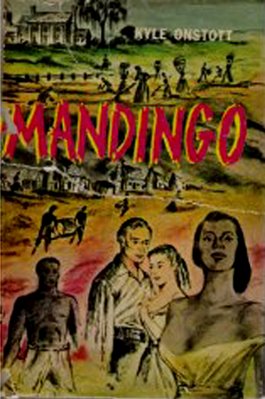
First edition of MANDINGO, featuring perhaps the worst book cover of all time. Seriously, somebody got paid to produce this!
Since blacks in America were brought here very much against their will and subjected to every form of degradation the human mind could conceive, slavery remains a hot button issue and one that touches very raw nerves when discussed in any format. Many pop culture analysts will tell you that the first major work to really present the myriad horrors of slavery in realistic and uncomfortable detail would be Alex Haley's multi-generational saga ROOTS, and more importantly its 1977 television dramatization; the TV miniseries hit the airwaves like a blowtorch to the stomach and forced white viewers to see the torture, mutilation, rape, forced separation of families and other such details of the human chattel system that fantasies like GONE WITH THE WIND gloss over to an alarming degree. Not only did it shake up adults across the nation, but it was also the first time that most non-black American kids really understood why slavery was an unmitigated evil that was inadequately explained in the woefully skewed history schoolbooks of the era. By the time the second episode aired, I had many of my classmates come up to me apologizing for atrocities committed by their ancestors some three hundred years past. (Needless to say, that shit got old fast, but it was a strange and interesting thing to witness.)
The impact of ROOTS was and is undeniable since it is still frequently discussed and referenced today, but for my money it was not the first pop culture hit to unflinchingly detail slavery for a mass audience. My vote for that distinction goes to Kyle Onstott's massive 1957 novel MANDINGO. You have probably heard the name and associate it with lurid interracial shenanigans during the plantation era Old South thanks to the outrageous 1975 movie version, but most people don't know the film was based on a lucrative bestseller that was the literary equivalent to Hiroshima and Nagasaki when it hit in the late 1950's, an era of post-war American prosperity that reveled in the secure knowledge of white superiority in all things and a barely acknowledged awareness of any wrongs committed on the historical road to getting the US to where it was. MANDINGO was an anti-epic, replete with scalding violence and then-shocking interracial sex — or rape, in most instances — peopled with characters that ranged from the pitiful and obsequious to the downright reprehensible. The core of the story centers on the daily goings-on at the Falconhurst plantation, an establishment for breeding and selling slaves, and the tawdry intrigues set into motion upon the young master simultaneously acquiring his cousin as his wife, a new “bed wench” slave girl who becomes the real love of his life, and an ultra-studly fighting slave of the title bloodline. None of the characters come off as admirable for a variety of reasons, and the narrative squarely points out that slave-owner, slave-breeder and slave were all victims of the foul system in no uncertain terms. So why has MANDINGO gone on to be universally hailed one of the most infamous and offensive concoctions of the twentieth century?
The blame for that falls largely on the movie adaptation, a film released nearly twenty years after the book's publication; despite its documented status as a runaway bestseller at the time, there was absolutely no way that MANDINGO could have been filmed and not seen every single person involved in its translation to the big screen arrested as twisted sadists and pornographers. Even after the advancements of the civil rights movement the book was still simply too hot to handle and though there was no screen adaptation there was a flourishing genre of potboiler paperback sequels that cheapened the literary impact of Onstott's original work until the series became sort of bodice-ripper drugstore fiction with as much sex and violence as the law would allow. By the time the feature version of MANDINGO hit screens in 1975 much of its content had become fodder for rip-off novels and porno films, and many people had not read the book in its unabridged form, so much of the character and sociological insight found therein was utterly lost. The film version simplified the complex 659-page source novel to fit within a two hour running time, dumbing it down to nothing more than an overacted, ludicrously-scripted S & M/soft-porn GONE WITH THE WIND parody filled with wall-to-wall nudity, torture, bloody violence, and an overwhelming blast of unbelievable bad taste. I personally relish the film for its balls-out insanity and tastelessness, parts of which convulse me with laughter every time I sit through it, and in my opinion it remains the single most offensive film ever released by a major motion picture studio. And there is absolutely no fucking way that film could have been made today without riots breaking out in the streets. Believe that, Jack!
Sadly, the film has tarnished the considerable merit and bravery found in the novel, a book that to the best of my knowledge is out of print today, and what stands amid the rubble is perhaps one of the most misunderstood books in all of American literature. Most people have never read it, and if they have they've only seen the abridged version — admittedly, Onstott's uncut version is a trifle unnecessarily long-winded — and read it only to glean what thrills can be had for those who get off on misery and master/slave sex fantasies. After seeing the movie during the late-1980's I tracked down the novel in its abridged form and read it, marveling at just how raw the book was for a mass-market item of its time, and determined to find the uncut version just for the sake of comparison. Thanks to eBay I acquired a first edition hardcover of MANDINGO and have read it from start to finish with the intent of analyzing it both as a book and as a statement about the dehumanizing aspects of slavery. The novel runs for fifty chapters but as previously stated the unabridged version tends to ramble, so I have reviewed the book in sections since sequences that cover twenty-four hours of time can go on for as many as six chapters.
PART 1: chapters 1-5.
MANDINGO takes place in the antebellum south of 1820 at the Falconhurst slave-breeding plantation, an establishment known throughout the land for turning out blacks of the highest quality for heavy field work or whatever whims the buyer may have (no matter how sick or twisted they may be, as we shall see). The place has definitely seen better days; the ground has petered out thanks to over-farming of cotton, the mansion has fallen into disrepair, and despite the plantation's intended purpose of breeding slaves there are more of them around than the proprietors know what to do with.
The patriarch of Falconhurst is Warren Maxwell, an irascible old fuck who treats his “niggers” as one would a mildly disobedient dog. He seldom has a kind word for them and displays a shockingly superior attitude for one so staggeringly ignorant. Plagued by crippling rheumatism - or “rheumatiz” as he would put it - Maxwell drinks corn whisky-laden hot toddies from the moment he wakes until the moment he retires at night, essentially rendering himself Shane McGowan-level drunk all day long. The one true joy in his life, aside from his toddies, is his only son, Hammond.
Hammond is eighteen years old and by all measure of “bodice ripper” fiction he is fairly handsome, but is physically flawed with a permanently stiff leg, an injury incurred during childhood after being thrown from the saddle by a stroppy gelding (after that incident Hammond's father grows to loathe geldings of both the equine and human varieties, leading to a plantation policy of never gelding either a horse or slave). Being the heir to the plantation and general administrator since his father is hobbled by his “rheumatiz,” Hammond is pretty much a prince, flush with cash and the master's right to fuck any of the slaves as he sees fit, whether they like it or not, since as his father claims, “nigger wench crave her master for her first time.” It is made very clear that Hammond has rampantly impregnated slave girls since he was fourteen, siring many offspring in the process (including one being carried by his two months pregnant bed wench, Dite, which is short for Aphrodite), offspring who are immediately categorized as potential sale items, made all the more valuable since they are “half human.” An unexpected side effect of Hammond's virulent jungle fever is his utter lack of attraction to white women, a very important plot point that sets the main meat of the story into motion in chapter six, but more on that when we get to it.
Anyway, the first five chapters cover a period of roughly twenty-four rain-soaked hours and introduce us to the Maxwells and their staff of house slaves, chief among whom is the requisite fat mammy stock character so common to tales of this ilk, this time dubbed Lucrecia Borgia; in this and subsequent books in what became the Falconhurst series, it is clear that Lucrecia Borgia - always referred to by her full name - is the real power behind the Falconhurst hierarchy, and while the Maxwell men may give orders and such, they grudgingly respect and trust Lucrecia Borgia and allow her to handle all of the house matters and much of the concerns that extend beyond the big house. She also displays a cruel enjoyment in watching slaves of lesser rank - which is basically everyone else on the plantation with a trace of melanin - receive corporal punishment, especially when personally meted out with a whip or paddle in her hand with the full approval of her owners. Part of her status stems from her prodigious reproductive capabilities, an Herculean fecundity that yielded at least ten sets of twins, but when the story begins she is described as “pretty much bred out.”
Also of note are Alpha and Omega (Alph and Meg for short), the youngest of Lucrecia Borgia's brood, tweener scalliwags engaged in a fierce war for the attentions of their respective masters; Alph is forced into spending much of his time with the elder Maxwell's feet pressed against his belly in an ill-informed attempt to drain the rheumatism from the old man into the young boy, while Meg obsequiously sets out to fulfill Hammond's every minute whim or need out of an apparently homosexual/masochistic love for his master, even to the point of demanding regular beatings from Hammond that he interprets as proving his master's love, beatings from which he derives an obviously sexual pleasure.
The other important Falconhurst slave is Agamemnon (Mem for short), the thirty-something houseboy who is the object of constant abuse from everyone around him, slave or otherwise; Mem is the classic lazy nigger who only shapes up when threatened with physical punishment for his sloth, and while having no choice but to put up with his station, he is the only slave to flat out realize that his situation simply sucks ass. Upon being caught stealing whisky after a number of other minor infractions, Mem is sentenced to be hung up and given thirty lashes, a sentence that is delayed after Hammond sadistically administers a near-fatal dose of syrup of ipecac as an extra bit of punishment intended to heighten Mem's pre-whipping misery. Hammond realizes his vindictiveness nearly cost Mem his life, but he has no idea that that act has sown the seeds of impending tragedy…
During the aforementioned twenty-four hour period, the Maxwells play grudging hosts to Brownlee, an ignorant and ultra-sleazy slave trader (with whom the elder Maxwell makes an exchange of two slaves from Falconhurst for two so-so specimens of Brownlee's and a little cash to make up for the difference in quality), and the three men “treat” readers to in-depth discussions of the intricacies of the flesh trade, their philosophies on slavery and other subjects, along with their twisted medical “knowledge” in regard to the veterinary care of niggers.
The plantation's prize wench, a girl of pure Mandingo blood named Big Pearl because of her sturdy and statuesque build (who is the intentionally inbred offspring of her grandfather and his daughter), appears to be ailing, so a slave is sent out to fetch Doc Redfield, the local veterinarian. Upon arrival, Redford diagnoses Big Pearl as being “hipped,” in other words she's in heat and craves for Hammond to fuck her. Hearing this, Hammond admits to being intimidated by her size and the fact that she, like all niggers, we are told, is “powerful musky.” Working with a suggestion provided by Brownlee, it is decreed that Big Pearl will be bathed in a strong solution that “renders niggers right sweet smellin' for two, three days,” and Hammond will soon come over and do his masterly duty. After the men return to the house for yet more booze and overblown prose, Brownlee drunkenly requests a bed wench from Mem, but when Mem wisely doesn't supply a wench without the permission of his masters Brownlee sneaks out to Big Pearl's cabin with every intention of taking her virginity for himself. Her irate mother, Lucy, alerts the Maxwells to Brownlee's sniffing about before anything can happen, and Brownlee is unceremoniously asked to leave Falconhurst. END OF CHAPTER FIVE.
NOTES:
PART 2: chapters 6-14. After being badgered by his father, Hammond reluctantly agrees to marry a white woman and use her as a broodmare to generate an heir to the majesty that is Falconhurst, and in order to keep the bloodline as pure as possible he sets his sights on his second cousin, sixteen-year-old Blanche Woodford of the Crowfoot plantation. Hammond has not seen her since she was a toddler so he barely remembers her, but since he intends to go to the Coign plantation to borrow Big Pearl's father for stud work on his own daughter, he figures that he'll stop off at Crowfoot since it's on the way and “go sparkin'” after Blanche. Since it's a matter of custom for him to still have bed wenches, it's no skin off of his nose and all pretty much a business arrangement since white women physically repulse him. Also, Hammond's desire for a fighting nigger percolates…
Mem attempts to convince Hammond not to whip him for his recent transgressions, but his pleas fall upon deaf ears. Young Meg's obsequiousness continues to grow and he begs to be the one to apply the burning pimentade to Mem's raw wounds after the beating to come; Meg's hatred of Hammond's bed wench, Dite, begins to ferment and he tells Hammond in no uncertain terms that he wishes that his master would “pleasure” with him like he does with Dite. Hammond is thoroughly disgusted at that prospect and his reaction prompts Meg to wish that he were a girl so massa would fuck him.
Hammond finally gets around to Mem's promised whipping, aided by slaves Napoleon - Pole for short - and the ever-obsequious Meg, and the beating with a leather covered paddle is savage and damaging indeed, made worse by Napoleon mocking Mem's obvious misery. Meg is disappointed to see Hammond relinquish the actual task of the beating to Pole, thereby somewhat diminishing his fantasies of being beaten into near oblivion by his master. What remains hidden from the slaves is the fact that witnessing such “necessary” punishment makes Hammond ill, prompting him to call a brief halt to Mem's agony so that he can leave the barn and collect himself; more so than for his slaves, Hammond sought to prove his ruthless master role to himself and began to realize that he was too soft for the corporal punishment responsibilities of his job, or as he says to himself, “not cut out fer threshin' niggers.” That realization does not stop Hammond from resuming the beating, and Mem is whipped until his ass resembles bloody, pulped hamburger meat. That indignity is compounded by Meg happily applying the caustic pimentade to the gory wounds, a substance full of ground pepper in a solution that allows it to stick fast to the gaping lacerations, causing Mem unimaginable, screaming agony. Hammond then retires to his room and guiltily cries himself to sleep.
The young Maxwell soon embarks on his quest to borrow the old stud Mandingo from Coign, but first he stops off at Crowfoot to put his incredibly awkward moves on cousin Blanche. Blanche is the epitome of the southern belle found in many an antebellum romance fantasy; curly blonde hair, pretty as a peach, whiny and petulant until she gets her way... basically an obnoxious, drawling princess who you just can't wait to punch square in the gob. And Hammond's appraisal of his cousin/intended isn't exactly flattering:
He would have to get used to the whiteness of female flesh. Its pallor seemed to him not quite healthy, somehow leprous, cold. He knew the beauty of blondeness, but failed to appreciate it. He knew, moreover, that if he was to have a wife he would have to tolerate that she was white.
While riding to a church meeting, Hammond and Blanche are caught making out by her older brother, the scrawny, “gotch-eyed” and obviously inbred Charles, and he is rather irate at the sight. He threatens to tell their father but Blanche wields a powerful hold over her brother thanks to “something he did” to her three years previous. He defers to her, but reminds her that they were both equally guilty — and more importantly, consensual — of their unnamed transgression and that there was nothing anyone could do about it anyway… Once Charles leaves, Hammond proposes to his cousin with a lack of enthusiasm that is truly staggering, and though she is clearly into it, she suggests that he ask her father first.
Major Woodford tentatively agrees to let Hammond wed his daughter, provided that the elder Maxwell will lend him $5000 until harvest time; it turns out that the opulent Crowfoot plantation and all of its assets are mortgaged to the hilt and the banks are about to come crashing down on the Major. Hammond promises to have his father fork over half of the money in cash the minute he returns to Falconhurt.
That night Hammond bunks with Charles, who displays a friendlier aspect than early in the day. His earlier rudeness was due to realizing what Hammond would be getting into by marrying Blanche, and he informs Hammond in no uncertain terms that his sister is “pizen” and a manipulative bitch, to say nothing of the fact that she would never allow him to have a fighting nigger. Hammond doesn't care that she may be childish since all he wants her for is to bear his children, and he plans to use the fact that his father is bailing her family out of a major financial mess as his leverage against any of her uppity behavior. This reverie is interrupted by the arrival of two bed wenches, and Hammond is appalled to discover that Charles is a kinky motherfucker who seriously gets off on beating his wench before fucking her, and she of course feigns enjoyment of the abuse, but also enjoys her status as Charles' steady squeeze. Their obvious romantic attachment grosses Hammond out since it implies equality between master and slave, but while Hammond enjoys pleasuring with black women he looks upon it mostly as “a duty without pleasure and little satisfaction; mere detumescence, a voiding of accumulated waste.” Hammond uses his bed wench out of respect for his host's hospitality, but he is put off by Charles' lovemaking, and when he finishes with her he kicks the poor girl out of the bed and forces her to sleep on the chilly floor.
The next day, despite Blanche's tantrums, Hammond leaves for Coign, unwillingly accompanied by Charles who craves to see the world beyond Crowfoot. Needless to say Charles turns out to be immature to a fault and a royal pain in the ass, but for the time being Hammond has no choice but to put up with him since it would eat up a good deal of time to return to Crowfoot and drop him off.
Hammond and Charles are overwhelmed by the charm of the Coign and its owner, the decrepit Mister Wilson. Wilson is a pretty mellow old man who is quite content and resigned to the fact of his impending demise, and he is constantly attended by Old Ben - hands-down the most erudite and dignified slave character in the whole book - a servant whose bearing and excellent diction make Hammond feel inferior. Ben also happens to be Wilson's son, and only seventeen years his junior.
After initial pleasantries, Hammond gets to the point of his visit and discovers that the old Mandingo buck he wanted to borrow - Xerxes by name - was gored to death by a bull three months prior, but Wilson offers the services of a much superior specimen. The young Mandingo in question is Mede - named for Zeus' male love object, Ganymede - and he is a slave-fancier's wet dream; built like a Michelangelo work, smart (and fairly articulate for a character in this book), adoring of his master and thoroughly obedient. In other words, everything Hammond would want as both a stud and a fighting nigger. He agrees to purchase Mede for $2750 in cash that he will have sent from Falconhurst, and Wilson is quite amenable to the arrangement since he also needs money to cover the sizable debts incurred by his estate. Once the deal is sealed it is time for bed, and Hammond and Charles are offered the “use” of complimentary bed wenches.
The wenches arrive and are declared to virgins; Charles is excited by this prospect but Hammond is indifferent. He ends up with a plump, pretty light-skinned girl named Ellen and soon his indifference turns to genuine attraction. Ellen is sweet and smart, and most importantly she is not put off by his bad leg. An evening of some exploration is hinted at but it is made clear that Hammond did not take Ellen's virginity. The same cannot be said for the poor, scared girl on the receiving end of Charles' attentions.
The next morning Hammond readies to leave and offers to buy Ellen as his personal bed wench; Wilson agrees upon a $1500 price tag and throws in Ellen's “delicate like a wench” brother, Jason, as a present to the elder Maxwell. END OF CHAPTER 14.
NOTES:
And on a side note, as previously stated, I had only read MANDINGO in its abridged form, and now I understand why an abridgment of such a bestseller was neccessary...
JESUS H. CHRIST, IS THIS BOOK A PLODDING MOTHERFUCKER!!!
(pause)
Sorry, but I had to get that out of my system.
I normally devour books as I read them — in fact I read the entirety of James Clavell's SHOGUN while laid up in bed with a rampaging flu, a read that took about six nonstop hours — but the original MANDINGO thwarted me like no book that I have ever read. I stalled at page 235 and nothing, NOTHING was happening, just a bunch of badly-written white dudes sitting around talking about forcing eggs down a major character's throat as part of his training as a "fightin' nigger." Let's face it: the hook of this work is the bizarre interracial soap opera tensions between Hammond and his slave Ellen, and the upcoming "fuck me or else" coupling between white Southern belle Blanche and big, hung-like-a-mastadon buck, Mede, and as of almost halfway through the ponderous volume the real action of the plot is often derailed for scores of pages by endless jibba-jab that amounts to little but the occasional drop of foreshadowing. That's why I say stick to the movie version; true, there is some stuff that's coming up in the book that is far more twisted and offensive than anything found in the film adaptation — and that's really saying something — but the film trims away enough fat to feed a village of Inuits for three decades. The things I suffer through to keep you enlightened...
PART 3: chapters 15-24.
Hammond and his entourage leave the Coign plantation and drag the readers along for the ride in the longest fifty-two pages ever committed to paper, the interminable chapter fifteen. Nowhere in the book is the need for some judicious editing more evident than here since the chapter meanders endlessly, and despite an all-too-in-depth recounting of two stopovers during the road trip back to Falconhurst, nothing of any significance whatsoever to the story happens. The only events of even the slightest import are:
Anyway, Hammond eventually brings Mede into town to fight another slave in a prearranged bout, the kind of savage brawl that would rightly be described as a human cockfight. Luckily Mede proves to be rather a natural grappler, handily whupping his opponent with a submission hold that simultaneously causes the fight to be conceded in Hammond's favor and disappoints the bettors since no blood was shed. Mede goes on to win all fights in which he is entered, and within the space of two weeks no one is willing to pit their slaves against the unbeatable Mandingo buck. Oddly, during Mede's last battle, the owner of his opponent unexpectedly dies right there on the tavern floor. The corpse's pockets are riffled through and while some cash is found there is also a deed to some land, but the exact details are obscure due to the poor penmanship found on the document. Since the deceased's slave was losing to Mede anyway, the fight is forfeited in Hammond's favor, winning him the man's slave and the deed.
Suddenly the fighting plot comes to a screeching halt when the author remembers that he has betrothed his hero to Cousin Blanche back at the Crowfoot plantation and has wasted one hundred and thirteen pages on useless bullshit and road trip stopovers, effectively derailing his own narrative in the process. So Hammond gives cousin Charles the $2500 to take back to the Major at Crowfoot, along with Blanche's ring and Jason the slave. Hammond then reluctantly gets his own shit together and prepares to make it to Crowfoot by the agreed-upon wedding date, meaning obtaining new clothes for himself and Meg, a stultifying process that is explained in excrutiatingly minute detail for far too many pages, and unwillingly leaves behind a distraught Ellen, who is fearful that she will be supplanted in Hammond's heart by his new white wife/prospective broodmare. Then, when Hammond and Meg finally get underway, what does the author have up his sleeve for the readers? You guessed it: more road trip stopover anti-adventures.
The latest round of meanderings delights us with yet more overly-described meals and boring examples of Southern hospitality that serve no purpose to the story whatsoever and introduce us to Madison Church ("Mad" for short) a spoiled and gluttonous man-child of an age near Hammond's but with the emotional maturity and behavior of a child in the throes of the "terrible twos." Mad displays great distaste at all matters of male-to-female coupling, even among thoroughbred horses, his chief interest in life, and finds young Meg to be irresistible to the point of wanting the boy to join him and Hammond in the bed that will share overnight at a hotel. It is alluded to that Mad has his lard-ridden way with Meg, and the next day he nags and whines at Hammond, even resorting to blubbery tears in order to get Hammond to stop over at his mother's estate despite Hammond's frequently-mentioned intent to be at Crowfoot within a day. We are then treated to yet another (!!!) stop over and feast, complete with yet more displays of slaves for sale; the only ironic part of all this is that by this point even Hammond is bored with the direction in which the story is going, and Mad proves himself to be one of the most flat-out obnoxious, annoying and downright irritating creations in the world history of fiction. Dear readers, every moment spent reading about this character was an agony and I actually longed for another meal to be served so that the endless description of his fevered mastication would shut him up, no matter how briefly.
After leaving the noxious presence of Mad, Hammond ends up at another stopover, this time finding him obtaining a pair of mustee slaves (a mustee is a slave light-skinned enough to be nearly white) who run away on him almost immediately and then he finally makes it to Crowfoot. Along the way Hammond has made mention of Charles heading back to his home, having departed Falconhurst over a month prior, but he is constantly met with ignorance regarding any sort of a homecoming by Charles. Upon arriving to claim his bride, Hammond finds out that Charles never went home and absconded with the money, the wedding ring and, most offensively of all to all concerned, a slave that didn't belong to him. Slave stealing is just about the worst crime a white man can commit, so if he is caught and prosecuted it would shame his family beyond all hope of recovery. The only cure is to get Blanche and Hammond hitched as quickly as possible since it would be unseemly to charge an in-law with nigger-stealing, and if Charles did ever turn up again the whole incident could be passed off as "a mistake." None of this sits too well with the bratty Blanche, whose Scarlet O'Hara-style fantasies of affluence and a dream wedding have been dashed by her brother's douchebaggery, but she has no choice in the proceedings, no matter how petulantly she behaves. A lightning-fast ceremony performed by Blanche's preacher brother, Dick, seals the deal and Hammond and Blanche retire for a night of connubial bliss...
After very nearly escaping from the Crowfoot plantation in a state of unthinking outrage, Hammond buries a burning anger, makes nice with his new in-laws, and rides off with his new bride. But what, you may ask, was Hammond so pissed off about? Well, after putting the meat to Blanche it is quite obvious to Hammond that she may be a belle, but she sure as hell ain't no virgin, a fact that he points out to her in no uncertain terms, and for all intents and purposes she has sold him used goods. He demands to know who got to her first so he can find the guy and put a bullet through his head, but Blanche stays mum. It doesn't take the deductive skills of Sherlock Holmes to figure out that Blanche was deflowered by her miscreant brother, Charles, but her internal reminiscence of her "violation" while the siblings played house a few years previous reveals that she took great pleasure in the act despite its forbidden nature. Blanche proclaims her virginity-until-Hammond over and over, but to no avail, and simply cannot figure out how he knows she wasn't "pure," despite the fact that her hubby had fucked scores of virgin slave wenches for years on end. Hammond nonetheless resigns himself to his status of being victimized by the treachery of the Woodfords and forces Blanche to agree not to tell his father of her besmirched condition.
On the way back to Falconhurst, Hammond recovers his runaway mustees and drops in on that asshole Mad again (thereby subjecting the reader to more of his infantile histrionics) gives him one of the mustees as his "body slave," and grosses out his host to the point of nausea by fucking Blanche right there in the same bedroom that he is sharing with the fat bastard. The next morning sees the journey back to Falconhurst lurching forward once again, with no end immediately in sight for travel-weary readers.
All of what you just read is a very merciful summation of two hundred and fourteen incredibly slow and dull pages, punctuated by repellent characters about whom no one in their right mind would want to read. As I have previously stated, I have read the abridged version of this novel, and most of the events contained in the chapters recounted here were kindly missing from that expurgated edition. The fact that someone actually got paid to edit this book for it's THE STAND-like monolith of a first edition is laughable.
PART 4: chapters 25-32. And so at last the bedraggled group of weary travelers FINALLY arrive at Falconhurst and the book picks up steam again.
Upon seeing Falconhurst and comparing its no-frills practicality to the opulence of her father’s Crowfoot estate, Blanche is sorely disappointed and launches into a childishly petulant litany of criticisms and comparisons that are quickly quashed by the still-fuming Hammond; from here on Hammond holds his knowledge of Blanche’s incestuous relationship with her brother over her as his one surefire means to ruin her reputation permanently. Nothing that she says or does carries any weight, and she knows it, which will eventually lead to the most infamous plot point in the entire novel…
Hammond introduces Blanche to her new father-in-law and the two bond over a mutual love of strong toddies, so much so that Blanche very quickly spirals down the path of hardcore, all-day alcoholism thanks to boredom (since she never gets to go anywhere and visitors of quality never drop by, other than Doc Redfield) and her husband’s spiteful neglect of his husbandly duties. You see, Hammond only beds down with Blanche a couple of times, purely to facilitate an heir to the plantation, but his outright distaste for white chicks in general and Blanche in particular only strengthens his bond to Ellen the wench. Upon meeting Ellen, Blanche figures out the nature of the slave girl’s ties to Hammond and a slowly-simmering cold war between the two begins in earnest although there is nothing that Blanche can do about her husband’s dalliances in dusky-town. Anyway, the two enemies soon turn out to be pregnant and Hammond gushes over the prospect of a child with his slave lover, while he cares not one whit for Blanche’s spawn, except for its future status as his heir. And speaking of pregnancies, uber-stud Mede manages to knock up both Lucy and Big Pearl, who unbeknownst to him are his mother and half-sister, respectively.
Mede’s training resumes to an extent when Hammond receives news of a rich man from New Orleans who seeks to pit his seasoned fighter, Topaz, against the unbeatable Maxwell Mandingo, so Hammond obsesses over readying his man to win the fight and score him some money and more slaves; during the training Hammond begins to worry about whether Mede can defeat a city-trained combatant, and since the challenge from Topaz’s owner is the only fight that Mede has been offered since he established a rep for being unbeatable Hammond contemplates selling Mede since his buying price of $2700 has pretty much gone to waste (he has obviously forgotten about Mede’s stud services). That plan is immediately shot down by the elder Maxwell, who tells Hammond in no uncertain terms that Mede is not for sale under any circumstances, despite his being Hammond’s property, and since he is the finest Mandingo that anyone has ever seen he is invaluable to the plantation’s breeding pool.
With her husband’s attentions diverted to his trophy buck, Blanche’s drunkenness becomes overwhelming and she stops bothering with taking care of her appearance unless company shows up (which is pretty much never), so she wanders about the big house in a Mother Hubbard nightgown with no shoes on and her greasy, stringy hair unkempt and looking like someone had boiled her head. The only attention she receives from Hammond is an obligatory kiss on the forehead as the smallest of acknowledgements or hostile reproach whenever she opens her mouth to speak, and while she finds herself fond of the old man she finds his rambling stories boring and only puts up with them as a social excuse to get completely shitfaced, at one point getting melancholy over not getting any Hammond dick and lamenting the absence of her brother’s gotch-eyed affections, in front of the slaves no less.
During one of her all day toddy-fests, a guest shows up to announce the arrival of the challenging slave owner and, while dressed in her finest Scarlett O’Hara rags, Blanche bottoms out rather publicly, and vomits her guts out as she is lead upstairs and away from the eyes of the guest. This incident causes Hammond to order Lucretia Borgia and the slaves to under no circumstances supply Blanche with liquor. But, like any good trashy novel character, Blanche’s vices prove unstoppable as she not only sneaks toddies, but is also aided and abetted by her father-in-law who honestly thinks her Jones for stiff mixed drinks has to do with curing her “headaches,” which may not be inaccurate thanks to the old “hair of the dog” theory.
The fight between the two slaves takes place at the tavern in Benson, and upon arrival Hammond is surprised to encounter that scumbag Brownlee (see part 1), who coveted Alph and Meg at the bar. The owner of the challenger, one Neri by name, wants to bet five grand and not wager slaves as Hammond had expected, leaving Ham with nothing to wager but the five hundred in gold coins that he had dug up from one of the kettles buried at Falconhurst and the assembled pot of cash that those who vouch for his word cobble together, and the promise of money from the local Jewish banker. The icing on the cake is Hammond’s desperate willingness to do anything to win, and that desire causes him to put up both Alph and Meg as stakes despite his promise to Lucretia Borgia that he would never sell her twin sons. His father rationalizes this breach in keeping a promise by reminding Hammond that he only promised that the boys were exempt from being sold, but there was no mention of wagering them. Besides, it was only a promise made to a nigger anyway…
After the tavern owner drags out the fight’s start time in order to sell as much whisky as possible, the battle begins and Mede’s opponent is revealed to be a cocaine fueled giant with years of bare-knuckle experience, a fact plainly evident by a visible mosaic of scars and his complete lack of ears, both a casualty of his career. The unspeakably savage brawl involves much graphic description of every dirty move in the book — made worse by the fact that the opponents are completely naked —, a catalog of knees grinding into groins, fingernails clawing through flesh, attempted eye-gouging, you name it, and the fight goes on for over thirty-five minutes. As both slaves try to overcome each other and a combination of serious injury and exhaustion, it looks like the fight will go to Topaz until Mede, pinned beneath the vicious juggernaut, gets him in a solid hold and chews out his jugular, spitting out the chunk of flesh in a sickening display of gore.
With Topaz deader than disco, Neri leaves (accompanied by Brownlee) Hammond to his victory, and our heroes pack up the savaged Mede for the return to Falconhurst. On the way back the party is robbed by two masked highwaymen, probably Neri and Brownlee but there is no proof since they are masked, and while Hammond is pissed off about it his father isn’t too concerned since all the robbers got was what they put in; don’t forget that most of the promised wager cash was promised from the bank so it wasn’t in hand and consequently not stolen. After that harrowing setback, our heroes make the trek back to the plantation.
PART 5: chapters 33-50, aka the apocalyptic and ultra-offensive conclusion.
As you have no doubt noticed from the previous installments, there was apparently no form of editorial control over MANDINGO whatsoever, so as a public service I am going to utterly gloss over the unnecessary clutter that impedes getting to the crux of the tome’s remainder, so I accept your thanks with much grace.
And so we finally reach the home stretch, the final one hundred and eighty-seven pages of this monolith of bad taste, and, HOO-BOY, what a final one hundred and eighty-seven pages they are…
The pregnancies of Ellen and Blanche are now about seven months along and Hammond leaves Falconhurst with Doc Redfield for a slave-selling business trip to Natchez — shooting down his plans to go to New Orleans since it is the site of a raging “cholrie” epidemic — unknowingly leaving his lover unprotected and at the mercies of the now Bukowski-level-drunk Blanche, who seems to spend her every waking hour pouring corn liquor toddies down her gullet. Shortly after Hammond sets off, Blanche gets plowed and orders Ellen sent to her bedroom. Upon arrival, Ellen is stripped naked, subjected to a litany of drunken, jealousy-driven cursing, and the sudden revelation that Blanche keeps a bullwhip in her night stand (???), an implement that the drunken brother-fucker cruelly uses to beat the unborn child out of her husband’s favorite (!!!). When Ellen loses the baby and the whip wielding Blanche is caught in the act by the elder Maxwell and Lucretia Borgia, the elder Maxwell orders Blanche, Ellen and Lucretia Borgia stay mum about the real cause of Ellen’s miscarriage.
Meanwhile in Natchez, Hammond and Redfield sell a bunch of slaves, go to a high class whorehouse — where Hammond blows off the unwanted advances of the beautiful white whores who throw themselves at him since they are too white for him to even think about getting down with — and run into cousin Charles, who excuses his theft of both Blanche’s bridal price money and wedding ring (to say nothing of gay-as-the-hills slave, Jason) by claiming that he considered it a loan and that he would eventually pay the cash back to his father, cash that he spent on living the high life. That said, Hammond accepts Charles’ apology (???), even agreeing not to tell Charles’ family that he is alive, rather than dead, as they had assumed. And Charles, upon hearing of his sister’s delicate condition, mysteriously comments “I sure hope the baby don’t come out all gotch-eyed like me…” Hammond, being about as sharp as a bag of wet mice, of course fails to realize the implications of his cousin’s statement. And lastly, in a move that surely wins some sort of prize for sheer stupidity, Hammond buys two identical pairs of pricy earrings, one for his wife and one for his beloved slave girl, the gift for the latter being intended to mark her as his chosen mate.
The homecoming (yet again!!!) to Falconhurst is somber as Hammond learns of the loss of Ellen’s “sucker,” but Hammond, smoothie that he is, mollifies Ellen with the gift of earrings, making her forget her loss and cry tears of unbridled joy (???!!!???). In no time Blanche notices Ellen’s fancy bling-bling and rejects her matching gift, loudly refusing to be marked as just another of Hammond’s whores. Shortly thereafter Blanche gives birth to a baby girl, Sophy (the spelling of whose name changes to the conventional "Sophie" in the subsequent novels), who is indeed, as Charles predicted, “gotch-eyed.” Hammond, clueless as ever, chalks the resemblance to Charles up to the fact that he and Blanche are from the same gene pool, while the reader can do the math and figure out that Blanche and her brother had been getting it on with regularity for years, rather than just the one-shot occurrence Blanche had previously claimed.
Though a physician was sent for to assist with Blanche’s delivery, the doctor arrives stinking drunk hours after the event, propped up by his handsome young assistant. The assistant performs a perfunctory post-birth examination of Blanche — which of course turns her on like nobody’s business — and afterward discusses with the male Maxwells a virulent outbreak of the clap that has been breaking out on other plantations in the area, an epidemic that he turns out to be knowingly responsible for, which Hammond discovers a week or two after his visit when the guest’s complimentary bed wench turns up with the disease. Fortunately the girl had not had sex with any of the other slaves after her romp with the doctor’s assistant, so the outbreak is quelled by placing her under quarantine.
As for Blanche’s aptness at motherhood, she doesn’t give a flying rat-fuck about the kid and turns it over to be raised by Big Pearl, after which Hammond takes up with Ellen practically full-time, throwing Blanche the occasional bone in hope of siring a male heir.
Hammond once again leaves on business and Blanche, fed up with her husband’s interest in slaves detouring his attentions from her, drunkenly plots the ultimate revenge via her husband’s prize slave, Mede. Blanche orders Mede to fuck her senseless — an act which occurs “off screen” — pierces his ears with her gifts from Hammond, and has him service her several times during her hubbie’s absence. All of the slaves know about this sordid turn of events and Mede is flat-out not into it, but as a docile slave he has no choice but to obey his mistress, despite fears of a horrible outcome should Hammond get a clue. The one unexpected wrinkle to the situation is Hammond’s young slave, Meg, informing Blanche in no uncertain terms that he will rat her out to the master if she doesn’t comply to his desire for some white poontang whenever he wants some, even getting his twin brother, Alph, in on the sexual blackmail. Inevitably, Blanche becomes preggers, but whose baby is it? When Hammond returns and learns of the new pregnancy he naturally assumes the child is his.
A Frenchman from New Orleans who is an obvious homosexual drops in after hearing about the twins, Alph and Meg, and offers an incredible sum of money to possess them, even offering to buy their mother, Lucretia Borgia, to keep them happy. Despite her vital role in the running of the household and her importance to the Maxwells in general, Hammond agrees to sell the loyal slave and her dickhead sons to the Frenchman, and after much crying and hand wringing the slave and her boys are bound to new lives in the Big Easy. Soon enough, however, Lucretia Borgia escapes back to Falconhurst, citing the increasingly assholish behavior of her sons while residing in the lap of comparative luxury as being just too intolerable to deal with (more intolerable than slavery?), so she returned to familiar surroundings on the back of a mule. After some half-hearted chastisement she is welcomed back to the fold and things return to normal. The Frenchman, apparently happy with his nightly bungholery of the twins, makes no attempt to reclaim Lucretia Borgia despite having legally purchased her (convenient for the plot, no?).
Blanche’s mother shows up to visit and ends up staying when she finds out about her daughter’s pregnancy, and her rampaging temperance and enforcement of religion drives both Hammond and his father to near insanity.
Then the big day comes and Blanche goes into labor, with Doc Redfield, his wife, “the widder,” and Blanche’s mother in attendance. When the child is born, he is the enormous spitting image of Mede, and upon seeing her grandson Blanche’s mother picks up the infant, smashes its brains out against the wall and hastily departs. When Hammond finds out the truth, he ices over and calmly poisons his wife with a toddy laced with the powder used by Doc Redfield to do away with slaves who are too old to be worth maintaining anymore. Then he questions the house slaves as to their knowledge of the situation, discovering that everybody in the house but himself, his father and Blanche’s mother knew what was going on but could do nothing about it since they were bound to obey their mistress’ whims with no questions asked and no going to the master. In the course of the interrogations Hammond also learns that Blanche actively engaged in the jungle fever and was not raped, as Hammond and his father naturally assumed. “A white lady wantin’ to pleasure with a nigger? Preposterous!” But Hammond finally realizes that his wife was simply trash of the worst order, what with all the brother-fucking and such.
Hammond limps out to Mede’s quarters and orders the Mandingo to fire up the gigantic hog-boiling kettle and keep the fire burning until the water reaches a high cooking temperature. He then forces the terrified Mede into the scalding water by using a pitchfork, holding him under the water until the heat kills him and covering the pot with a big lid. He then orders Lucy — Mede’s mother and lover, remember — to keep the pot covered and keep it boiling until told otherwise. The Mede soup graphically simmers for two solid days — complete with a description of Hammond checking the stew and producing Mede’s partially-denuded skull on the end of his pitchfork —until the slave’s flesh has been completely rendered into a thick, bone-filled broth, after which it is poured into an open grave over the corpses of Blanche and her love-child, a bit of poetic “justice” since Hammond figures that if she wanted to be with a nigger so bad she could be with him for eternity. Hammond graciously allows a grieving Lucy to take Mede’s bones as a keepsake (!!!).
A weary Hammond returns to the big house and informs his father that he is going to find Alph and Meg and kill them for daring to fuck Blanche, after which he intends to move “to the Texies” so he can avoid being known to the locals as “Hammond Maxwell, whose wife pleasured with niggers.” His father is distraught upon hearing this intended course of action, but he assures his son that Falconhurst will be there for him if he should choose to return.
Then the whole fucking mess comes to a startlingly abrupt end.
Wow.
So there you have it, a mercifully short summation of one of the most infamous books ever unleashed upon an unsuspecting American populace.
A few final notes:
The first of two legitimate sequels to MANDINGO (in having been written by the original author) and a cracking good read in its own right that does away with many of the structural and narrative deficiencies found in the original, presumably thanks to the input of Lance Horner and an editor who wasn't asleep at the wheel. Adapted to film in a drastically rewritten version in 1976, the movie features the great Warren Oates as an older Hammond Maxwell, Pam Grier as his current favorite, Cheryl "Rainbeaux" Smith as precocious interracial terrorist/ nymphomaniac Sophie, and somehow manages to be even more unintentionally hilarious than the 1975 film.
MASTER OF FALCONHURST (1964)
The second of the legitimate sequels, in which a black man not only becomes the legal master of Falconhurst, but also marries the white Sophie Maxwell. Needless to say, much tragedy, sex and violence ensues.
FALCONHURST FANCY (1966)
My favorite of the series. In a departure from the other books, this installment focuses on a female protagonist, Dovie Verder, a plantation owner who is a lot more complex than any other character in the entire series and a strong, open-minded proto-feminist, and recounts her deep love affair with Colt, a slave so beautiful that his description brings to mind a Greek god. The usual sex and violence shenanigans are on hand again, but this time it’s utterly compelling and would have made for a great, if inflammatory, film. After this the series remained readable, but by that point it was all story via assembly line.
Also of note is the fact that many of the books in the series feature the adventures of Bricktop, a redheaded mustee slave who is indistinguishable from a white man, but for some brown markings on his torso that he keeps covered with his shirt. All of the books involving Bricktop feature him fucking everything in sight, including guys, since “niggers ain’t got sense enough to care,” and he always gets engaged to some gorgeous southern belle after fucking her into puppy dog-like docility. His true status as a slave is soon revealed, and after a near-fatal beating upon discovery he escapes to find adventure and pussy in another book, leaving behind a pregnant white girl who doesn’t care if he was black since the dicking was just so good. If you read one book about Bricktop, you have read them all, so the only one I’ll recommend is 1975’s GOLDEN STUD.
NOTE: this is a loooong piece, but I promise you it's easier to swallow than the full-length novel.
First edition of MANDINGO, featuring perhaps the worst book cover of all time. Seriously, somebody got paid to produce this!Since blacks in America were brought here very much against their will and subjected to every form of degradation the human mind could conceive, slavery remains a hot button issue and one that touches very raw nerves when discussed in any format. Many pop culture analysts will tell you that the first major work to really present the myriad horrors of slavery in realistic and uncomfortable detail would be Alex Haley's multi-generational saga ROOTS, and more importantly its 1977 television dramatization; the TV miniseries hit the airwaves like a blowtorch to the stomach and forced white viewers to see the torture, mutilation, rape, forced separation of families and other such details of the human chattel system that fantasies like GONE WITH THE WIND gloss over to an alarming degree. Not only did it shake up adults across the nation, but it was also the first time that most non-black American kids really understood why slavery was an unmitigated evil that was inadequately explained in the woefully skewed history schoolbooks of the era. By the time the second episode aired, I had many of my classmates come up to me apologizing for atrocities committed by their ancestors some three hundred years past. (Needless to say, that shit got old fast, but it was a strange and interesting thing to witness.)
The impact of ROOTS was and is undeniable since it is still frequently discussed and referenced today, but for my money it was not the first pop culture hit to unflinchingly detail slavery for a mass audience. My vote for that distinction goes to Kyle Onstott's massive 1957 novel MANDINGO. You have probably heard the name and associate it with lurid interracial shenanigans during the plantation era Old South thanks to the outrageous 1975 movie version, but most people don't know the film was based on a lucrative bestseller that was the literary equivalent to Hiroshima and Nagasaki when it hit in the late 1950's, an era of post-war American prosperity that reveled in the secure knowledge of white superiority in all things and a barely acknowledged awareness of any wrongs committed on the historical road to getting the US to where it was. MANDINGO was an anti-epic, replete with scalding violence and then-shocking interracial sex — or rape, in most instances — peopled with characters that ranged from the pitiful and obsequious to the downright reprehensible. The core of the story centers on the daily goings-on at the Falconhurst plantation, an establishment for breeding and selling slaves, and the tawdry intrigues set into motion upon the young master simultaneously acquiring his cousin as his wife, a new “bed wench” slave girl who becomes the real love of his life, and an ultra-studly fighting slave of the title bloodline. None of the characters come off as admirable for a variety of reasons, and the narrative squarely points out that slave-owner, slave-breeder and slave were all victims of the foul system in no uncertain terms. So why has MANDINGO gone on to be universally hailed one of the most infamous and offensive concoctions of the twentieth century?
The blame for that falls largely on the movie adaptation, a film released nearly twenty years after the book's publication; despite its documented status as a runaway bestseller at the time, there was absolutely no way that MANDINGO could have been filmed and not seen every single person involved in its translation to the big screen arrested as twisted sadists and pornographers. Even after the advancements of the civil rights movement the book was still simply too hot to handle and though there was no screen adaptation there was a flourishing genre of potboiler paperback sequels that cheapened the literary impact of Onstott's original work until the series became sort of bodice-ripper drugstore fiction with as much sex and violence as the law would allow. By the time the feature version of MANDINGO hit screens in 1975 much of its content had become fodder for rip-off novels and porno films, and many people had not read the book in its unabridged form, so much of the character and sociological insight found therein was utterly lost. The film version simplified the complex 659-page source novel to fit within a two hour running time, dumbing it down to nothing more than an overacted, ludicrously-scripted S & M/soft-porn GONE WITH THE WIND parody filled with wall-to-wall nudity, torture, bloody violence, and an overwhelming blast of unbelievable bad taste. I personally relish the film for its balls-out insanity and tastelessness, parts of which convulse me with laughter every time I sit through it, and in my opinion it remains the single most offensive film ever released by a major motion picture studio. And there is absolutely no fucking way that film could have been made today without riots breaking out in the streets. Believe that, Jack!
Sadly, the film has tarnished the considerable merit and bravery found in the novel, a book that to the best of my knowledge is out of print today, and what stands amid the rubble is perhaps one of the most misunderstood books in all of American literature. Most people have never read it, and if they have they've only seen the abridged version — admittedly, Onstott's uncut version is a trifle unnecessarily long-winded — and read it only to glean what thrills can be had for those who get off on misery and master/slave sex fantasies. After seeing the movie during the late-1980's I tracked down the novel in its abridged form and read it, marveling at just how raw the book was for a mass-market item of its time, and determined to find the uncut version just for the sake of comparison. Thanks to eBay I acquired a first edition hardcover of MANDINGO and have read it from start to finish with the intent of analyzing it both as a book and as a statement about the dehumanizing aspects of slavery. The novel runs for fifty chapters but as previously stated the unabridged version tends to ramble, so I have reviewed the book in sections since sequences that cover twenty-four hours of time can go on for as many as six chapters.
PART 1: chapters 1-5.
MANDINGO takes place in the antebellum south of 1820 at the Falconhurst slave-breeding plantation, an establishment known throughout the land for turning out blacks of the highest quality for heavy field work or whatever whims the buyer may have (no matter how sick or twisted they may be, as we shall see). The place has definitely seen better days; the ground has petered out thanks to over-farming of cotton, the mansion has fallen into disrepair, and despite the plantation's intended purpose of breeding slaves there are more of them around than the proprietors know what to do with.
The patriarch of Falconhurst is Warren Maxwell, an irascible old fuck who treats his “niggers” as one would a mildly disobedient dog. He seldom has a kind word for them and displays a shockingly superior attitude for one so staggeringly ignorant. Plagued by crippling rheumatism - or “rheumatiz” as he would put it - Maxwell drinks corn whisky-laden hot toddies from the moment he wakes until the moment he retires at night, essentially rendering himself Shane McGowan-level drunk all day long. The one true joy in his life, aside from his toddies, is his only son, Hammond.
Hammond is eighteen years old and by all measure of “bodice ripper” fiction he is fairly handsome, but is physically flawed with a permanently stiff leg, an injury incurred during childhood after being thrown from the saddle by a stroppy gelding (after that incident Hammond's father grows to loathe geldings of both the equine and human varieties, leading to a plantation policy of never gelding either a horse or slave). Being the heir to the plantation and general administrator since his father is hobbled by his “rheumatiz,” Hammond is pretty much a prince, flush with cash and the master's right to fuck any of the slaves as he sees fit, whether they like it or not, since as his father claims, “nigger wench crave her master for her first time.” It is made very clear that Hammond has rampantly impregnated slave girls since he was fourteen, siring many offspring in the process (including one being carried by his two months pregnant bed wench, Dite, which is short for Aphrodite), offspring who are immediately categorized as potential sale items, made all the more valuable since they are “half human.” An unexpected side effect of Hammond's virulent jungle fever is his utter lack of attraction to white women, a very important plot point that sets the main meat of the story into motion in chapter six, but more on that when we get to it.
Anyway, the first five chapters cover a period of roughly twenty-four rain-soaked hours and introduce us to the Maxwells and their staff of house slaves, chief among whom is the requisite fat mammy stock character so common to tales of this ilk, this time dubbed Lucrecia Borgia; in this and subsequent books in what became the Falconhurst series, it is clear that Lucrecia Borgia - always referred to by her full name - is the real power behind the Falconhurst hierarchy, and while the Maxwell men may give orders and such, they grudgingly respect and trust Lucrecia Borgia and allow her to handle all of the house matters and much of the concerns that extend beyond the big house. She also displays a cruel enjoyment in watching slaves of lesser rank - which is basically everyone else on the plantation with a trace of melanin - receive corporal punishment, especially when personally meted out with a whip or paddle in her hand with the full approval of her owners. Part of her status stems from her prodigious reproductive capabilities, an Herculean fecundity that yielded at least ten sets of twins, but when the story begins she is described as “pretty much bred out.”
Also of note are Alpha and Omega (Alph and Meg for short), the youngest of Lucrecia Borgia's brood, tweener scalliwags engaged in a fierce war for the attentions of their respective masters; Alph is forced into spending much of his time with the elder Maxwell's feet pressed against his belly in an ill-informed attempt to drain the rheumatism from the old man into the young boy, while Meg obsequiously sets out to fulfill Hammond's every minute whim or need out of an apparently homosexual/masochistic love for his master, even to the point of demanding regular beatings from Hammond that he interprets as proving his master's love, beatings from which he derives an obviously sexual pleasure.
The other important Falconhurst slave is Agamemnon (Mem for short), the thirty-something houseboy who is the object of constant abuse from everyone around him, slave or otherwise; Mem is the classic lazy nigger who only shapes up when threatened with physical punishment for his sloth, and while having no choice but to put up with his station, he is the only slave to flat out realize that his situation simply sucks ass. Upon being caught stealing whisky after a number of other minor infractions, Mem is sentenced to be hung up and given thirty lashes, a sentence that is delayed after Hammond sadistically administers a near-fatal dose of syrup of ipecac as an extra bit of punishment intended to heighten Mem's pre-whipping misery. Hammond realizes his vindictiveness nearly cost Mem his life, but he has no idea that that act has sown the seeds of impending tragedy…
During the aforementioned twenty-four hour period, the Maxwells play grudging hosts to Brownlee, an ignorant and ultra-sleazy slave trader (with whom the elder Maxwell makes an exchange of two slaves from Falconhurst for two so-so specimens of Brownlee's and a little cash to make up for the difference in quality), and the three men “treat” readers to in-depth discussions of the intricacies of the flesh trade, their philosophies on slavery and other subjects, along with their twisted medical “knowledge” in regard to the veterinary care of niggers.
The plantation's prize wench, a girl of pure Mandingo blood named Big Pearl because of her sturdy and statuesque build (who is the intentionally inbred offspring of her grandfather and his daughter), appears to be ailing, so a slave is sent out to fetch Doc Redfield, the local veterinarian. Upon arrival, Redford diagnoses Big Pearl as being “hipped,” in other words she's in heat and craves for Hammond to fuck her. Hearing this, Hammond admits to being intimidated by her size and the fact that she, like all niggers, we are told, is “powerful musky.” Working with a suggestion provided by Brownlee, it is decreed that Big Pearl will be bathed in a strong solution that “renders niggers right sweet smellin' for two, three days,” and Hammond will soon come over and do his masterly duty. After the men return to the house for yet more booze and overblown prose, Brownlee drunkenly requests a bed wench from Mem, but when Mem wisely doesn't supply a wench without the permission of his masters Brownlee sneaks out to Big Pearl's cabin with every intention of taking her virginity for himself. Her irate mother, Lucy, alerts the Maxwells to Brownlee's sniffing about before anything can happen, and Brownlee is unceremoniously asked to leave Falconhurst. END OF CHAPTER FIVE.
NOTES:
- While all of this gives us a very clear and thorough insight into the mindset of white male participants in the slavery system, it also points out the fact that the writer really needed an editor since this stuff takes up five dense chapters, made all the harder to wade through because the reader has to get used to deciphering the southern colloquialisms, slang and general bad grammar issuing from the characters' mouths.
- The ignorance of the whites is really incredible to read, but one must take into account the fact that in the early 1800s in rural areas such as that depicted here, people pretty much had contact only with their families and those encountered during excursions for provisions, due to how far away everyone was from one another. Your nearest neighbor was about eight to ten miles away if you were lucky.
- The majority of the Falconhurst slaves have names derived from classical mythology, famous historical figures or biblical characters in an attempt for the Maxwells to show off how cultured they are(n't) by coming up with such high-falutin' and pretentious monikers. Yeah, way to go with "Lucrecia Borgia," dude!
- With the exception of Agamemnon, all of the slaves at Falconhurst worship the Maxwells, especially Hammond, as devotionally as the ancient Greeks revered the occupants of Mount Olympus, cheerfully reveling in the squalor of their lives and happily acquiescing to Hammond's priapic needs. These are the NC-17 versions of the kind of slaves who populated such works as GONE WITH THE WIND, and each and every one of them makes me sick. They have accepted their status as little more than pets or objects and not one of them are in the least bit sympathetic. They are there to solely to take it up the ass from life with little or no complaint, both figuratively and literally.
- Particularly offensive are Alph and Meg; horrid little turds to begin with, they swiftly mutate into the worst kind of toadies, especially Meg, whose inner monologue on the magnificence of Hammond and his desire to love him in all ways reeks of NAMBLA fantasies from the late 1950's. The kid demands that Hammond beat him to show the world that he is “Masta Hammond's nigger, an' no one else'ns,” for fuck's sake!!! And don't get me started on Alph, pressganged into being a “rheumatiz” sponge after the elder Maxwell hears from Brownlee about “nekkid Mexican dogs” who can drain off joint pains if you apply your feet to their bellies as often as possible; the image of James Mason doing this to a little black boy in the film has gone on to well deserved cinematic infamy and is so outrageous/hilarious that you won't know what to think when you actually see it.
PART 2: chapters 6-14. After being badgered by his father, Hammond reluctantly agrees to marry a white woman and use her as a broodmare to generate an heir to the majesty that is Falconhurst, and in order to keep the bloodline as pure as possible he sets his sights on his second cousin, sixteen-year-old Blanche Woodford of the Crowfoot plantation. Hammond has not seen her since she was a toddler so he barely remembers her, but since he intends to go to the Coign plantation to borrow Big Pearl's father for stud work on his own daughter, he figures that he'll stop off at Crowfoot since it's on the way and “go sparkin'” after Blanche. Since it's a matter of custom for him to still have bed wenches, it's no skin off of his nose and all pretty much a business arrangement since white women physically repulse him. Also, Hammond's desire for a fighting nigger percolates…
Mem attempts to convince Hammond not to whip him for his recent transgressions, but his pleas fall upon deaf ears. Young Meg's obsequiousness continues to grow and he begs to be the one to apply the burning pimentade to Mem's raw wounds after the beating to come; Meg's hatred of Hammond's bed wench, Dite, begins to ferment and he tells Hammond in no uncertain terms that he wishes that his master would “pleasure” with him like he does with Dite. Hammond is thoroughly disgusted at that prospect and his reaction prompts Meg to wish that he were a girl so massa would fuck him.
Hammond finally gets around to Mem's promised whipping, aided by slaves Napoleon - Pole for short - and the ever-obsequious Meg, and the beating with a leather covered paddle is savage and damaging indeed, made worse by Napoleon mocking Mem's obvious misery. Meg is disappointed to see Hammond relinquish the actual task of the beating to Pole, thereby somewhat diminishing his fantasies of being beaten into near oblivion by his master. What remains hidden from the slaves is the fact that witnessing such “necessary” punishment makes Hammond ill, prompting him to call a brief halt to Mem's agony so that he can leave the barn and collect himself; more so than for his slaves, Hammond sought to prove his ruthless master role to himself and began to realize that he was too soft for the corporal punishment responsibilities of his job, or as he says to himself, “not cut out fer threshin' niggers.” That realization does not stop Hammond from resuming the beating, and Mem is whipped until his ass resembles bloody, pulped hamburger meat. That indignity is compounded by Meg happily applying the caustic pimentade to the gory wounds, a substance full of ground pepper in a solution that allows it to stick fast to the gaping lacerations, causing Mem unimaginable, screaming agony. Hammond then retires to his room and guiltily cries himself to sleep.
The young Maxwell soon embarks on his quest to borrow the old stud Mandingo from Coign, but first he stops off at Crowfoot to put his incredibly awkward moves on cousin Blanche. Blanche is the epitome of the southern belle found in many an antebellum romance fantasy; curly blonde hair, pretty as a peach, whiny and petulant until she gets her way... basically an obnoxious, drawling princess who you just can't wait to punch square in the gob. And Hammond's appraisal of his cousin/intended isn't exactly flattering:
He would have to get used to the whiteness of female flesh. Its pallor seemed to him not quite healthy, somehow leprous, cold. He knew the beauty of blondeness, but failed to appreciate it. He knew, moreover, that if he was to have a wife he would have to tolerate that she was white.
While riding to a church meeting, Hammond and Blanche are caught making out by her older brother, the scrawny, “gotch-eyed” and obviously inbred Charles, and he is rather irate at the sight. He threatens to tell their father but Blanche wields a powerful hold over her brother thanks to “something he did” to her three years previous. He defers to her, but reminds her that they were both equally guilty — and more importantly, consensual — of their unnamed transgression and that there was nothing anyone could do about it anyway… Once Charles leaves, Hammond proposes to his cousin with a lack of enthusiasm that is truly staggering, and though she is clearly into it, she suggests that he ask her father first.
Major Woodford tentatively agrees to let Hammond wed his daughter, provided that the elder Maxwell will lend him $5000 until harvest time; it turns out that the opulent Crowfoot plantation and all of its assets are mortgaged to the hilt and the banks are about to come crashing down on the Major. Hammond promises to have his father fork over half of the money in cash the minute he returns to Falconhurt.
That night Hammond bunks with Charles, who displays a friendlier aspect than early in the day. His earlier rudeness was due to realizing what Hammond would be getting into by marrying Blanche, and he informs Hammond in no uncertain terms that his sister is “pizen” and a manipulative bitch, to say nothing of the fact that she would never allow him to have a fighting nigger. Hammond doesn't care that she may be childish since all he wants her for is to bear his children, and he plans to use the fact that his father is bailing her family out of a major financial mess as his leverage against any of her uppity behavior. This reverie is interrupted by the arrival of two bed wenches, and Hammond is appalled to discover that Charles is a kinky motherfucker who seriously gets off on beating his wench before fucking her, and she of course feigns enjoyment of the abuse, but also enjoys her status as Charles' steady squeeze. Their obvious romantic attachment grosses Hammond out since it implies equality between master and slave, but while Hammond enjoys pleasuring with black women he looks upon it mostly as “a duty without pleasure and little satisfaction; mere detumescence, a voiding of accumulated waste.” Hammond uses his bed wench out of respect for his host's hospitality, but he is put off by Charles' lovemaking, and when he finishes with her he kicks the poor girl out of the bed and forces her to sleep on the chilly floor.
The next day, despite Blanche's tantrums, Hammond leaves for Coign, unwillingly accompanied by Charles who craves to see the world beyond Crowfoot. Needless to say Charles turns out to be immature to a fault and a royal pain in the ass, but for the time being Hammond has no choice but to put up with him since it would eat up a good deal of time to return to Crowfoot and drop him off.
Hammond and Charles are overwhelmed by the charm of the Coign and its owner, the decrepit Mister Wilson. Wilson is a pretty mellow old man who is quite content and resigned to the fact of his impending demise, and he is constantly attended by Old Ben - hands-down the most erudite and dignified slave character in the whole book - a servant whose bearing and excellent diction make Hammond feel inferior. Ben also happens to be Wilson's son, and only seventeen years his junior.
After initial pleasantries, Hammond gets to the point of his visit and discovers that the old Mandingo buck he wanted to borrow - Xerxes by name - was gored to death by a bull three months prior, but Wilson offers the services of a much superior specimen. The young Mandingo in question is Mede - named for Zeus' male love object, Ganymede - and he is a slave-fancier's wet dream; built like a Michelangelo work, smart (and fairly articulate for a character in this book), adoring of his master and thoroughly obedient. In other words, everything Hammond would want as both a stud and a fighting nigger. He agrees to purchase Mede for $2750 in cash that he will have sent from Falconhurst, and Wilson is quite amenable to the arrangement since he also needs money to cover the sizable debts incurred by his estate. Once the deal is sealed it is time for bed, and Hammond and Charles are offered the “use” of complimentary bed wenches.
The wenches arrive and are declared to virgins; Charles is excited by this prospect but Hammond is indifferent. He ends up with a plump, pretty light-skinned girl named Ellen and soon his indifference turns to genuine attraction. Ellen is sweet and smart, and most importantly she is not put off by his bad leg. An evening of some exploration is hinted at but it is made clear that Hammond did not take Ellen's virginity. The same cannot be said for the poor, scared girl on the receiving end of Charles' attentions.
The next morning Hammond readies to leave and offers to buy Ellen as his personal bed wench; Wilson agrees upon a $1500 price tag and throws in Ellen's “delicate like a wench” brother, Jason, as a present to the elder Maxwell. END OF CHAPTER 14.
NOTES:
- By the end of chapter fourteen, all of the major players in the narrative have been introduced; there will be a few more who need to make an appearance, but all who figure into the real meat of the piece are now present.
- Hammond's character becomes more pathetic with each page. The reader sees that he is a fairly decent guy but he has been ruined for life by his relative lack of education and growing up as a privileged son of the top of the slavery system food chain, and despite his oft-cited sense of his presumed natural superiority by nature of his whiteness, even he realizes that he ain't all that. He's ignorant and his hygiene is terrible, a fact pointed out by mention of his not having bathed in a week because his father taught him that regular baths are unhealthy. Nasty motherfucker…
- The sequence in which Charles explains his enjoyment of beating wenches before having his way with them is stomach-churning to the extreme, and even Hammond is offended. When coupled with the knowledge of Hammond's squeamishness when dealing out corporal punishment, this scene really drives home the damage done to most of the white characters since virtually none of them would have taken umbrage at Charles' behavior, and Hammond's disgust over it makes him a bit more sympathetic to the reader since he too is a casualty of the system.
- After his appalled contemplation of the offensiveness of Charles' intimacy with his at-home bed wench, Hammond's sudden ardor for Ellen comes as a bit of an odd twist, but much will occur as a result of it.
- Mede is truly the stereotype of the "super-nigger" buck, and as if that's not bad enough he's also the equally-inbred brother of Big Pearl, a fact that Hammond decides not to reveal to either Mede or Big Pearl. Hey, what does he care as long as he gets a healthy "sucker" or two out of their incestuous coupling?
And on a side note, as previously stated, I had only read MANDINGO in its abridged form, and now I understand why an abridgment of such a bestseller was neccessary...
JESUS H. CHRIST, IS THIS BOOK A PLODDING MOTHERFUCKER!!!
(pause)
Sorry, but I had to get that out of my system.
I normally devour books as I read them — in fact I read the entirety of James Clavell's SHOGUN while laid up in bed with a rampaging flu, a read that took about six nonstop hours — but the original MANDINGO thwarted me like no book that I have ever read. I stalled at page 235 and nothing, NOTHING was happening, just a bunch of badly-written white dudes sitting around talking about forcing eggs down a major character's throat as part of his training as a "fightin' nigger." Let's face it: the hook of this work is the bizarre interracial soap opera tensions between Hammond and his slave Ellen, and the upcoming "fuck me or else" coupling between white Southern belle Blanche and big, hung-like-a-mastadon buck, Mede, and as of almost halfway through the ponderous volume the real action of the plot is often derailed for scores of pages by endless jibba-jab that amounts to little but the occasional drop of foreshadowing. That's why I say stick to the movie version; true, there is some stuff that's coming up in the book that is far more twisted and offensive than anything found in the film adaptation — and that's really saying something — but the film trims away enough fat to feed a village of Inuits for three decades. The things I suffer through to keep you enlightened...
PART 3: chapters 15-24.
Hammond and his entourage leave the Coign plantation and drag the readers along for the ride in the longest fifty-two pages ever committed to paper, the interminable chapter fifteen. Nowhere in the book is the need for some judicious editing more evident than here since the chapter meanders endlessly, and despite an all-too-in-depth recounting of two stopovers during the road trip back to Falconhurst, nothing of any significance whatsoever to the story happens. The only events of even the slightest import are:
- Hammond’s interest in Ellen the wench blooms into openly-expressed, full-blown true love with absolutely nothing in the narrative to make such instant passion believable in the slightest.
- Ellen is forced to switch clothes with her obviously queer brother, Jason, and with the switch in clothes Jason becomes somewhat desirable to Hammond’s annoying cousin, Charles.
- At the first of two uninteresting stopovers, an attempt is made by some random white guy to steal Ellen as a bed wench for his epileptic brat of a son (who shits himself during his fits), but the plan is thwarted when the would-be abductor is subdued by Mede after the culprit mistook the in-drag Jason for Ellen. After being released, the would-be abductor shoots at Hammond’s party as they leave, mildly injuring Charles’ horse. Much is made of this injury since no real sex or violence occurs during this chapter, so I guess that the author felt that a horse’s minor gunshot wound was better than nothing.
- During the second stopover, Hammond and his party fall victim to a minor flea infestation thanks to the squalid conditions in their host’s shack.
- Upon his master’s return to Falconhurst, Meg becomes jealous of Ellen and launches into a more explicit homosexual reverie than those witnessed in previous chapters.
Anyway, Hammond eventually brings Mede into town to fight another slave in a prearranged bout, the kind of savage brawl that would rightly be described as a human cockfight. Luckily Mede proves to be rather a natural grappler, handily whupping his opponent with a submission hold that simultaneously causes the fight to be conceded in Hammond's favor and disappoints the bettors since no blood was shed. Mede goes on to win all fights in which he is entered, and within the space of two weeks no one is willing to pit their slaves against the unbeatable Mandingo buck. Oddly, during Mede's last battle, the owner of his opponent unexpectedly dies right there on the tavern floor. The corpse's pockets are riffled through and while some cash is found there is also a deed to some land, but the exact details are obscure due to the poor penmanship found on the document. Since the deceased's slave was losing to Mede anyway, the fight is forfeited in Hammond's favor, winning him the man's slave and the deed.
Suddenly the fighting plot comes to a screeching halt when the author remembers that he has betrothed his hero to Cousin Blanche back at the Crowfoot plantation and has wasted one hundred and thirteen pages on useless bullshit and road trip stopovers, effectively derailing his own narrative in the process. So Hammond gives cousin Charles the $2500 to take back to the Major at Crowfoot, along with Blanche's ring and Jason the slave. Hammond then reluctantly gets his own shit together and prepares to make it to Crowfoot by the agreed-upon wedding date, meaning obtaining new clothes for himself and Meg, a stultifying process that is explained in excrutiatingly minute detail for far too many pages, and unwillingly leaves behind a distraught Ellen, who is fearful that she will be supplanted in Hammond's heart by his new white wife/prospective broodmare. Then, when Hammond and Meg finally get underway, what does the author have up his sleeve for the readers? You guessed it: more road trip stopover anti-adventures.
The latest round of meanderings delights us with yet more overly-described meals and boring examples of Southern hospitality that serve no purpose to the story whatsoever and introduce us to Madison Church ("Mad" for short) a spoiled and gluttonous man-child of an age near Hammond's but with the emotional maturity and behavior of a child in the throes of the "terrible twos." Mad displays great distaste at all matters of male-to-female coupling, even among thoroughbred horses, his chief interest in life, and finds young Meg to be irresistible to the point of wanting the boy to join him and Hammond in the bed that will share overnight at a hotel. It is alluded to that Mad has his lard-ridden way with Meg, and the next day he nags and whines at Hammond, even resorting to blubbery tears in order to get Hammond to stop over at his mother's estate despite Hammond's frequently-mentioned intent to be at Crowfoot within a day. We are then treated to yet another (!!!) stop over and feast, complete with yet more displays of slaves for sale; the only ironic part of all this is that by this point even Hammond is bored with the direction in which the story is going, and Mad proves himself to be one of the most flat-out obnoxious, annoying and downright irritating creations in the world history of fiction. Dear readers, every moment spent reading about this character was an agony and I actually longed for another meal to be served so that the endless description of his fevered mastication would shut him up, no matter how briefly.
After leaving the noxious presence of Mad, Hammond ends up at another stopover, this time finding him obtaining a pair of mustee slaves (a mustee is a slave light-skinned enough to be nearly white) who run away on him almost immediately and then he finally makes it to Crowfoot. Along the way Hammond has made mention of Charles heading back to his home, having departed Falconhurst over a month prior, but he is constantly met with ignorance regarding any sort of a homecoming by Charles. Upon arriving to claim his bride, Hammond finds out that Charles never went home and absconded with the money, the wedding ring and, most offensively of all to all concerned, a slave that didn't belong to him. Slave stealing is just about the worst crime a white man can commit, so if he is caught and prosecuted it would shame his family beyond all hope of recovery. The only cure is to get Blanche and Hammond hitched as quickly as possible since it would be unseemly to charge an in-law with nigger-stealing, and if Charles did ever turn up again the whole incident could be passed off as "a mistake." None of this sits too well with the bratty Blanche, whose Scarlet O'Hara-style fantasies of affluence and a dream wedding have been dashed by her brother's douchebaggery, but she has no choice in the proceedings, no matter how petulantly she behaves. A lightning-fast ceremony performed by Blanche's preacher brother, Dick, seals the deal and Hammond and Blanche retire for a night of connubial bliss...
After very nearly escaping from the Crowfoot plantation in a state of unthinking outrage, Hammond buries a burning anger, makes nice with his new in-laws, and rides off with his new bride. But what, you may ask, was Hammond so pissed off about? Well, after putting the meat to Blanche it is quite obvious to Hammond that she may be a belle, but she sure as hell ain't no virgin, a fact that he points out to her in no uncertain terms, and for all intents and purposes she has sold him used goods. He demands to know who got to her first so he can find the guy and put a bullet through his head, but Blanche stays mum. It doesn't take the deductive skills of Sherlock Holmes to figure out that Blanche was deflowered by her miscreant brother, Charles, but her internal reminiscence of her "violation" while the siblings played house a few years previous reveals that she took great pleasure in the act despite its forbidden nature. Blanche proclaims her virginity-until-Hammond over and over, but to no avail, and simply cannot figure out how he knows she wasn't "pure," despite the fact that her hubby had fucked scores of virgin slave wenches for years on end. Hammond nonetheless resigns himself to his status of being victimized by the treachery of the Woodfords and forces Blanche to agree not to tell his father of her besmirched condition.
On the way back to Falconhurst, Hammond recovers his runaway mustees and drops in on that asshole Mad again (thereby subjecting the reader to more of his infantile histrionics) gives him one of the mustees as his "body slave," and grosses out his host to the point of nausea by fucking Blanche right there in the same bedroom that he is sharing with the fat bastard. The next morning sees the journey back to Falconhurst lurching forward once again, with no end immediately in sight for travel-weary readers.
All of what you just read is a very merciful summation of two hundred and fourteen incredibly slow and dull pages, punctuated by repellent characters about whom no one in their right mind would want to read. As I have previously stated, I have read the abridged version of this novel, and most of the events contained in the chapters recounted here were kindly missing from that expurgated edition. The fact that someone actually got paid to edit this book for it's THE STAND-like monolith of a first edition is laughable.
PART 4: chapters 25-32. And so at last the bedraggled group of weary travelers FINALLY arrive at Falconhurst and the book picks up steam again.
Upon seeing Falconhurst and comparing its no-frills practicality to the opulence of her father’s Crowfoot estate, Blanche is sorely disappointed and launches into a childishly petulant litany of criticisms and comparisons that are quickly quashed by the still-fuming Hammond; from here on Hammond holds his knowledge of Blanche’s incestuous relationship with her brother over her as his one surefire means to ruin her reputation permanently. Nothing that she says or does carries any weight, and she knows it, which will eventually lead to the most infamous plot point in the entire novel…
Hammond introduces Blanche to her new father-in-law and the two bond over a mutual love of strong toddies, so much so that Blanche very quickly spirals down the path of hardcore, all-day alcoholism thanks to boredom (since she never gets to go anywhere and visitors of quality never drop by, other than Doc Redfield) and her husband’s spiteful neglect of his husbandly duties. You see, Hammond only beds down with Blanche a couple of times, purely to facilitate an heir to the plantation, but his outright distaste for white chicks in general and Blanche in particular only strengthens his bond to Ellen the wench. Upon meeting Ellen, Blanche figures out the nature of the slave girl’s ties to Hammond and a slowly-simmering cold war between the two begins in earnest although there is nothing that Blanche can do about her husband’s dalliances in dusky-town. Anyway, the two enemies soon turn out to be pregnant and Hammond gushes over the prospect of a child with his slave lover, while he cares not one whit for Blanche’s spawn, except for its future status as his heir. And speaking of pregnancies, uber-stud Mede manages to knock up both Lucy and Big Pearl, who unbeknownst to him are his mother and half-sister, respectively.
Mede’s training resumes to an extent when Hammond receives news of a rich man from New Orleans who seeks to pit his seasoned fighter, Topaz, against the unbeatable Maxwell Mandingo, so Hammond obsesses over readying his man to win the fight and score him some money and more slaves; during the training Hammond begins to worry about whether Mede can defeat a city-trained combatant, and since the challenge from Topaz’s owner is the only fight that Mede has been offered since he established a rep for being unbeatable Hammond contemplates selling Mede since his buying price of $2700 has pretty much gone to waste (he has obviously forgotten about Mede’s stud services). That plan is immediately shot down by the elder Maxwell, who tells Hammond in no uncertain terms that Mede is not for sale under any circumstances, despite his being Hammond’s property, and since he is the finest Mandingo that anyone has ever seen he is invaluable to the plantation’s breeding pool.
With her husband’s attentions diverted to his trophy buck, Blanche’s drunkenness becomes overwhelming and she stops bothering with taking care of her appearance unless company shows up (which is pretty much never), so she wanders about the big house in a Mother Hubbard nightgown with no shoes on and her greasy, stringy hair unkempt and looking like someone had boiled her head. The only attention she receives from Hammond is an obligatory kiss on the forehead as the smallest of acknowledgements or hostile reproach whenever she opens her mouth to speak, and while she finds herself fond of the old man she finds his rambling stories boring and only puts up with them as a social excuse to get completely shitfaced, at one point getting melancholy over not getting any Hammond dick and lamenting the absence of her brother’s gotch-eyed affections, in front of the slaves no less.
During one of her all day toddy-fests, a guest shows up to announce the arrival of the challenging slave owner and, while dressed in her finest Scarlett O’Hara rags, Blanche bottoms out rather publicly, and vomits her guts out as she is lead upstairs and away from the eyes of the guest. This incident causes Hammond to order Lucretia Borgia and the slaves to under no circumstances supply Blanche with liquor. But, like any good trashy novel character, Blanche’s vices prove unstoppable as she not only sneaks toddies, but is also aided and abetted by her father-in-law who honestly thinks her Jones for stiff mixed drinks has to do with curing her “headaches,” which may not be inaccurate thanks to the old “hair of the dog” theory.
The fight between the two slaves takes place at the tavern in Benson, and upon arrival Hammond is surprised to encounter that scumbag Brownlee (see part 1), who coveted Alph and Meg at the bar. The owner of the challenger, one Neri by name, wants to bet five grand and not wager slaves as Hammond had expected, leaving Ham with nothing to wager but the five hundred in gold coins that he had dug up from one of the kettles buried at Falconhurst and the assembled pot of cash that those who vouch for his word cobble together, and the promise of money from the local Jewish banker. The icing on the cake is Hammond’s desperate willingness to do anything to win, and that desire causes him to put up both Alph and Meg as stakes despite his promise to Lucretia Borgia that he would never sell her twin sons. His father rationalizes this breach in keeping a promise by reminding Hammond that he only promised that the boys were exempt from being sold, but there was no mention of wagering them. Besides, it was only a promise made to a nigger anyway…
After the tavern owner drags out the fight’s start time in order to sell as much whisky as possible, the battle begins and Mede’s opponent is revealed to be a cocaine fueled giant with years of bare-knuckle experience, a fact plainly evident by a visible mosaic of scars and his complete lack of ears, both a casualty of his career. The unspeakably savage brawl involves much graphic description of every dirty move in the book — made worse by the fact that the opponents are completely naked —, a catalog of knees grinding into groins, fingernails clawing through flesh, attempted eye-gouging, you name it, and the fight goes on for over thirty-five minutes. As both slaves try to overcome each other and a combination of serious injury and exhaustion, it looks like the fight will go to Topaz until Mede, pinned beneath the vicious juggernaut, gets him in a solid hold and chews out his jugular, spitting out the chunk of flesh in a sickening display of gore.
With Topaz deader than disco, Neri leaves (accompanied by Brownlee) Hammond to his victory, and our heroes pack up the savaged Mede for the return to Falconhurst. On the way back the party is robbed by two masked highwaymen, probably Neri and Brownlee but there is no proof since they are masked, and while Hammond is pissed off about it his father isn’t too concerned since all the robbers got was what they put in; don’t forget that most of the promised wager cash was promised from the bank so it wasn’t in hand and consequently not stolen. After that harrowing setback, our heroes make the trek back to the plantation.
PART 5: chapters 33-50, aka the apocalyptic and ultra-offensive conclusion.
As you have no doubt noticed from the previous installments, there was apparently no form of editorial control over MANDINGO whatsoever, so as a public service I am going to utterly gloss over the unnecessary clutter that impedes getting to the crux of the tome’s remainder, so I accept your thanks with much grace.
And so we finally reach the home stretch, the final one hundred and eighty-seven pages of this monolith of bad taste, and, HOO-BOY, what a final one hundred and eighty-seven pages they are…
The pregnancies of Ellen and Blanche are now about seven months along and Hammond leaves Falconhurst with Doc Redfield for a slave-selling business trip to Natchez — shooting down his plans to go to New Orleans since it is the site of a raging “cholrie” epidemic — unknowingly leaving his lover unprotected and at the mercies of the now Bukowski-level-drunk Blanche, who seems to spend her every waking hour pouring corn liquor toddies down her gullet. Shortly after Hammond sets off, Blanche gets plowed and orders Ellen sent to her bedroom. Upon arrival, Ellen is stripped naked, subjected to a litany of drunken, jealousy-driven cursing, and the sudden revelation that Blanche keeps a bullwhip in her night stand (???), an implement that the drunken brother-fucker cruelly uses to beat the unborn child out of her husband’s favorite (!!!). When Ellen loses the baby and the whip wielding Blanche is caught in the act by the elder Maxwell and Lucretia Borgia, the elder Maxwell orders Blanche, Ellen and Lucretia Borgia stay mum about the real cause of Ellen’s miscarriage.
Meanwhile in Natchez, Hammond and Redfield sell a bunch of slaves, go to a high class whorehouse — where Hammond blows off the unwanted advances of the beautiful white whores who throw themselves at him since they are too white for him to even think about getting down with — and run into cousin Charles, who excuses his theft of both Blanche’s bridal price money and wedding ring (to say nothing of gay-as-the-hills slave, Jason) by claiming that he considered it a loan and that he would eventually pay the cash back to his father, cash that he spent on living the high life. That said, Hammond accepts Charles’ apology (???), even agreeing not to tell Charles’ family that he is alive, rather than dead, as they had assumed. And Charles, upon hearing of his sister’s delicate condition, mysteriously comments “I sure hope the baby don’t come out all gotch-eyed like me…” Hammond, being about as sharp as a bag of wet mice, of course fails to realize the implications of his cousin’s statement. And lastly, in a move that surely wins some sort of prize for sheer stupidity, Hammond buys two identical pairs of pricy earrings, one for his wife and one for his beloved slave girl, the gift for the latter being intended to mark her as his chosen mate.
The homecoming (yet again!!!) to Falconhurst is somber as Hammond learns of the loss of Ellen’s “sucker,” but Hammond, smoothie that he is, mollifies Ellen with the gift of earrings, making her forget her loss and cry tears of unbridled joy (???!!!???). In no time Blanche notices Ellen’s fancy bling-bling and rejects her matching gift, loudly refusing to be marked as just another of Hammond’s whores. Shortly thereafter Blanche gives birth to a baby girl, Sophy (the spelling of whose name changes to the conventional "Sophie" in the subsequent novels), who is indeed, as Charles predicted, “gotch-eyed.” Hammond, clueless as ever, chalks the resemblance to Charles up to the fact that he and Blanche are from the same gene pool, while the reader can do the math and figure out that Blanche and her brother had been getting it on with regularity for years, rather than just the one-shot occurrence Blanche had previously claimed.
Though a physician was sent for to assist with Blanche’s delivery, the doctor arrives stinking drunk hours after the event, propped up by his handsome young assistant. The assistant performs a perfunctory post-birth examination of Blanche — which of course turns her on like nobody’s business — and afterward discusses with the male Maxwells a virulent outbreak of the clap that has been breaking out on other plantations in the area, an epidemic that he turns out to be knowingly responsible for, which Hammond discovers a week or two after his visit when the guest’s complimentary bed wench turns up with the disease. Fortunately the girl had not had sex with any of the other slaves after her romp with the doctor’s assistant, so the outbreak is quelled by placing her under quarantine.
As for Blanche’s aptness at motherhood, she doesn’t give a flying rat-fuck about the kid and turns it over to be raised by Big Pearl, after which Hammond takes up with Ellen practically full-time, throwing Blanche the occasional bone in hope of siring a male heir.
Hammond once again leaves on business and Blanche, fed up with her husband’s interest in slaves detouring his attentions from her, drunkenly plots the ultimate revenge via her husband’s prize slave, Mede. Blanche orders Mede to fuck her senseless — an act which occurs “off screen” — pierces his ears with her gifts from Hammond, and has him service her several times during her hubbie’s absence. All of the slaves know about this sordid turn of events and Mede is flat-out not into it, but as a docile slave he has no choice but to obey his mistress, despite fears of a horrible outcome should Hammond get a clue. The one unexpected wrinkle to the situation is Hammond’s young slave, Meg, informing Blanche in no uncertain terms that he will rat her out to the master if she doesn’t comply to his desire for some white poontang whenever he wants some, even getting his twin brother, Alph, in on the sexual blackmail. Inevitably, Blanche becomes preggers, but whose baby is it? When Hammond returns and learns of the new pregnancy he naturally assumes the child is his.
A Frenchman from New Orleans who is an obvious homosexual drops in after hearing about the twins, Alph and Meg, and offers an incredible sum of money to possess them, even offering to buy their mother, Lucretia Borgia, to keep them happy. Despite her vital role in the running of the household and her importance to the Maxwells in general, Hammond agrees to sell the loyal slave and her dickhead sons to the Frenchman, and after much crying and hand wringing the slave and her boys are bound to new lives in the Big Easy. Soon enough, however, Lucretia Borgia escapes back to Falconhurst, citing the increasingly assholish behavior of her sons while residing in the lap of comparative luxury as being just too intolerable to deal with (more intolerable than slavery?), so she returned to familiar surroundings on the back of a mule. After some half-hearted chastisement she is welcomed back to the fold and things return to normal. The Frenchman, apparently happy with his nightly bungholery of the twins, makes no attempt to reclaim Lucretia Borgia despite having legally purchased her (convenient for the plot, no?).
Blanche’s mother shows up to visit and ends up staying when she finds out about her daughter’s pregnancy, and her rampaging temperance and enforcement of religion drives both Hammond and his father to near insanity.
Then the big day comes and Blanche goes into labor, with Doc Redfield, his wife, “the widder,” and Blanche’s mother in attendance. When the child is born, he is the enormous spitting image of Mede, and upon seeing her grandson Blanche’s mother picks up the infant, smashes its brains out against the wall and hastily departs. When Hammond finds out the truth, he ices over and calmly poisons his wife with a toddy laced with the powder used by Doc Redfield to do away with slaves who are too old to be worth maintaining anymore. Then he questions the house slaves as to their knowledge of the situation, discovering that everybody in the house but himself, his father and Blanche’s mother knew what was going on but could do nothing about it since they were bound to obey their mistress’ whims with no questions asked and no going to the master. In the course of the interrogations Hammond also learns that Blanche actively engaged in the jungle fever and was not raped, as Hammond and his father naturally assumed. “A white lady wantin’ to pleasure with a nigger? Preposterous!” But Hammond finally realizes that his wife was simply trash of the worst order, what with all the brother-fucking and such.
Hammond limps out to Mede’s quarters and orders the Mandingo to fire up the gigantic hog-boiling kettle and keep the fire burning until the water reaches a high cooking temperature. He then forces the terrified Mede into the scalding water by using a pitchfork, holding him under the water until the heat kills him and covering the pot with a big lid. He then orders Lucy — Mede’s mother and lover, remember — to keep the pot covered and keep it boiling until told otherwise. The Mede soup graphically simmers for two solid days — complete with a description of Hammond checking the stew and producing Mede’s partially-denuded skull on the end of his pitchfork —until the slave’s flesh has been completely rendered into a thick, bone-filled broth, after which it is poured into an open grave over the corpses of Blanche and her love-child, a bit of poetic “justice” since Hammond figures that if she wanted to be with a nigger so bad she could be with him for eternity. Hammond graciously allows a grieving Lucy to take Mede’s bones as a keepsake (!!!).
A weary Hammond returns to the big house and informs his father that he is going to find Alph and Meg and kill them for daring to fuck Blanche, after which he intends to move “to the Texies” so he can avoid being known to the locals as “Hammond Maxwell, whose wife pleasured with niggers.” His father is distraught upon hearing this intended course of action, but he assures his son that Falconhurst will be there for him if he should choose to return.
Then the whole fucking mess comes to a startlingly abrupt end.
Wow.
So there you have it, a mercifully short summation of one of the most infamous books ever unleashed upon an unsuspecting American populace.
A few final notes:
- It amazes me that the thing that most blew people’s minds about the book is Blanche’s forced seduction of Mede, an event that doesn’t occur until roughly the last fifty pages of a six hundred and fifty-nine page behemoth. One would think that in a book replete with virtually every form of sexual, violent and psychological perversion imaginable that would scandalize the audience of the late-1950’s — rape, incest, pedophilia, cross-dressing, homosexuality, sadomasochistic bedroom games with whips, castrations of slaves, torture, men biting chunks out of each other, raging alcoholism on nearly every page — the interracial coupling of a black man and a white woman would seem insignificant by comparison, but apparently not.
- Author Kyle Onstott was a homosexual (hence much of the book's content in that department) writer of technical manuals and books on dog-breeding, and his orientation toward such volumes is very evident in his intricately detailed recounting of the minutia of the slave trade. While Onstott is clearly against such practices, his matter-of-fact detachment from the described atrocities only helps to lend a stark illumination to the horror and dehumanization involved, both for whites and blacks, and the fact that the high-falutin’ whites are portrayed as ignorant and oblivious to the fact that their world is both cripplingly insular and visibly decaying around them is rare for a narrative of this sort. At no point do we admire any of the white characters, and the reader’s opinion of them ranges from pity for their inhumanity and contempt for what a bunch of domination-mad assholes they are.
- The only black character in the entire book that is sympathetic in any way is Hammond’s bed wench, Ellen. She is the one truly sweet soul in the piece, without guile for anyone — except for Blanche, but, hey, the white bitch started that shit — and wanting nothing more than the love of her master. Sadly, she has no personality other than what is necessary for Hammond’s love object and she accepts her status as a privileged piece of property with no protest whatsoever, subservient in all ways to the bitter end. Interestingly, once the events with the killing of Mede are over and Hammond readies to go on his mission of vengeance against the twins and eventually relocate to “the Texies,” there is no mention at all of what will become of Ellen.
- The 1975 film adaptation, while seriously flawed in many ways, vastly improves over its source material by eliminating all of the extraneous subplots and diversions and tightening up the overall story structure. It also ups the sensationalism factor by rewriting parts of the story that needed tweaking, such as introducing Mede not as some schmuck hanging out at a plantation, but by having him show up in all of his Black Superman glory clad in naught but a loin cloth and getting his naughty bits shockingly inspected by a horny Dutch widow who intends to purchase him as a fuck toy, all while looking bored at all of it. The film’s handling of the Hammond/Ellen relationship is a lot more believable than that found in the novel and is truly bittersweet since the film acknowledges that their love may be true but when push comes to shove Ellen is still nothing more to Hammond than just a nigger, and that is all she ever will be, a fact that Hammond yells at her near the film’s end when his judgment is clouded by raging anger over the Blanche/Mede thing. The shattered look on Ellen’s face at that moment of unbridled truth will break your heart. Oh, and we also get to see full frontal nudity from Perry “Riptide” King in the role of Hammond Maxwell, so if you ever wanted to see a TV star’s dick.
- The film turned out to be an unintentional laugh riot for those of us who revel in offensiveness and truly bad movies, and while the whole movie is a gold mine of cinematic schlock, special recognition must be accorded to Susan George, the Brit actress whose controversial performance in Sam Peckinpah’s classic study of the violence in man, STRAW DOGS (1971), is still the subject of much discussion some thirty-seven years after its release. George was cast as cousin Blanche and her turn as the brother-fucking, interracial sex offender is one of the most hilariously over-the-top performances in the entire history of human civilization, much less the history of Hollywood. You simply have not lived until you witness her histrionics when Hammond accuses her of not being a virgin on their wedding night. Run out right fucking now and rent this film!
- The success of the novel lead to a sequel, DRUM, written by an aging Onstott and assisted by his "dear friend" Lance Horner. It’s actually a pretty good read, certainly superior to its predecessor, but after that one Onstott croaked and Horner took the reins of the series (sometimes crediting Onstott as a co-author, which was outright bullshit), turning it into a long-running festival of outright potboilers that essentially created the genre known as “plantation porn.” All of the books that succeeded DRUM are howling trash, but a few are more entertaining to read than others. They jump back and forth in history, providing prequels and sequels to MANDINGO, all somehow featuring an appearance by Hammond Maxwell, whose age varies accordingly, thereby providing the only real link to the original book. The books in the series that are worth your reading time simply for the sleazy entertainment value are the following:
The first of two legitimate sequels to MANDINGO (in having been written by the original author) and a cracking good read in its own right that does away with many of the structural and narrative deficiencies found in the original, presumably thanks to the input of Lance Horner and an editor who wasn't asleep at the wheel. Adapted to film in a drastically rewritten version in 1976, the movie features the great Warren Oates as an older Hammond Maxwell, Pam Grier as his current favorite, Cheryl "Rainbeaux" Smith as precocious interracial terrorist/ nymphomaniac Sophie, and somehow manages to be even more unintentionally hilarious than the 1975 film.
MASTER OF FALCONHURST (1964)
The second of the legitimate sequels, in which a black man not only becomes the legal master of Falconhurst, but also marries the white Sophie Maxwell. Needless to say, much tragedy, sex and violence ensues.
FALCONHURST FANCY (1966)
My favorite of the series. In a departure from the other books, this installment focuses on a female protagonist, Dovie Verder, a plantation owner who is a lot more complex than any other character in the entire series and a strong, open-minded proto-feminist, and recounts her deep love affair with Colt, a slave so beautiful that his description brings to mind a Greek god. The usual sex and violence shenanigans are on hand again, but this time it’s utterly compelling and would have made for a great, if inflammatory, film. After this the series remained readable, but by that point it was all story via assembly line.Also of note is the fact that many of the books in the series feature the adventures of Bricktop, a redheaded mustee slave who is indistinguishable from a white man, but for some brown markings on his torso that he keeps covered with his shirt. All of the books involving Bricktop feature him fucking everything in sight, including guys, since “niggers ain’t got sense enough to care,” and he always gets engaged to some gorgeous southern belle after fucking her into puppy dog-like docility. His true status as a slave is soon revealed, and after a near-fatal beating upon discovery he escapes to find adventure and pussy in another book, leaving behind a pregnant white girl who doesn’t care if he was black since the dicking was just so good. If you read one book about Bricktop, you have read them all, so the only one I’ll recommend is 1975’s GOLDEN STUD.
Labels:
IT'S BLACK HISTORY MONTH
Subscribe to:
Posts (Atom)


