Search This Blog

Sunday, October 25, 2015

31 DAYS OF HORROR 2015-Day 25: TWINS OF EVIL (1971)

Sexual repression, misogyny, and "religious" zealotry: A dire formula.

TWINS OF EVIL, the last of Hammer's Karnstein Trilogy and a film I'd heard was not all that, despite it starring a pair of very, very cute twin sisters who were not afraid to get nekkid, was a movie I almost ignored. Well, I'm glad that I put forth the effort because TWINS OF EVIL came from out of nowhere to become my favorite Hammer vampire flick. No disrespect to Christopher Lee's work as Dracula, but this film works solidly for me from start to finish, something I can't say about most of Lee's films.

Taking place in that signature Hammer world that's like some particularly grim fairytale (pun totally intended), TWINS OF EVIL opens on an ominous note as we see a group of witchfinders dragging an innocent woman from her hovel and burning her at the stake. They are the Brotherhood, led by the fanatical Gustav Weil, played by Hammer mainstay Peter Cushing in what may be his most intense performance.

Peter Cushing as the fanatical Gustav Weil.

Basically a pack of sexually frustrated religious fanatics and misogynists who can't deal with the existence of sexy women, The Brotherhood is feared throughout the land for their sadistic activities, but the public can do nothing by way of protest because The Brotherhood has the support of the government. Into this not exactly female-friendly environment come the lovely Gellhorn sisters, Maria and Frieda (played by Mary and Madeleine Collinson, respectively), just in from Venice in the wake of their parents' deaths and now they are entrusted to the care of their uncle, who, unfortunately for them, is Brother Weil.


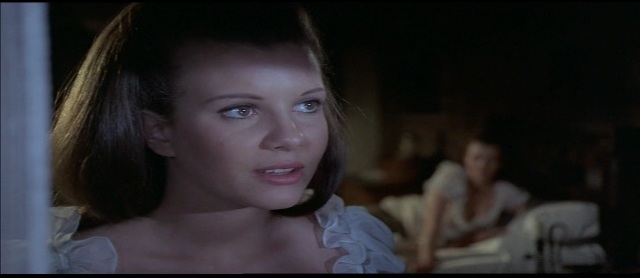
Frieda (Madeleine Collinson) and Maria (Mary Collinson), the title characters.

Upon seeing their "disrespectful" attire, Gustav's dislike of the girls is instantaneous and he relegates them to their room, where they spend a lot of time hanging out (quite literally, if you get my drift) in their diaphanous nighties. It is there that we get to know the girls' unguarded personalities and they are quite easy to tell apart, thanks to the lusty-eyed Frieda being something of an enthusiastic "bad" girl with an interest in boozing and men, while Maria is sweet, innocent and decidedly virginal, as well as being the never-heeded voice of reason in their sibling dynamic.

Upon their arrival in town, the tasty twins catch the eye of every creature with a Y chromosome and in short order they are informed of the castle across the way from their uncle's house, a textbook example of the kind of place in horror movies where you just know great evil resides. It's the home of the sybaritic Count Karnstein (Damien Thomas), a sleazy and totally evil aristocrat who would be Number One on Brother Weil's hit list if not for his connection to the government, and he's introduced when The Brotherhood goes to burn another innocent woman and finds her about to get her hump on with the Count.


Count Karnstein (Damien Thomas): giving the amoral a bad name.

In the exchange between Brother Weil and the Count during that sequence, we witness the interesting contrast/comparison between the two characters, one being balls-out and unashamedly evil, and the other committing heinous atrocities but deluding himself into believing he's doing God's work, and it sets the two on paths of character development that bears satisfying fruit as the film progresses. Anyway, upon hearing about the forbidden pleasures to be had up at Castle Karnstein, Frieda practically drips like a broken fridge at the prospect of spending some quality time there, while her sister implores her not to consider such pursuits.
Frieda, yearning for corruption.

Meanwhile, the Count earnestly seeks to be even more evil than he already is, openly proclaiming his desire to become an active agent of Satan and going so far as to conduct a black mass in his dining hall, complete with a naked local peasant girl — who is equipped with an impressive briefly-glimpsed '70's bush — as a sacrifice. Dissatisfied with the performance of the so-called professional Satanists brought in by his chief servant (where one found those back in the days before Craig's List is anyone's guess), the Count dismisses them and himself prays to the Devil in what amounts to a job application, and in no time the spirit of his infamous vampiric lesbian ancestor, Countess Mircalla Karnstein (Katya Wyeth), manifests, fucks him senseless and puts the bite on him before returning to her infernal rest, thus transforming him into an undead suckface and he could not be happier.


A Karnstein family reunion: Mircalla (Katya Wyeth) returns from Hell.

Once happily vampirized, the Count embarks on a wanton and unholy killing spree, setting his sights on the clearly interested Frieda as a very personal "fuck you" to her uncle.

The lusty Frieda, as first seen by Count Karnstein. Ah, the subtlety of Hammer's filmmaking...

Quicker than you can say "girls gone wild," Frieda sneaks out of her uncle's house and hightails it to Castle Karnstein, where the Count turns her into a vampire and offers her his understandably horrified girlfriend as her first kill.

Frieda, fully vamped-out.

From that point on, Frieda becomes a full-blown force in direct opposition to common decency and starts feasting her way through the immediate populace, all while innocent Maria realizes something is quite wrong and the hunky boar-hunting choirmaster at the girls' needlepoint school (who coincidentally happens to be an expert on the occult in general and vampires in particular) begins fancying Maria, a sentiment that is definitely mutual. Needless to say, these plotlines eventually collide with apocalyptic results, and no one comes out of it unscathed.


The twins in their room: guess which one's the newly-minted undead suckface?

Following THE VAMPIRE LOVERS (1970) and LUST FOR A VAMPIRE (1971) as the final installment of the trilogy, TWINS OF EVIL kicks the shamelessly exploitative lesbian angle to the curb, presumably in favor of the titillating twin thing, but the two do not spend even one second face-deep in each others' humid and furry recesses, which is surprising since the Collinsons reportedly did exactly that three years earlier in SOME LIKE IT SEXY, one of the innumerable European softcore flicks, a film shot when they were seventeen (!!!). Hailing from Malta, the mirror-image beauties came to the attention of the American public when they became PLAYBOY's first twin centerfold models in the landmark skin-mag's October 1970 issue.

Needless to say, many an imagination was put into carnal overdrive at the mere thought of the geometric configurations possible with this pair of stunners, and their centerfold has since understandably become the stuff of legend.

Mary and Madeleine Collinson, PLAYBOY's first twin centerfold models. Jumpin' Jesus in a basket of honey-glazed chicken...

Sadly, TWINS OF EVIL proved to be the last acting work of the Collinsons but their legacy lives on in the hearts of vampire fans and Hammer devotees. What I would not give for their autographs on this behind-the-scenes shot...

This is only a third of the shot in question; the rest can be seen in author and Hammer expert Wayne Kinsey's excellent book HAMMER FILMS: A LIFE IN PICTURES (2008).

Along with the indelible presence of the Collinson sisters, TWINS OF EVIL offers a plot that's sure to keep vampire fans glued to their seats and is a firm reminder of the time before Anne Rice ruined vampires by making them into unscary fops, a cultural blight that opened the door for the even more odious pussification found in the TWILIGHT series (aka "Transylvania 90210"). Hammer's trademark Gothic sensibility is in full effect here, aided and abetted by Peter Cushing's fantastic performance as Brother Weil, and the expected amount of gore and boobs that put the company on the map. Though quite tame by today's standards, the "adult" content found here was the good stuff back in the days and it still serves its purpose, yet its excesses are nothing that I would not allow my nieces and nephews to see.

Madeleine Collinson's "rightie": not a threat to western civilization. Quite the opposite, actually.

The sexy bits are handled with considerable good taste and would mostly go right over the heads of the under-tens — a naked boob here and there notwithstanding — and the gore, while shocking, is of the bogus but fun red paint variety familiar to anyone who's seen even one post-1966 Hammer flick. For example:

And this:

The film also contains what may be the best Hammer beheading on record, but I'll let you see that one for yourself when you check out the movie.

TWINS OF EVIL definitely doesn't deserve its rep as a feeble late entry in Hammer's vampire cycle, and I'm guessing it wears that ignominious mantle due to audiences who'd enjoyed the Sapphic elements in the two previous Karnstein movies being irked at the loss of the girl-on-girl action. Whatever the reason for that assessment, it is an unfair cross that the movie bears, but now the film can be re-evaluated on DVD by those who did not get to see it thanks to it being infrequently run on TV or any of the numerous cable movie channels (although I hear it has run fairly recently in uncut form on Turner Classic Movies). If submitted as is to the MPAA nowadays for a rating, TWINS OF EVIL would most likely garner an R for the very brief nudity, but it's really a hard PG-13 if you ask me, so TRUST YER BUNCHE and add it to your Netflix queue.

Poster from the original theatrical release.

Saturday, October 24, 2015

31 DAYS OF HORROR 2015-Day 24: ZOMBIELAND (2009)

It's been said by various highbrow film critics and analysts that horror movies reflect the societal zeitgeist, so I don't know what the past decade-plus's spate of zombie movies has to say about our collective state of mind. Films about the undead are nothing new but there just seem to be a lot of them lately and they vary widely in quality, and I'm not really the guy to comment on them fairly from a zombie fan's point of view but I will say that ZOMBIELAND is a fast-paced and fun take on the whole "it's the end of the world and the hungry dead are everywhere scenario." Kind of a comedic head-on collision of a Romeroesque apocalypse and the visceral thrills of a "shooter" video game, the film has little on its mind other than being an amusing, violent popcorn flick, and that's a goal at which it succeeds quite well.

Just a typical day in ZOMBIELAND, U.S.A.

ZOMBIELAND drops the audience right into a world already crawling with zombies, and while it's bad enough that legions of ravenous flesh-eaters are literally every goddamned place, what's even worse is that these aren't the rigor-ridden shamblers as seen in most horror films of yore; rather they're quite spry and able to sprint after you, so unless you're in good shape, that's your ass.

The film's ostensible hero is "Columbus" (Jesse Eisenberg), so named for his intended destination, where he hopes against all odds to find his parents still alive. He's a college-age nerd and loner whose lifetime of friendlessness has given him time to think and develop an analytical mind, and once the zombie plague breaks out he's ready for it with a list of basic common sense rules relating to the world's new and utterly deadly status quo. With damned near everybody (un)dead, it's a simple matter to appropriate vehicles and high-gauge weapons, but when Columbus totals his car, he hits the road on foot and eventually is given a lift by "Tallahassee" (Woody Harrelson, looking exactly like a comedic version of his Mickey Knox character from NATURAL BORN KILLERS), a redneck genius at zombie-killing who shows up in an SUV equipped with a cow-catcher up front. The two set off together and then encounter a pair of sisters, "Wichita" (Emma Stone) and "Little Rock" (Abigail Breslin), a couple of smart, ruthless and totally survival-oriented chicks whose personal philosophy can be summed up as "trust no one but each other and look out for Number One." These two give the guys quite a hard time and outfox them on a few occasions before teaming up with them and more or less aimlessly journeying through "Zombieland" (the nickname for the world at large) and becoming a loose-knit family in the process.

The family that slays together, stays together: (L to R) Columbus (Jesse Eisenberg), Wichita (Emma Stone), Little Rock (Abigail Breslin) and Tallahassee (Woody Harrelson).

To say more would give away a lot of fun stuff — especially a major surprise cameo that I know for a fact has long since been let out of the bag in numerous online forums, but I'm not gonna do that; in fact, if anyone starts to tell you about the cameo sequence, punch them in the mouth, Hard — So I'll just stop right here and instead offer a little advice.

ZOMBIELAND is thoroughly entertaining, very funny, and is definitely worth your time. In terms of attitude, it's America's answer to SHAUN OF THE DEAD (though admittedly not as good), and the appetite for destruction that is so hard-wired into the American psyche is given full unintentional (?) reign. However I do have two warnings about the film:
  1. As previously stated, do not let anyone tell you about the cameo sequence.
  2. Giving away nothing in the plot, much of the film's running time is spent clearly establishing Wichita and Little Rock as ruthless, cunning, survival-minded opportunists who are perfectly suited to strategically getting by in a world overrun by flesh-eating zombies, yet during the final act they do something completely stupid that the audience by that time understands with absolute certainty that they would NOT do. The move in question violates what they (and we) know about what attracts zombies en masse and no one in the audience I saw it with bought it when the script called for a needless bit of conflict. Luckily there was still a lot of gore, violence and humor to follow, and what came before was so good that I was willing to let the major scripting fuckup slide.
So with that said, check out ZOMBIELAND. And if you have kids who want to see it, I say it's perfectly suitable for any who are around ten and older, provided they can handle the gore. The cursing is nothing they don't hear everyday at school (or, if truth be told, at home), there's no sex, and the violence is nothing new to them if they've played some of the more violent adult-oriented video games (c'mon, don't delude yourself into thinking that they haven't), and when you add a general sense of good-natured fun to those elements, I'd say it's really little worse than an exceptionally gory PG-13. And for those of you who like to have these things spelled out on a numbered rating, I'd give this a very strong four out of five, with the one star it requires for a perfect score being held back solely for the aforementioned very stupid script fuckup near the end.


Lesson to be learned: let no zombie stand in the way of Tallahassee's quest for Twinkies.

Friday, October 23, 2015

SOUND & FURY: DEAD! THE GRIM REAPER'S GREATEST HITS (2006)

Always on the lookout for a good compilation CD, especially around the Halloween season, I was fortunate to stumble across this comprehensive collection of two decades-worth of "death rock" classics. Once an inexplicably popular subgenre of American pop music (with the occasional British offering thrown in for good measure) the death rock ouvre began as tales of star-crossed young lovers who were parted due to not receiving their parents' blessings, engaging in stock car racing or some other such teen woe before meeting a horrible demise in a flaming car wreck. Not my idea of romantic but that kind of stuff was big back in the days, with "Teen Angel" serving as the template from which the genre would arise, reaching its peak with the Shangri-Las' "Leader of the Pack" (a tune conspicuously missing from this disc, but the compilers instead gave us another Shangri-Las downer, the overwraught "Give Us Your Blessings").

The Shangri-Las: "Yeah, we're from Queens. So fuckin' what?"

Virtually all of the songs here will flat-out crush any life and happiness in the room if you're stupid enough to play it at a party, with the prize for most depressing being a toss-up between Ferlin Husky's "The Drunken Driver," a song that not only has the nerve to feature a long-absent father mowing down his own kids on the very day he's returning home to them, but also has the mangled and expiring kids give him an extra guilt-trip by demanding an explanation with their dying breath; "Patches" — not to be confused with the equally-uber-depressing 1970's hit by Clarence Carter —  this one tells of a rich kid whose parents don't approve of his white trash girlfriend, so he's forbidden to see her and she commits suicide, after which he solves his dilemma by offing himself; and "Mother, Mother (I Feel Sick)," in which a woman's lifelong playing of headgames and emotional manipulation of others catches up with her when she discovers she has a terminal illness.

"Don't Worry, Be Happy" this ain't (thank God!), but at times it wallows so shamelessly in its tear-jerking that you can't help but laugh your ass off. The nauseating "Once You Understand" by Think comes off like a "relevant" song you'd hear performed as intentional humor on a show like GET A LIFE or something (it would have fit in perfectly with "Zoo Animals on Wheels"), and dredges up memories of the ultra-saccharine "I'd Like To Teach The World To Sing." It's just a hippy-dippy chorus of "things get a little easier, once you understand," repeated ad infinitum, as sort of punctuation to scenery-chewing "sketches" of teenagers and their dysfunctional relationships with their stereotypical "establishment" parents (this song has late-1960's/early-1970's written all over it in that trite BILLY JACK way). Mom and dad bitch out their admittedly whiny kids over every conceivable thing, such as not wanting daughter to visit a certain part of town because they "don't like the kind of people living there," son's too-long hair, lack of trust that daughter's not getting laid when she's supposed to be babysitting, the kids wasting their lives on "foolish things," son not having a job in which he works "twelve hours a day, six days a week, to pay for food and board" just like dad did, and so on, culminating in dad berating his son on how "there's more to life than joining a group or playing your guitar." Son responds with, "Yeah, dad? What is there to life?" Then "life' gets repeated several times with a "spooky" echo effect as that fucking chorus escalates into full-blown tambourine/piano/handclapping idiocy before it all comes to an abrupt halt and we hear a voice ask a "Mr. Cook" if he has "a son named Robin, aged 17." When Mr. Cook replies in the affirmative, he's told that his son has died from an overdose and he'd better come down to the station house. The father's anguished sobs continue through the end of the song as the chorus starts up once more.  Perhaps this would have had some kind of tragic effect if we were told that Mr. Cook was the gruff dad heard throughout the song, but we have no idea who this guy is and he sounds completely different from the way the father sounds on the rest of the record, so our ability to care at all just gets whizzed down the song's metaphorical leg. And what happened to mom and the daughter? Who the fuck knows?

But while "Once You Understand" is unintentionally funny, Jimmy Cross' infamous 1964 classic "I Want My Baby Back" is genuinely hilarious and downright gleefully offensive. In what is a contemporary parody of the death rock style in general, Cross relates the tragic death and dismemberment of his girlfriend while they're on their way home from a Beatles concert and they run smack into the Leader of the Pack. Distraught over his loss, Cross wails about how he wants his baby back, how he misses her "oh so much" and "can't live without her touch," as the sounds of earth being dug with a shovel register in the background. When his tale of heartbreak is finally told, Cross opens his girl's coffin, gets in with her corpse, closes the lid, and finishes by singing "I've got my baby back!" Necrophilia rock is a tough sell some fifty-one years after the song was released, but when it arrived in '64 it was quite controversial, what with it being in generally questionable taste as well as coming less than ten years after the Ed Gein case, an event that still resonates nearly six decades later, so you can imagine that it still hadn't faded from the public consciousness at the time.

Ed Gein: murderer, cannibal, amateur tailor, and possible inspiration for Jimmy Cross's "I Want My Back."

I have no complaints about this compilation other than the omissions of "Leader of the Pack" and some "classics" from the early-1970's, namely "D.O.A." by Bloodrock — a song relating the point of view of a corpse on a morgue slab — Bobby Goldsboro's "Honey" (a strong contender for the title of most maudlin song of all time), "Rocky" by Austin Roberts (a bald-faced ripoff of "Honey" that some consider to be even more maudlin), "Run, Joey, Run" by David Geddes (guy gets girlfriend pregnant, girlfriend's dad chases guy with shotgun, girlfriend's dad accidentally kills his own daughter when she takes a shotgun blast meant for the boyfriend), and of course "Timothy" by the Buoys, the only song about cannibalism ever to crack the Top 20, as well as having been written by Rupert Holmes, the diabolical mastermind behind "Escape (The Pina Colada Song)." Come to think of it, there are enough omissions to warrant expanding this into a perfect, kitschy two-disc set, but what the hey? Worth every cent of its cost, DEAD! THE GRIM REAPER'S GREATEST HITS is a lot of fun, provided you're in the mood to be buried beneath an avalanche of Top 40 morbidity. And if you're curious, the full track listing can be seen below.

1. Terry - Twinkle
2. Give Us Your Blessings - The Shangri-Las
3. Endless Sleep - Jody Reynolds & The Storms
4. Death Of An Angel - Donald Woods & The Vel-Aires
5. Condition Red - The Goodees
6. I Want My Baby Back - Jimmy Cross
7. Dead Man’s Curve - Jan & Dean
8. The Drunken Driver - Ferlin Husky
9. Johnny Remember Me - John Leyton
10. Last Kiss - J. Frank Wilson & The Cavaliers
11. Patches - Dickey Lee
12. Once You Understand - Think
13. The Death Of A Surfer - The Riviares
14. Dead! - Carolyn Sullivan
15. Psycho - Jack Kittel
16. Ebony Eyes - The Everly Brothers
17. Requiem (For A Girl Born Of The Wrong Times) - Betty Barnes
18. A Beginning From An End - Jan & Dean
19. Tell Laura I Love Her - Ray Peterson
20. The Dream - The Fox
21. Teen Angel - Mark Dinning
22. Mother Mother (I Feel Sick) - The Martin Sisters
23. The Bed - Walter Jackson
24. Let's Think About Living - Bob Luman

31 DAYS OF HORROR 2015-Day 23: THE VAMPIRE LOVERS (1970)

Old school vampire lore + boobs = Hammer film.

This first in Hammer Films’ “Karnstein trilogy” — comprised of THE VAMPIRE LOVERS, LUST FOR A VAMPIRE (1971) and TWINS OF EVIL (1972) — is far and away the best of the lot and deservedly made a horror star out of Polish-born Ingrid Pitt. Though rather tame by current standards, THE VAMPIRE LOVERS was just the hit that the ailing Hammer studio needed, fueled by a letter perfect combination of the usual Hammer tone and the then-new explicit rather than implicit lesbian angle allowable thanks to British censors shifting the “X” certificate from age sixteen and over for admission to eighteen and over (essentially equivalent to the MPAA’s “R” rating and allowing for nudity, simulated sex and gore, but not gynecologically detailed or pornographic content).

The haunting Ingrid Pitt as Mircalla/Marcilla/Carmilla Karnstein.

Based on Joseph Sheridan Le Fanu’s novella CARMILLA (1875), THE VAMPIRE LOVERS lays out the eerie events set in motion in the early 1800’s (I think) when a beautiful and mysterious woman (Ingrid Pitt) arrives in the Duchy of Stiri and works her way through the populace, killing off members of the local populace with her vampiric feeding. Her M.O. is to insinuate herself into the house of an aristocratic family and feed on that family’s virginal young daughter (who is invariably cute as hell) until the girl wastes away, presumably because of anemia, and then the sultry vampiress moves on to her next victim. The vampire in question is Mircalla Karnstein, the last of a line of undead suckfaces who were believed wiped out years earlier, and she operates under the anagrammatically rearranged monikers of “Marcilla” and “Carmilla,” as the possibly unwilling thrall of a mysterious horseback-mounted man in black (John Forbes-Robertson) who’s obviously a master vampire. First working her baleful magic upon the niece of General Spielsdorf (Hammer mainstay Peter Cushing, in a role that amounts to slightly more than a cameo), the vampiress soon moves on to the doll-like and smokin’ hot Emma Morton (the adorable ginger-tressed Madeline Smith, who sports a pair of alabaster Brit-breasts that you just want to latch onto with eager lips and tongue), and it’s that literally unnatural relationship that drives the movie.

Carmilla and Emma share a tender moment.

As the vampiress slowly drains away the poor girl’s life, members of the household gradually twig to what’s up, so it’s only a matter of time until Emma lies dead or Mircalla is thwarted. Let us not forget that Peter Cushing, cinema’s most notable and formidable Van Helsing, is in this flick, so it’s a no-brainer as to how things simply must turn out; following the miserable demise of his niece, Cushing’s General seeks the aid and advice of Baron Hartog (Douglas Wilmer), who some years earlier avenged the death of his own daughter by taking out what was presumed to be the last of the vile Karnstein clan, and from there it’s time to kick some fanged ass.

Though set in various identifiable European locales and sometimes foreign lands such as Egypt, the Hammer horror world may as well all take place in the same stylized realm, so instantly recognizable is their atmospheric style. Replete with isolated country back-roads, misty graveyards, busty peasant women in dairy-showcasing bodices — one of the things that got me into these films during my formative years — and lavish period sets and costumes that drive home the fantasy and bring to mind MASTERPIECE THEATER as filtered through a Dan Curtis sensibility, the Hammer efforts are as unique and fun as the genre-defining Universal Studios classics that preceded them. The Universal influence comes as zero surprise since Hammer’s horror films launched from a template established by their Yank antecedents, starting in the 1950’s with gored-up re-interpretations of Dracula, Frankenstein and the Mummy, followed later by their take on the Wolf Man, and those films were always worth a look. Filled with terrific eerie visuals, including a great bit with an earlier Karnstein lady searching the graveyard for her burial shroud (without which she cannot return to her tomb) and two shocking beheadings by sword. THE VAMPIRE LOVERS has much to savor from both the visual and narrative standpoints, and its interest has only increased with each passing year.

Perhaps most renowned for its lesbian content, the film is nowhere near as shocking in that respect as it was some forty years ago, and when looked at today it reveals layers far more rich than its initial prurient value. Mircalla does not appear to enjoy her state as one of the undead and seems to commit her evil acts either as a result of being compelled to do so by the mysterious (and unexplained) man in black, the occasional basic need for sanguinary sustenance or simply out of a need to defend herself against those who have figured out what she is. When it comes to her relationship with Emma, what at first may seem predatory or a symbolic mission to destroy innocence in the face of the girl’s obvious and untried womanhood is revealed to be a genuine affection, and Mircalla prolongs the inevitable by feeding on a couple of unfortunate locals so she can enjoy as much time with her inamorata as possible. The scenes of sexual intimacy between “Carmilla” and Emma are tastefully handled and have an almost childlike innocence in their emotional content, at least until the vampiress kisses her way south — if you know what I mean and I think you do — as the camera remains focused on the wide-eyed and ecstatic face of Emma.

Which brings me to Ingrid Pitt. One of the short list of indelible female figures in pre-1980’s horror cinema, Pitt simply owns THE VAMPIRE LOVERS in much the same way as THE EMPIRE STRIKES BACK was Darth Vader’s movie and I simply cannot picture anyone else in the role of Mircalla (unless the film was remade with Monica Bellucci). Pitt’s vampire is graceful, somewhat terse unless interacting with the object of her desire, and wears an expression that’s a curious mix of indifference and resignation to her lot in un-life. Mircalla is definitely creepy, but there is some indefinable something about her that evokes sadness to such a degree that one almost cannot help but pity her despite the trail of carnage she leaves in her wake. Pitt is also extremely easy on the eyes and has an air of commanding elegance that is evident even when she’s sponging her nekkid self in a bathtub or frolicking topless with Emma during a preamble to their first Sapphic encounter.

As I stated previously, the film’s naughty content is tame by modern standards, and I sat there for roughly the first half hour wondering why the film received an “R” rating form its U.S. release after witnessing only the most minor display of blood and one bare tit from the general’s niece during a brief post-mortem medical going-over, but then the bathtub scene where “Carmilla” engages in initially innocent girl time with Emma came on and all was right in the world…

THE VAMPIRE LOVERS is one of the last times when the horror engine that was Hammer fired on all cylinders, and it is very much recommended to horror fans and followers of the whole lesbian vampire sub-genre. Available on one of those reasonably priced MGM-released Midnite Movies DVDs in a double feature with the vastly inferior COUNTESS DRACULA, THE VAMPIRE LOVERS is a very welcome must-have for aficionados and those looking to remember the days before vampires were ruined by Anne Rice’s pussification and that fucking TWILIGHT bullshit.

The marvelously cheesy poster from the American release. None of the stuff seen on this poster happens in the movie.

Thursday, October 22, 2015

31 DAYS OF HORROR 2015-Day 22: HALLOWEEN III: SEASON OF THE WITCH (1982)

 Masks in a horror movie. Yeah, that's undoubtedly gonna work out well...

The week leading up to Halloween, 1982: In the wake of a bizarre murder followed by the immolation suicide of the killer, Dr. Daniel Challis (Tom Atkins) embarks on his own investigation with the victim's daughter, Ellie (Stacey Nelkin, late of GET CRAZY), providing transportation. The trail of clues leads to the remote, all-Irish Californian town of Santa Mira, home of the Silver Shamrock Novelties company, which this year is mass-producing children's Halloween masks — a skull, a witch, and a Jack O'lantern — bolstered by a saturation marketing campaign with commercials featuring a jingle that is an earworm of Godzilla-like proportions.

Seriously, do not play this unless you want the Silver Shamrock jingle stuck in your brain for a week.

Masterminded by Irish expat Conal Cochran (Dan O'Herlihy), a renowned master of the practical joke, the marketing blitz is itself a mask for a twisted plot involving the old school Gaelic festival of Samhain, chips harvested from one of the Stonehenge monoliths, and the playing of the ultimate evil trick (rather than a treat) on all children who wear the Silver Shamrock mask while watching a TV special at a certain time on Halloween night...

Long kept at arm's length like some sort of bastard child of the franchise, HALLOWEEN III: SEASON OF THE WITCH was released to universal disdain from both professional critics and horror movie fans alike. Intended as the first in an annual horror anthology series in the wake of HALLOWEEN II's seeming coda to the Michael Myers "boogeyman" thing, HALLOWEEN III: SEASON OF THE WITCH tried something different and genuinely inspired in its weirdness, but its era's slasher-hungry audience wanted its thrills as undemanding and brain-dead as the same crap they'd been repeatedly spoon fed since the release of FRIDAY THE 13th (1980), and that wave rode out the decade to increasingly diminishing returns. And though all of the films bearing the HALLOWEEN franchise brand that followed in its swiftly-dismissed wake brought back Michael Myers as their unstoppable antagonist, none of them were any good and not one of them displayed even one-tenth of the imagination and creativity to be had with SEASON OF THE WITCH. Though sparse on gore/violence (though what there is is quite memorable) and low on actual scares, it's completely loony and rich in atmosphere. What most compels about HALLOWEEN III: SEASON OF THE WITCH is its concept and the eventual knowledge that its threat is a dire anti-child practical joke on a truly diabolical and insane scale, which only serves to counterpoint Cochran's techno-sorcerous genius.

Conal Cochran (Dan O'Herlihy). Who says dark magicians can't have a sense of humor?

SEASON OF THE WITCH's focus on ancient pagan magic was a good way to shift from Michael Myers's silent "Boo!-and-stab" schtick but while Celtic magic and alignment of the stars for evil ritual purposes would be touched upon again in later HALLOWEEN installments, that perhaps noble attempt at not totally sweeping SEASON OF THE WITCH's contributions to the franchise under the rug brought nothing to the proceedings and only served to make the stories make even less sense.

To be 100% honest, I was among the disgusted naysayers who experienced HALLOWEEN III: SEASON OF THE WITCH when it first hit, and none of my peers at the time had anything kind to say about it. But, unlike the creatively-bankrupt Michael Myers followups, the years have been very kind to the misbegotten SEASON OF THE WITCH and it is finally being re-assessed on its own low-key merits. If you're one of the legion of haters, do yourself the favor and give it a second look. It's a hell of a lot better than you may think.

Poster from the original theatrical release.

Wednesday, October 21, 2015

31 DAYS OF HORROR 2015-Day 21: CURSE OF BIGFOOT (1976)

In the glorious days of pre-cable TV wherein one could find any number of local movie shows, cash-strapped regional stations would occasionally fill out their film schedules with bottom-of-the-barrel and most likely public domain flicks that would be broadcast at Jesus o’clock in the morning and be viewed mostly by insomniacs or the heavily self-medicated. These celluloid stink bombs would mostly come and go, being run only once, but every now and then there would be one that stood above the pack and would be remembered for all time as a movie so mind-bendingly terrible that it was literally unbelievable. In the days of my misspent East Coast youth, no film exemplified this misbegotten breed like 1976’s CURSE OF BIGFOOT, a movie that ran with surprising frequency on New York’s WOR-TV (aka Channel 9) and became a minor cult classic to myself and several of my like-minded friends. We first witnessed its anti-spectacle in the late 1970’s and we’ve been devoted to it ever since, it being the first film I ever saw that led me to describe it as being so boring, worthless and bad that it somehow manages to transcend its own awfulness and become a thing of perverse fascination.

It’s probably impossible these days to convey to those who weren’t there for it just how much of the 1970’s seemed like 
everybody was stoned, including the president, and this perceived pot haze clouded pop culture with many strange fads and manias, among which could be counted “weird phenomena” stories of shit like the Bermuda Triangle, U.F.O.’s and other assorted strangeness that became mesmerizing after a few bowls of Indica. But the heavy-hitter of the genre had to be the nation’s fascination with Sasquatch, more commonly known as “Bigfoot,” a shaggy forest-dwelling specimen of cryptozoology who memorably teamed up with the Six-Million Dollar Man. I don’t recall exactly when the Bigfoot craze caught on but I do remember the country being inundated, seemingly overnight, with books, cheapjack horror movies, TV specials and pseudo-documentaries about the hairy bastard, and while I dig the idea of the missing link/nature spirit or whatever the fuck Bigfoot was supposed to be, I must admit that I never really got exactly why the creature was so popular. There was never much by way of concrete proof of its existence, the most famous example of which is the short out-of-focus 1967 film purported to be of an actual Bigfoot crossing a road that looks to me like some Amazonian woman in a rented gorilla costume; I say “woman” because in the famous out-of-focus still shot of Bigfoot taken from the film it looks like Bigfoot’s rockin’ a decent rack.

The alleged real-life Bigfoot from the famous 1967 film. Is it just me, or does it look like Bigfoot's sportin' titties?

But whatever the case, Bigfoot became an indelible part of the Seventies zeitgeist and low-budget filmmakers were only too willing to crank out shitty flicks to cash in on the craze and rook moviegoers out of their hard-earned greenbacks. None of the Bigfoot movies were any good, in fact most of them were downright terrible, but not one of them even begin to approach the nadir of quality that is CURSE OF BIGFOOT, a work that appears to have been cobbled together from a poorly-made and totally-unrelated-to-Bigfoot attempt at a horror film, a scene taking place in a classroom that looks worse than one of the educational flicks they used to run in health class, a staggering amount of seemingly random stock footage and, last but certainly least, what meager footage was available from an apparently unfinished 1958 would-be monster movie entitled TEENAGERS BATTLE THE THING. A true oddity, the film was not inaccurately described on the Internet Movie Database’s “user comments” section with the headline “A Sasquatch could make a better movie,” a sentiment I share after having sat many times, slack-jawed in disbelief, through this sole effort of director Don Fields.

NOTE: as of this point, this review becomes an in-depth examination of CURSE OF BIGFOOT's anti-grandeur, so if you want to see it for yourself and save the threadbare surprises I advise you to stop reading right now and get your hands on the DVD or check it out in chapters on YouTube.

The legs of Bigfoot as seen during the pre-credits sequence. Note the stunning cinematography.

The film opens with a glimpse of the distant past that wouldn’t have passed muster on IT'S ABOUT TIME as a narrator “ominously” fills us in on a strange creature that would kill cavemen for no apparent reason. That creature was known as…(Wait for it!)…Bigfoot!!!


Oh, shit! It's Bigfoot!!!

Suddenly, in what is unquestionably the film’s only almost-exciting moment, a monster meant to be Bigfoot runs face-first and full-tilt into the camera and mauls an unseen caveman to death (unseen save for an arm with crepe hair crudely glued to it, that is), causing chocolate syrup to run down a boulder in a poor substitution for stage blood. The titles then roll and list a cast of non-stars (such as Ken Kleopfer, Ruth Ann Manella, and Bill Simonsen as Dr. Bill Wyman) as the camera for some reason delights our eyes with what appears to be elementary school documentary footage of Native American cliff-dwellings and caves which has squat to do with Bigfoot.

The film then shifts to a nigh-interminable sequence featuring a nighttime scene in which a woman scolds her dog for barking at what she assumes is some wild animal but is in actuality the slowest-moving, most nondescript and bogus-looking monster in recent memory.


Exactly what the fuck is this monster supposed to be? Anybody?

The monster lurks in the bushes or aimlessly shambles along while the camera can’t make up its mind as to whether it wants to show us the monster, the dog, the woman or random shots of the house or the dripping spigot to which one would attach a garden hose. After what feels like a short suspense-free eternity, the monster finally makes it to within arm’s length of the woman and makes his move, but we don’t get to see what happens because the footage abruptly comes to a halt when it’s revealed that we’ve been watching a movie along with a classroom full of teenagers who have themselves been watching the pitiful horror movie; the film has been shut off by the class’ professor who states something to the effect of “Well, I think you all get the idea,” thus simultaneously leaving his students and the audience feeling distinctly gypped.

This teacher’s acting is smarmy to the nth degree and comes off just as vile and unctuous as any seventies-era gameshow host, only minus any shred of charm. Of far more interest (?) is the classroom full of students, comprised of a bunch of young actors whose faces betray the unmistakable look of being both bored and stoned, providing a screen image that in more artful hands would have been intentionally meant to comment on what was likely the mindset being experienced by the viewing audience.


The stoned and bored-looking students: an ironic comment on the audience?

Alas, the film does not give us time to consider such an artistic possibility and instead allows the teacher of what is apparently a myths & legends course to whip out a placard with an illustration of Bigfoot emblazoned upon it and expound upon the existence of the hairy bastard.


"And for those students who speak Ebonics, this here nigga is Bigfoot, muthafukkas!!!"

So begins a veritable Cannes Film Festival of stock footage meant to convey the search for Bigfoot, footage including incongruous shots of assorted radar arrays,

maps and shit,

light aircraft flying at an altitude guaranteed not to allow a clear look at anything other than miles of tree cover, let alone a Sasquatch,

and copious footage depicting the logging industry.


I shit you not; the fucking logging industry!!!

To further drive home his point — nebulous though it may be — the professor then regales us with the "true encounter" had by two gurk-gurks out driving aimlessly through the backwoods. After about three solid minutes of shots of their truck slooooooowly meandering over small hills and around trees, the yokels spot...Bigfoot!

The Hairy One casually saunters across the road and vanishes into the brush, causing the stunned (stoned?) drivers (about whom we know absolutely nothing) to stop the truck and get out to investigate. The pair consists of a dude who looks like a long-lost member of SCTV's MacKenzie Brothers

and a mulleted wonder who's pretty much the living embodiment of the mid-1970's burnout who hung around shopping malls, parking lots and fast food joints looking to score some weed or underage pussy.

The mid-1970's burnout, far removed from his natural habitat of shopping malls and parking lots.

These two veeeeeeeery sloooooooowly search the brush for any sign of Bigfoot, traipsing through brambles, random branches and such, wasting nearly ten suspense-free minutes during which time we get a brief glimpse of the monster's right foot that stiffly twitches.


The right foot of...Bigfoot!!!

Sadly, our intrepid explorers don't get to see that horrifying sight and instead continue to wander about aimlessly. Finally the burnout hears the sounds of his pal being horribly mauled — which is conveniently not depicted for the edification or entertainment of the audience — and runs to his friend's aid, but too late: the lost MacKenzie lays dead and the burnout reacts with less emotion than he would have expressed if he'd spilled his bong in the rear of his bitchin' customized van.


The lost Mackenzie Brother lays dead, viciously mauled by a rapacious Bigfoot...


...while his burnout pal reacts with a depth of emotion that fairly screams "Bummer, dude."


That sub-IN SEARCH OF re-enactment goes on for so long that you'll swear you'd felt your facial hair grow, an effect compounded by whatever intoxicants may be running rampant through your system. Which reminds me that I neglected to mention that CURSE OF BIGFOOT should not be attempted without beers, hard liquor or copious amounts of weed within easy reach.

Before we're given a chance to regain our composure following that exercise in flesh-crawling horror/boredom, class resumes with the bored/stoned students identifying old woodcuts of mythic beasts while turning in performances that would have embarrassed the cast of Mrs. Gage's fifth grade production of WHO'S AFRAID OF VIRGINIA WOOLF? But then things take a turn for the worse when the professor's special guest shows up, a creepy bespectacled guy who claims to have firsthand experience with a vicious Bigfoot, an event from some fifteen years previous.

"Kids, I had an encounter in the woods with Bigfoot, and...Hey! Stop laughing! This shit's serious!!!"

Following what's supposed to be an ominous lead-in (that isn't the least bit ominous) to the tale he's about to tell, the movie suddenly turns into footage from an unreleased no-budget horror flick from the 1950's, TEENAGERS BATTLE THE THE THING (1958). Complete with obviously different film stock and another opening narration, it's a jarring effect that not only makes the viewer think they've downed some off-date Piel's but also leads one to conclude they've been trapped in a cruel cinematic Moebius strip that will randomly re-start the film over and over again for all of eternity, with each new beginning helmed by a completely new director.

Of far less interest than the patchwork incoherence/boredom festival/endurance test of the film's earlier segments, the 1950's mini-movie is merely a deadly-dull account of a teacher and his students discovering a mummified Bigfoot in a hillside cave and what happens when said critter gets loose. There's a little bit of dimestore mayhem before Bigfoot meets an untimely and uninteresting death by immolation, but before we're finally granted the mercy of the familiar words "The End" we're forced to endure scene after scene of some boring Eisenhower-era white folks wandering around some nondescript hills for what you'd swear was the entire running time of the U.S. version of BERLIN ALEXANDERPLATZ.


Can your heart stand the excitement?


Even when the monster goes on the rampage, not one single thing of interest happens, and when "The End" does finally pop up the film just abruptly comes to a complete halt. No cutting back to the anguished Bigfoot massacre survivor, no summing up from the professor, no comments from the class, no twist ending, no anything. The shit just ends and the viewer is left to sit in silence for a few moments, reeling from the cumulative boredom and confusion, but thankful that they didn't spend the cash to see it in the theater. Yes, you read that right: CURSE OF BIGFOOT was apparently actually released onto the big screen, probably to the drive-in circuit, a wasteland where the attendees were more often than not too concerned with getting stoned or fucking to care if the movie being shown was the cinematic equivalent to an empty McDonald's Big Mac container.

But believe me when I say I'd have loved to have seen this monument to how 
not to make a movie if it had played theatrically during my youth. Films of this ilk are best enjoyed with an unwitting audience of liquored-up grindhouse regulars who enliven such flicks with their non-stop barrage of often vulgar commentary and impromptu insinuation of themselves into the movie's events with observations such as "If I was in this movie I'd've kicked that muthafukkin' Bigfoot muthafukka right in the fuckin' nuts!" which would probably have been answered back with "You wouldn'ta done shit 'cuz Bigfoot would be too busy bonin' you up the ass!" We may not have seen it projected, but my friends and I had a field day with CURSE OF BIGFOOT whenever it aired on Channel 9, and just the other night myself and my friend of twenty-six years, Chris, sat through it yet again and laughed ourselves silly. There are those who slag off Ed Wood and his films as being the worst ever made, but at least Wood had a unique vision all his own and legitimate desire to make viable movies; CURSE OF BIGFOOT appears to have been cobbled together from spare parts with naught on its mind save ripping-off the moviegoing public, and it certainly succeeds at that dubious goal, and what entertainment can be garnered from its towering ineptness was almost certainly not intentional.

Bottom line: CURSE OF BIGFOOT is exactly the kind of film that should be considered when trying to define "the worst movie of all time," a flick lacking any of the things that make a movie legitimately entertaining in the first place, such as characters you care about in any way, thrills, romance, a coherent plot, gratuitous titties, graphic violence, talking dogs, 
anything. Being wholly without merit, CURSE OF BIGFOOT is recommended only for those who have worked their way through the Thirty-Six Chambers of Bad Moviedom and attained the Zen-like mastery needed to weather its complete and utter inertia. That said, I would also recommend it to those who think they may be ready to handle it; if you newcomers can make it all the way through CURSE OF BIGFOOT's eighty-eight minute running time you may find yourself among the growing legion of moviegoers who love it for a number of indefensible reasons, and may even find yourself attempting to lure the innocent down the path of ruin that you yourself have trod upon, becoming sort of a bad movie "pusher," if you will. A pusher just like me. (He smiles evilly.)

Tuesday, October 20, 2015

31 DAYS OF HORROR 2015-Day 20-I WAS A TEENAGE WEREWOLF (1957)

Tony Rivers (Michael Landon): Poster child for anger management.

High-schooler Tony Rivers (a pre-BONANZA Michael Landon) is plagued with a volatile temper that ignites at the slightest provocation, making him notorious in his school and landing him in trouble with the authorities. After an unwarranted violent confrontation with a classmate brings him a warning from an understanding police officer, followed by an equally un-called-for assault on a friend at a party, Tony takes the cop's suggestion and seeks therapy with hypnotherapist Dr. Alfred Brandon (Whit Bissell). Unfortunately for Tony, Dr. Brandon is the type of mad medical professional common to 1950's sci-fi and horror yarns, and the doc uses Tony as an unwitting guinea pig in drug and hypnotherapy treatments intended to regress the lad to his most primitive instincts. For no adequately explained reason, Dr. Brandon is convinced that his regression therapy technique will eventually save humanity from itself (???) and somehow he thinks it would be a good idea to suggest to the hypnotized, drugged-up Tony that he was a werewolf in one of his past lives. (How a werewolf fits into mankind’s evolutionary tree I won’t even begin to theorize.) Of course Tony turns into a slavering lycanthrope and savagely murders a couple of people before the police twig to the fact that they're on the trail of a creature straight out of legend, and it's only a matter of time until his fateful final encounter with Dr. Brandon and inevitable tragic demise.

A couple of lapses into hokey 1950's "teen" movie territory (where the teenagers are all played by people who are obviously in their twenties) notwithstanding, I WAS A TEENAGE WEREWOLF offers up a fun and mildly creepy metaphor for the horrors and pains of adolescence and wouldn't be the last lycanthropy flick to tackle that theme. That said, the film is mostly remembered these days for its classic title, early performance by future TV royalty Michael Landon, and its overbite-sporting werewolf clad in a varsity jacket, but it does contain one of the most effective werewolf-on-the-hunt moments in film, a moment of primal terror that permanently burned this, the first werewolf movie I ever saw (I was six years old at the time), into my consciousness. Just after a meeting with his school's principal, in which he's told that Dr. Brandon has had some very good things to say about his improving attitude, Tony's curse is triggered by a ringing school bell.

At that time, Tony is in the school's gym, observing a toothsome girl (May 1957 Playboy Playmate Dawn Richard) practicing moves on the uneven parallel bars. As she executes a move that inverts her visual perspective, she comes face-to-face, upside-down, with the slavering monster.


One of the most memorable P.O.V. looks at approaching death in cinema history.

Terrified, she falls to the floor and attempts to flee, but there is no escape.


Physical fitness is no match for a werewolf on the hunt.

If you see this movie for no other reason, don't miss that sequence. It's the film's one true moment of outright horror and as such it's a doozy.


Poster from the original theatrical release.