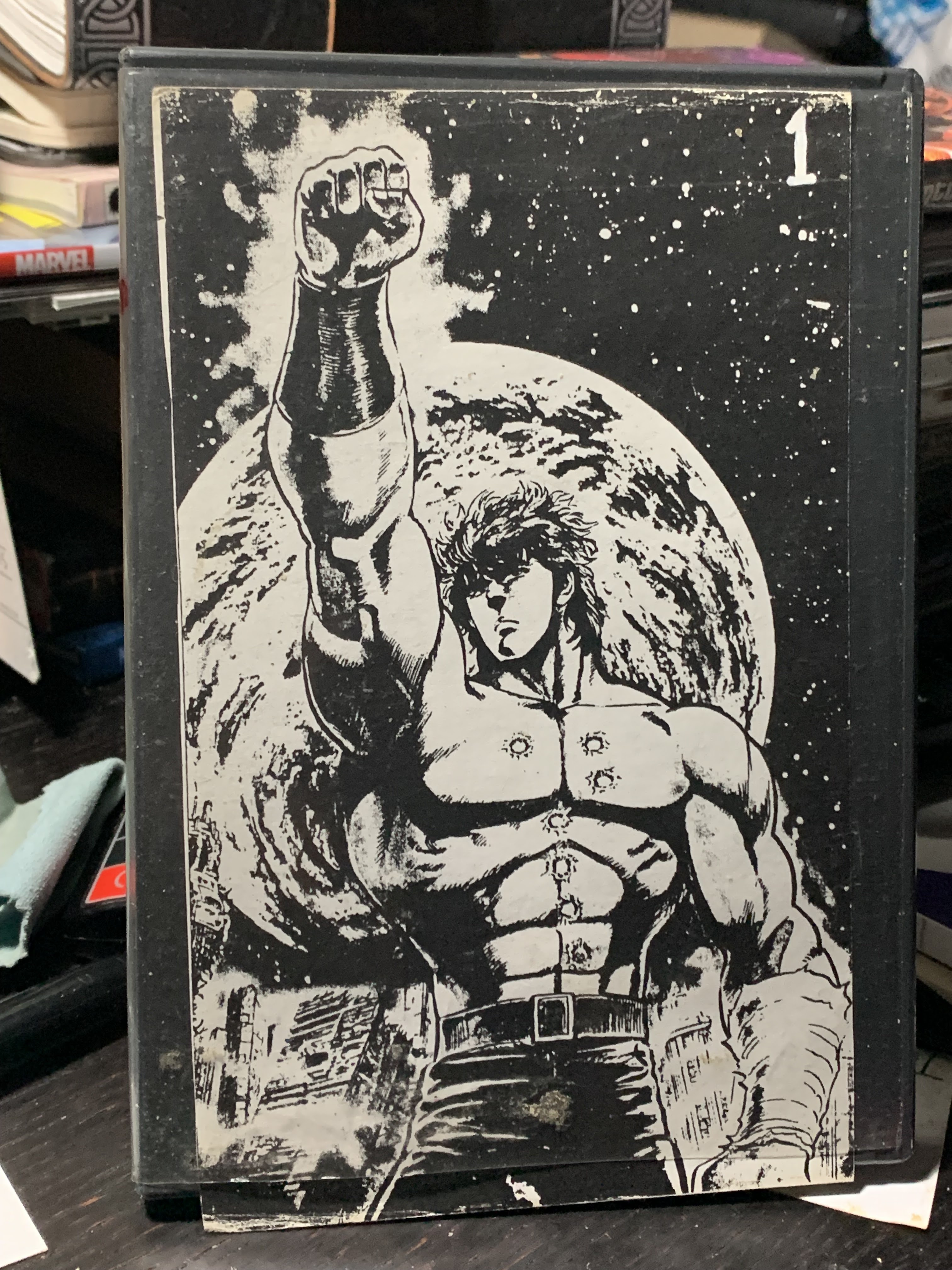
While sorting though my stacks, I unearthed a classic.
Back in the period when I was buying untranslated tapes of FIST OF THE NORTH STAR from Tokyo Video as it was airing new episodes in Japan, I edited together a VHS tape of highlights from the show's second year — arguably when the show really began firing on all cylinders and earned its reputation — and that tape was screened countless times between my final year of college and when I left Connecticut to start working in the Marvel Bullpen. The usual suspects would gather in my college domicile or my mother's TV room in the basement, and we would watch the anime's post-apocalyptic kung fu mayhem splatter across the screen while we swilled adult beverages and smoked roughly a Borg cube's mass worth of kind buds. It was untranslated but we did not care, as it was colorful, lively, and completely out of its mind. A real revelation for American viewers at the time. If you were there for any of those screenings, please stand up and be counted and give a shout out in the comments section.
Anyway, at some point in the '90's I took that beloved tape to a Manhattan camera store that transferred VHS tapes to crude DVD's, and when I handed it to the clerk, he watched a little of it, asked "What the fuck is this?" and "I'm not duping anything illegal, am I?' I assured him that it fell into the vague parameters of the international "gray market," and he soon handed me a DVD transfer. The tape had by that point been through nearly a decade of serial of repeated viewings, so its race was pretty much run, and the new format would allow it to go out with cherished dignity. Then, sometime in the mid-2000's the entire TV series got a proper subtitled translation and was released to the US market in four big boxed sets, thus rendering the old VHS tapes superfluous (though the tapes off of the Japanese airwaves did contain tons of entertaining and baffling commercials). Nonetheless, this self-made highlight package shall always have a place of honor among my video distractions.
Today's dialysis got off to a late start, thereby guaranteeing my session would not end until late. That sucks for a number of reasons, but the later the ride home begins, the greater the likelihood of being hampered by schools letting out and my car being stuck behind school buses. My session ended at 2pm, so I went down and got into my car, only to be told I was yet again stuck with a double-pickup. I sat in the car for a half hour before calling the dispatcher to complain, and was told that the guy was on his way down. He was a 20-something African guy who was clearly absorbed in whatever he was watching on his phone. He finally got into the back with me and the car took off, and the guy remained riveted by whatever the hell he was watching. I was admittedly in a bit of a mood, but I was curious to know what was so engrossing. I sneaked a side-eye and noted it was anime. It looked familiar, and then I recognized what held his attention so firmly.
NOTE: this is a long one, folks, so if you have no interest in FIST OF THE NORTH STAR, bail out now.
The first boxed set of the complete unedited and subtitled run of FIST OF THE NORTH STAR is finally out in legal, licensed form in the U.S. (as opposed to the previously available and horrendously subtitled “gray market” version from Hong Kong), with the second (of a total of four) just recently out as well, so now is as good a time as any to give you my overview of the whole shebang. The first boxed set contains episodes 1-36, but first a wee bit of history for the uninitiated. (NOTE: though I've seen the entire series all the way through in various states of translation ranging from the totally untranslated — when I was first watching it on tapes culled from the original Japanese airings in the mid-1980's — to the passable and the downright awful, this viewing of these fully-authorized and professionally subtitled episodes is the first time I'll be making my way through all of it with a quality, unified vision of the story told in English, so this is as almost as much of a journey of discovery for me as it is for you, dear Vaultie.)
A strong contender for the title of "Best Cartoon Theme Song Ever."
Much has been written on this blog about my undying love of HOKUTO NO KEN, aka FIST OF THE NORTH STAR, in all its many iterations, but the one that started me on all of this is the animated TV series that ran from 1984-1987 and it's immediate sequel series, HOKUTO NO KEN 2 (1987-1988). Based on the landmark manga series by artist Tetsuo Hara and co-writer Buronson that ran in weekly installments in Japan's SHONEN JUMP weekly comics anthology from 1983-1988 (and as of 2007 was the 7th best-selling collected manga series of all time), the TV adaptation followed its source's template of over-the-top martial arts super-heroic ultra-violence and manliness, and even went it one better by exaggerating its already considerable excesses from the ridiculous to the sublime. While definitely possessed of skills and abilities that would meet anyone's definition of the term "powerful," the characters became kuh-razy super-powerful in the TV version, and it is from that launching point that all other versions of the series' signature mega-martial arts stem. It was the element of a very Japanese take on superheroes combined with an equally Nippon-tastic spin on what one could get away with in what was originally considered a kids' series that guaranteed HOKUTO NO KEN classic status, and it is in many ways even more popular today than it ever was in the first place.
A typical day in FIST OF THE NORTH STAR's post-apocalyptic shithole of a world.
The show's basic premise is the same as the manga's: in the year 199X, World War III breaks out and after the nuclear holocaust's smoke and fire clears (to say nothing of the attendant fallout), the earth has been rendered a scorched and barren wasteland where lawlessness and savagery rule and the weak are the pathetic prey of the strong and cartoonishly sadistic. Out of the blistering, Sergio Leone-esque wastes strides Kenshiro, a tall, stoic and impossibly-muscled warrior who is a completely flagrant fusion of the ENTER THE DRAGON-era Bruce Lee's martial prowess (taken of course to an insane next level) and Mel Gibson as Mad Max, for both the Aussie hero's post-apocalyptic setting and basic visual. (NOTE: Kenshiro can't be considered a total visual ripoff of Mad Max because Ken's leather jacket does not have any trace of sleeves!)
Mel "Sugartits" Gibson: the sartorial template for Kenshiro.
It is at this point that I’ll break down the episodes contained in this first boxed set by which installments the viewer really should not miss, with notes on the various important characters encountered along the way. There will be spoilers, but they don’t really spoil anything because, if truth be told, about two-thirds of FIST OF THE NORTH STAR’s early run is simply not very good, and I say that as a hardcore fan.
The series' first twenty-three episodes comprise "Chapter One" and what's contained therein is rather a mixed bag, as we shall see.
Our protagonist: Kenshiro, the 64th successor of Hokuto Shin Ken, the deadliest martial art known to man. Episode 1: In which Kenshiro wanders out of the wasteland and begins has ass-kicking career in bloody earnest. This implacable and initially-unexplained warrior arrives in a small town that's been attacked by a gang of Mohawked and feathered biker thugs, hulking human vermin who don't hesitate to kill any who offer them the slightest resistance when they come to raid the place for food and water. Before the awed and horrified eyes of the townspeople, Kenshiro (Ken for short) single-handedly, fatally and quite literally explosively sorts out the gang in a spectacular and jaw-dropping display of the secret martial art of Hokuto Shin Ken — literally "North Star God Fist" or "the Holy Fist of the North Star" — a discipline that grants its adepts a vast array of superhuman powers and abilities, and causes those struck by it to blow apart from within.
Kenshiro powers up: when the aura's sparking and the leather jacket burns away, that's your ass.
The typically shirtless Ken. Where does he get replacements for all the sleeveless leather jackets he burns through?
Fit to burst: Hokuto Shin Ken in action.
When the gory and decidedly one-sided melee is over, Kenshiro departs and makes his way once more into the desert, single-mindedly continuing upon a quest in which his every step is galvanized by visions of a mysterious beauty named Yuria. What follows is a harrowing odyssey of escalating violence and literalized "martial" law through a savage new world, and we, the viewers, are taken along for one hell of a ride.
One of the show's many awesome/amusing tropes: a killing move is executed, the action is freeze-framed, and the move is identified, often with a lengthy narrated explanation of its particulars. In this example, Ken's move causes the bad guy's eyeballs and brain to spew out of his face.
It should be noted that the first episode introduces the only three characters who are there for the entirety of both the original and sequel series. Characters in FIST OF THE NORTH STAR in any version tend not to survive any given story arc, not even the favorites of the fans, or they get completely written out, so the trio of mainstays includes Kenshiro (obviously), Bat (or "Bart," depending on the translation) and Lin, a pair of orphaned survivor kids.
Lin and Bat: the show's only other full-time cast members.
They meet Ken when he staggers out of the desert demanding water and is immediately imprisoned, pending a determination of whether he's kosher or just another biker thug; Bat's in the same jail cell, also held on suspicion, and Lin is tasked with bringing them food and water. Once the biker gang shows up and Ken gorily reduces them to splattered chutney, saving Lin from getting her head torn from her body in the process, Bat follows Ken on his quest, declaring himself Ken's "manager" and intending to trade Ken's lethal skills for food. Lin soon joins them, and it's at that point that the viewer's patience begins a serious endurance test; both Bat and Lin embody two of the worst and most common aspects of manga and Japanese animation, specifically the unnecessary "cute" and comic relief characters in a series that would almost definitely be better off without them. A series as grim as this definitely requires some kind of levity and tender human feeling to alleviate some of its unrelenting tragic tone and there is certainly plenty of that to be had in Kenshiro's snide interaction with his opponents/Hokuto Shin Ken fodder and some of the other later supporting characters, but Bat and Lin are damned near insufferable from the moment when they show up, especially Lin. Almost universally reviled by even the most diehard fans, Lin's endless and shrill screams of Ken's name ("Keeeeeeeeeeeeen!!!") will make you want to shove the nearest pointy object through your eardrums, and that agony goes on unabated until the sequel series, at which point the plot skips ahead by several years and Lin is a grown woman.
Bat, while certainly annoying and abrasive in his own right, is at least around sixteen when we meet him, so he's not in any way "cute," but his self-serving shtick wears out its welcome pretty swiftly. Both kids follow Ken with full awareness of the incredible violence and danger that marks his journey, which at times makes them both look like self-destructive idiots while simultaneously painting Ken as huge douche for doing little or nothing to prevent them from barreling headlong into peril (not that his warnings or orders ever stop them). In their defense, the pair do kinda/sorta grow to have their place in the story as Kenshiro's surrogate children (which evolves in a couple of weird directions in the sequel series, but more on that when we get to it), with Lin frequently displaying great (if possibly suicidal) courage while Bat slowly learns from Kenshiro's selfless example and reveals himself to be less of an opportunistic turd than he wants the world to believe he is. Anyway, as the series progresses, we discover that Kenshiro is on a mission to rescue Yuria, his fiancee, from the clutches of Shin, a master of Nanto Sei Ken ("Southern Cross fist"), the martial art that is the yang to Hokuto Shin Ken's yin, and affords its masters the ability to carve through even the most dense of matter, but mostly people.
The deadly hands of Shin, master of Nanto Sei Ken, the "Southern Cross fist."
Shin visually resembles nothing so much as the "Fragile"-era Rick Wakeman decked out in an assortment of flamboyant outfits that look like castoffs from Sgt. Pepper's Lonely Hearts Club Band, thus rendering him the first in a long line of opponents — and sometimes allies — whose perceived borderline-flaming "fagginess" stands in direct contrast to Kenshiro's stoic, bikery butchness. Also going by the honorific of "King" and fronting a conquering army of ragingly sadistic assholes, the chiefs of which each bear ridiculous playing card-based names, Shin brutally ravages his way across the wasteland while making his base at the city of Southern Cross.(As Hokuto denotes the northern art, Nanto represents the southern flipside.) Episode 5: After witnessing Ken in action for four episodes and noting the seven scars on his frequently-exposed chest, the viewers are granted the first look into his past and shown the shattering event that set him on his path of rescue and revenge.At an unspecified time in the past but likely about a year before the events seen in the first episode, Kenshiro and Yuria, his fiancee, pay their respects at the grave of Ken's father and prepare to venture into the hostile wilderness, ready to start a new life flush with young love. The romance of Kenshiro and Yuria: the catalyst for a cornucopia of tragedy and death.
That plan is immediately derailed when Shin arrives and declares his intent to take Yuria for himself, citing that she needs a real man to protect her in the harsh post-nuke world and challenging Ken for her hand. At this point in his life, just after being declared the successor to his family's sacred martial art, Kenshiro was in no way the kung fu powerhouse that he would evolve into, and his resolve in the fight against Shin is hampered by two crucial points: the two-thousand year law that Hokuto and Nanto must never come into conflict because that battle of united opposites would potentially destroy the world (exactly how or why is never really made clear), and the fact that Ken and Shin grew up as friends. The fight goes quite badly and Kenshiro suffers severed tendons in his arms and legs. Then, adding enormous insult to equally dire injury, Shin forces Yuria to declare her love for him by using his stone-penetrating fingers to slowly poke deep holes into Ken's chest, holes that form (and mock) the Hokuto symbol, the constellation known in the West as the Big Dipper. Shin disrespectfully marks Kenshiro's body with what would become the Japanese answer to Superman's "S" crest.
Not wanting Ken to perish, Yuria proclaims her love for Shin and tearfully goes off with him. Galvanized by the trifecta of crushing defeat, grievous injury and having his fiancee taken away against her will (an act he knows she allowed to save his ass), Kenshiro somehow survives and doggedly begins killing his way through Shin's forces, a battle that continues over the next seventeen episodes.
As a bad guy, Shin is admittedly somewhat nuanced, but he's barely more than a post-apocalyptic mustache twirling "boss" villain. His love for Yuria is genuine but he is so deluded that he cannot accept that she will have room in her heart only for Kenshiro, so one would feel quite sorry for Shin if not for the fact that he clearly enjoys killing innocent people, all in the name of conquest that he is somehow convinced will be understood by Yuria as love offerings from him. The only truly interesting thing about him is that although he kidnapped Yuria with the clearly-stated intention of taking her as his woman, he is clearly shown not to be a rapist. He never once attempts to take Yuria sexually without her consent and would never raise a hand against her; instead, he seeks to win her heart by lavishing gifts upon her and ruthlessly conquering villages in her name, something that only drives her deeper into melancholy.
Yuria: the face that launched uncountable deaths.
For her part, Yuria is a bland and virtually undefined character, which comes as little surprise since this was originally very much a "boys only" manga, but that's rather beside the point. In fact, calling her a character at all is almost a stretch, since she only serves the narrative as an objective for Kenshiro's quest and the unrequited focus of Shin's demented ardor. She's passive in the extreme and has no real personality to speak of, yet she ends up as the over-used catalyst to many other as-yet-unseen characters' motivations and agendas (as we shall see as the series progresses) but her near-total lack of personality other than being "the girl" makes one wonder just what the big deal about her is. As previously stated, I've been a big fan of FIST OF THE NORTH STAR for twenty-five years, and I have yet to understand her appeal to any of the characters whose lives she is later revealed to have so drastically affected (with one major exception, but he doesn't show up for quite a while yet).
Episodes 6-8:the "God's Army" arc.
As his pursuit of Shin continues, Kenshiro runs into a highly-skilled paramilitary force known as God's Army, a vicious lot who prey upon the weak for provisions, kidnap women for breeding purposes, and mercilessly kill all who oppose their reign of terror.
Kenshiro tells the finest paramilitary force the world has ever known to "suck it."
Kenshiro would not have put up with their bullshit for long anyway, but when they make the drastically bad move of kidnapping Lin as an underage broodmare (she's maybe ten), God's Army signs its own death warrant. Kenshiro fights his way into their citadel and hands out the most righteous ass-whuppings of his career to date, but after he kills the rat bastards he still has to contend with The Colonel, their one-eyed leader, whose psychic powers allow him to read and counter Kenshiro's moves before he even makes them.
The Colonel orders his men to find and kill "the man with the seven scars." Yeah, good luck with that.
This arc marks the point where the show re-arranges the manga's storyline and juggles several elements that came after the conclusion of the Shin story, apparently in an effort to keep the thrills coming where the manga kind of floundered once Shin was out of the picture. Any fan who's read the manga can tell you flat-out that perhaps the greatest flaw in the early run was that the creators seemed to meander with the narrative until the series finally figured out what its real point was, but more on that later. The God's Army arc was hands down my favorite portion of FIST OF THE NORTH STAR's early period and I loved it for its non-stop action and genuine testing of Kenshiro's early-period skills (I've gone into detail on the manga version elsewhere), all of which is to be had in the TV version, even if the evil soldiers are now written to be underlings of Shin. That aspect is total bullshit because, even as formidable as he and his forces were, I very much doubt that Shin could have taken God's Army's elite warriors. Oh, and this arc is also of note because The Colonel explains to Ken (and, by association, us) exactly how and why World War III happened, a bit of exposition that one would think would be very interesting and important, but it's given pretty short shrift and is never mentioned again (until somewhat retconned in one of the recent theatrical film retellings).
Episodes 9 & 10: These are the first of several disposable and awful "filler" episodes that were thrown into the series in order to pad out the season, and they can be skipped over without missing anything. Anything, that is, excepting a great moment in Episode 10 where a member of a biker gang recognizes and identifies Kenshiro, prompting the whole lot to take off in the opposite direction at very high speed, a tactical decision that saves their worthless lives. That rare moment of intelligence in the series' villains would not be repeated, and as such it's pretty damned funny.
Epsiodes 11-13:the Jackal arc.
One of my least favorite sequences in both the manga and the TV series, this is of note for an interesting look at Bat's pre-Kenshiro existence and what spurred him to become a scavenger. The sequence's Big Bad is Jackal, a large but rather cowardly biker gang leader and pragmatist whose advises his men not to fight anyone who is stronger than they are, and he should know because he's no kind of match for Kenshiro and doesn't even try to prove otherwise. Instead he resorts to every bit of underhanded chicanery that he can muster, which makes him a very disappointing villain for a series that relies on the hero fighting worthy martial foes. Once Ken finally kills Jackal's gang and goes after the head man himself, Jackal runs to a conveniently-located prison that holds "Devil Rebirth" (often mis-translated as "Devil Reverse," as it is here) a towering giant of a man whose mastery of the ancient and unspeakably deadly "Arhat Deva fist" has turned him into a mass-murdering martial arts demon. Jackal unleashes this living horror against Kenshiro, giving our hero his first bout against a straight-up monster. Each week, FIST OF THE NORTH STAR's opening sequence famously depicted Ken launching himself into the gaping maw of some unexplained creature roughly the scale of King Kong, but that scene never occurred in the manga or anywhere in the TV version.
The end of the show's weekly opening sequence: a battle that never came to pass, but considering where Kenshiro's skills ended up going, I totally believe he would have kicked that monster's ass.
But Ken's encounter with Devil Rebirth is the closest we get to him fighting an actual giant monster, so I'll take what I can get.
Jackal unleashing Devil Rebirth.
I'm guessing the confusion over the translation of "Devil Rebirth" comes from the fact that his name in the original manga was in English and written phonetically with Japanese kanji, so its sound could easly be taken as "Devil Reverse." I go with "Rebirth" because the character is very much a an ogre-like horror straight out of Japanese yokai mythology, whereas a "devil reverse" would seem to be something of innate goodness, which this bad guy sure as hell ain't.
Episodes 14-21: Nothing but filler here, all of which can be skipped over, with Episode 17 holding the dubious distinction of being the first of many, many full episodes that recap the entire series up to that particular installment. There is a stunningly ludicrous scene where Ken fights a WWII-style tank with his bare hands and wins, but even that is not worth sitting through the entire episode.
Episode 22: The end of Chapter One, in which the well-tested and fully-motivated Kenshiro finally confronts Shin.
Kenshiro delivers a killing bow to his rival.
Driven to a berserker rage by the sight of Shin seemingly killing Yuria, Kenshiro puts an end to his rival once and for all, but all is not as it seems. Upon examining the body, Ken discovers that Shin had actually attacked a lifelike manikin, knowing Ken would think it was Yuria and thus put Shin out of his misery. When asked why he did this, Shin tearfully explains that upon hearing of his latest plan for violent conquest in her name, Yuria threw herself to her death from the tower of Southern Cross rather than bear the guilt for one more innocent life that would be lost. Despite his own demise by Hokuto Shin Ken being imminent, Shin makes like Yuria and takes a tower dive rather than suffer the indignity of exploding from his enemy's polar opposite fighting art.
With the long haul of the Shin storyline finally over and done with, the second chapter begins, and it is there that the first inklings of what made FIST OF THE NORTH STAR a classic are seen.
Episodes 23-29: This arc finds Ken and his young companions encountering a village led by Mamiya, a fierce warrior-woman armed with much moxie and razor-edged yo-yos that she wields like a champ. She also bears a strong resemblance to Yuria, which freaks Kenshiro out to no small degree.
Mamiya deploys her lethal yo-yo acumen.
Very tough and capable (though her skills are only within the boundary of normal human abilities), Mamiya is a worthy addition to the cast and becomes the series' lone regular female badass. (We learn a good deal more about her in the stories found in the next boxed set.)
When Ken and the kids arrive, Mamiya and her people are waging a decidedly one-sided battle against the wolf-like Fang Clan, an apparently limitless legion of waaaaaaay vicious and sadistic wolf-themed killers who are all the sons of a hulking leader who can literally turn his skin to impenetrable steel. Being the BMF that he is, Ken makes quite an impression when he kills scores of the Fangs, so Mamiya offers him the job of her town's protector, complete with housing, food and water, along with certain other "benefits" being hinted at. She digs Ken bigtime, but his heart only belongs to Yuria, and that's that.
Rei: the bishonen badass and the other true star of the early portion of the series.
The most significant element of this arc is the introduction of Rei, one of the top masters of the Nanto disciplines, in this case the spectacular Nanto Suicho Ken ("Southern Cross Water Fowl Fist"). Not dissimilar to Shin's style, Nanto Suicho Ken is also a martial discipline that principally concentrates on hand attacks, but as it is based upon the movements of a swan, it grants those who master it a superhuman grace that is seen to great effect when the style's moves are executed
Rei's very memorable first appearance.
Along with enabling its user to slice through virtually anything with surgical accuracy (accented by psychedelic laser-like trails streaming from the fingers), the art also grants its user the ability to "take flight" for impressive aerial attacks, lending the user the aspect of some great and beautiful bird.
Rei, seen in mid-air assault against the dastardly Fang Clan. They didn't stand a chance.
Nanto Suicho Ken's effect on the human head.
A classic '80's example of the manga/anime trope of the bishonen ("beautiful male") and pretty enough to believably pass himself off as a girl (which at one point he does, with hilarious results), Rei arrives from out of the desert in search of his sister, Airi, who has been sold into what is heavily implied to be multi-owner sexual slavery, and her abductor has been described by an eyewitness as a man with seven scars on his chest... Rei intends to visit some major and fatal hurt onto his sister's abductor and during the course of his quest for vengeance he has lost a good deal of his humanity, callously killing anyone who gets in his way and being willing to whore out his considerable skills to whichever side seems to have the upper hand. Playing the Enkidu to Kenshiro's Gilgamesh, Rei eventually succumbs to Kenshiro's example of decency and selfless protection of others, and in no time the two recognize kindred spirits in one another, forming one of the great bromances of manga/anime (to say nothing of introducing an intriguing somewhat-homoerotic subtext that has been the subject of much debate and conjecture among fans for twenty-five years). Though initially siding with the Fangs, Rei soon joins Kenshiro and Mamiya to form a heroic trio that lasts well into the next boxed set, with some very interesting results (which will be discussed in the review of the second boxed set), and the damage they inflict upon the Fang Clan leads the head of the clan to pull some seriously nasty business that cannot go unpunished.
Rei, Kenshiro and Mamiya: my vote for the defining superhero trio of '80's manga/anime.
Righteous punishment does indeed come, but not until our heroes engage in several memorable and definitive battles in the process. Among other highlights can be counted Ken's utter decimation of Madara, a Fang Clan member who is apparently some kind of horrifying human/lupine mutant hybrid,
Madara meets Ken's fist. Note the depth of impact.
and Ken's dispatching of the formerly steel-skinned clan leader with a move called the "mountain- splitting wave."
The devastating power of...
...the "mountain-splitting wave."
Episodes 30-32: the Jagi arc.
Once the Fang Clan is wiped out and Rei's poor, abused sister is rescued, Kenshiro susses out that the mysterious villain with scars that match those on his chest is none other than Jagi, Kenshiro's presumed-dead adoptive older brother and rejected contender for successorship to Hokuto Shin Ken.
Jagi: shattering proof of what can happen when you teach superhuman killing skills to a sociopath.
Sometime before the first episode of the series took place, Jagi, angered at being passed over for the successorship, confronts Kenshiro and demands that he renounce his new position and cede it to him. Ken ain't havin' it, so he thrashes Jagi to within an inch of his life, hideously disfiguring him in the process (thus necessitating Jagi's subsequent wearing of a face-obscuring helmet), yet allowing him to live because of their familial connection. That was in the days before Ken grew himself a real pair, and the mistake of not putting Jagi down when he had the chance has now come back to bite a huge chunk out of his ass; following his beatdown and banishment, Jagi scars himself and wanders the wastes, committing acts of wanton murder, rape (strongly implied but not explicitly stated) and other evil, all while identifying himself as Kenshiro in an attempt to besmirch his younger brother's name. When Ken finally faces Jagi, a number of interesting revalations roll out, allowing us our first real glimpse into Kenshiro's family and the Hokuto Shin Ken training process/culture, along with the fact that Jagi was the catalyst that spurred Shin to kidnap Yuria. But the biggest bombshell of all is that Ken's two eldest brothers, Toki and Raoh, also survived, and the two of them in many ways make Ken look like a weak younger sister. That leaves Kenshiro no choice but to find them and settle the matter of successorship once and for all.
Episodes 33-36:the Amiba arc.
This one's a bit of a throwaway, but it does serve to fill us in on even more about Kenshiro's family, specifically his much-admired elder brother, Toki. A sweet-natured pacifist who wanted to use his art to heal rather than kill, Toki would have been chosen as the successor to Hokuto Shin Ken if not for him being exposed to severe radiation when the bombs fell, which turned his hair white and left him only a limited amount of time to live. Toki apparently settles into a town that comes to be known as "the village of miracles" once he moves in and starts healing all and sundry, but then Toki's personality abruptly changes from kind to sadistic as he has a private gang of thugs kidnap innocent people for his twisted and painful medical experiments.
Kenshiro's older brother, Toki...or is it?
This change in temperment is questionable to say the least, so Ken sets out to prove whether it's an impostor or if his beloved brother has inexplicably snapped and turned completely evil. It spoils nothing to state that the evil healer is indeed not Toki, but a jealous impostor named Amiba, a self-proclaimed martial and medical genius who can mimic most of the particulars of any fighting style he sees. Incorrectly thinking he's mastered a form of Hokuto Shin Ken — exactly how and where he would have seen it is never made clear, and it makes no sense since none but the chosen ever witness its training secrets — Amiba sees Toki's successful healing of the sick and tries to duplicate it. When Toki sees Amiba injuring someone Toki had just healed, Toki slaps him aside and comes to the victim's rescue, warning Amiba not to use skills he has not mastered. Outraged at being hit by Toki, Amiba somehow manages to get rid of the healer (how is never made clear), alters his features in order to pass as Toki, and sets about attempting to reinvent Hokuto Shin Ken in his own image. Needless to say, Amiba needs killing, and Kenshiro's the guy for the job... END OF BOXED SET.
Once Amiba's splattered hither and yon, we move on to the next chunk of the story and the real point of the entire epic: Kenshiro's brothers — the gentle Toki, and Raoh (about whom we know nothing yet) — are still alive, so now Ken must settle the whole succession issue and reluctantly face his destiny as the potential savior of the post-apocalyptic world. The big stumbling block to that goal is...well, that would be telling, and all of that is found in the next boxed set.
Two more Hokuto brothers remain, and with that fact the glory days of FIST OF THE NORTH STAR kick into high gear (in the next boxed set).
If all of that seems rather convoluted and potentially confusing, it certainly is, but that's the unfortunate flaw of the early FIST OF THE NORTH STAR, in both manga and animated form. The Shin arc meanders quite a bit and once that's done things continue to ramble on seemingly without a point until Rei enters the narrative. I honestly think the creators didn't really have much of an idea for the manga at first, other than "badass kung fu superhero guy wanders a post-nuke wasteland and kills shitloads of evil scum in creative and gory ways," but with Rei and Ken's brothers added to the mix, an avalanche of excellence and unbridled badassery gets properly underway (with the next boxed set) and propels the series to classic iconic, landmark status. Nonetheless, considering how deeply flawed — no, make that downright bad — the show was for much of its first year, it's a miracle the series survived long enough to get good. Though this was perhaps the most action-packed anime series ever made up to that time, it had several aspects that turned off all but the most diehard of fans (who learned to ignore those aspects, for the most part), including frequent re-usage of footage and recaps up the ass (which really become egregious after the episodes covered here), plus to say nothing of the fact that when one really looks at the story's setting, it does not bear close examination and makes little sense in any kind of science-fictional context. I mean, think about this:
If the nuclear apocalypse happened in "199x" as is stated at the start of the story, the level to which what remains of society has sunk would have to have required maybe a minimum of two decades for such outright and fetishized tribalism to have taken root and become a part of actual cultures.
What would have been unquestionably high levels of radiation are apparently not an issue.
Considering the aforementioned radiation, the lack of outright mutants is surprising. Creatures like Devil Rebirth and Madara are given no plausible explanation at all and are not declared to be mutants, but maybe we are supposed to infer that that's indeed what they are. Who knows?
Plant life is practically nil, so crops are extremely unlikely and there would not necessarily be enough plants around to generate breathable air.
Cannibalism would be a viable and likely nutritional option, yet it is not addressed.
The world seen in the sequences depicting the days before the war seems to be somewhat multi-culturally futuristic even by early-1980's standards, so the stated start date of 199X seems seems a tad early.
Where is everybody getting all that fuel for cars, trucks, dune buggies, and motorcycles (not to mention the aforementioned WWII-style tank)? Considering that THE ROAD WARRIOR was an obvious cribbing source for all of this, I'm guessing the creators may have assumed everyone had seen that and would apply what was seen there to the world of FIST OF THE NORTH STAR.
"I object to your pointing out of my story's logical inconsistencies. NOW YOU DIE!!!"
There are many, many more such questions raised, so I'll answer all of them with this simple explanation: the series has nothing to do with realism (well, duh) and the creators used WWIII as an excuse to rewrite the human landscape into one of pure (if horrible) fantasy. FIST OF THE NORTH STAR has always struck me as kind of an heroic campfire story or epic poem told by tribal storytellers in its dire future, a tale about destiny, loyalty, family drama and romance (though that element is given admittedly-short shrift), and as such it works just fine. Just sit back and let it take you on its crazy ride. It obviously worked for a good number of people because it's still here after over a quarter of a century, and it's popularity shows no sign of slowing down. And if you've made it through the first thirty-six episodes, trust me when I say that what follows is brilliant (up to a point), as we shall see when I do a writeup on the next volume.
Needing an infusion of some of the pop culture stuff that always restores my moxie, I've begun work on a long-overdue overview of the classic TV version of HOKUTO NO KEN — aka FIST OF THE NORTH STAR — and the re-watching of the pertinent material has plastered an ear-to-ear grin across my face. It's loads of fun, but, much like its source manga, HOKUTO NO KEN is flawed in places and as a result I'll be examining its four "books" and alerting the newcomer to the "must see" segments. No lie, it just may be the single most "metal" cartoon of all time. I hope to have the first installment completed soon and with it re-start the weekly FIST OF THE NORTH STAR FRIDAY column, so stay tuned!
One of the things that makes absolutely zero sense to those who aren't into FIST OF THE NORTH STAR and its post-apocalyptic testosterone-fueled martial excesses is how anyone could care about a series whose protagonist, Kenshiro (or Ken for short), is so one-dimensional. At first glance Kenshiro is indeed something of a block of wood that bursts to lethal life, but that's due his sadness over the fates of all his friends, his favorite brother's slow death by radiation poisoning, the inevitability of his destiny, blah, blah, blah, pfooey. When I first got into the series via its animated TV version, I was drawn in by its then-startling level of violence and only gradually got involved in the story (I watched it untranslated, so understanding the intricacies of the narrative was slow going at first), and when I finally sussed out who was who and what was what I did not count Ken as my favorite character. That distinction fell to Raoh, the eldest of the North Star brothers and by far the most badassed of the lot.
Raoh as seen in the manga, atop his equally dangerous war horse, Koku-Oh ("Black King").
Visually cribbed from Frank Frazetta's painting of "The Death Dealer" — and with more than a little bit of Darth Vader thrown into the mix — Raoh was the ultimate exponent of "might makes right" and woe to those foolish enough to disagree with him or stand in the way of his acquisition of power. When introduced into the story, Raoh was a gigantic presence that even struck fear into the hearts of Kenshiro and his ailing, Christ-like brother, Toki (who would have been the successor to the family's martial art due to his skill and overall decency as a human being, but that's another story), and considering how much refined, badassed power those two wield, that's really nothing to sneeze at. When he finally appears in the flesh after a long, impressive and very ominous buildup, Raoh proves to be every bit of what his legend hypes him up to be and the narrative sets him up as the central antagonist for the whole series; this guy, moreso than any other crazed and superpowered martial arts megalomaniac faced by Kenshiro (with the notable exception of the unspeakable Souther), was the hero's raison d'etre, the black reflection that had to be overcome if the earth were to be saved by Kenshiro's benevolent restoration of justice and order.
Raoh as seen in the FIST OF THE NORTH STAR television series (1984-1987).
But while nearly every other bad guy faced by Ken was there solely to be evil and eventually blown to bloody chunks of meat following the judicious application of Hokuto Shinken to the proper pressure points, Raoh's personality and motivations were explored in great depth, giving this once jet black personification of tyranny, violence and death a level of shading that found me feeling a lot of sympathy for him and the tragic forces that made him into the monster that he became. His history was marked with a deep love and respect for the pacifistic Toki (who was also his biological brother, whereas Ken was one of four sons adopted by the Hokuto Shinken grandmaster) despite Toki's considerable potential as a threat to his campaign, and also by his borderline-insane ambition to be the strongest thing in all of creation, but little was known of Raoh's history following his departure from the Hokuto Shinken temple (after he murdered his adoptive father) and the moment when he and Kenshiro faced off for the first of two literally earth-shaking confrontations.
That narrative blank is finally filled in with the arrival of LEGENDS OF THE DARK KING, first as a manga series and now as a thirteen-part anime series. The second I found out about it being available in a licensed 2-disc DVD set with subtitles, I ordered it without hesitation and began watching it last night.
Raoh and Koku-Oh as seen in LEGENDS OF THE DARK KING. I'm not digging the designs, but...
I'm six episodes in and while I'm not exactly thrilled with the animation designs, I can honestly say that LEGENDS OF THE DARK KING is easily the best treatment FIST OF THE NORTH STAR has received since its heyday on TV in the Eighties. The tragic, opera-like tone is in full effect, new and old characters take the stage, and all the raucous violence that made FIST OF THE NORTH STAR a classic is on hand, only this time with a tighter script and a narrative whose rambling is reigned in by a thirteen-installment format rather than being allowed to unfurl over a hundred-and-fifty-some-odd episodes. Even the recently-added supporting characters, Souga and Reina, a pair of siblings who act as Raoh's most trusted companions and military aides, are finally made interesting and actually compelling, so it's a win/win all around.
But, as previously stated, the animation designs are not very good, at times seeming either cheap-looking or not all that fleshed-out, yet I endured the original series' wildly-diverging animation looks, an aspect wrought by several animation teams working on that show at once and apparently none of them working from the same model sheets, as well as there being several directors who approached the material in differing styles, so I guess I can live with the new stuff's look. Whatever the case, I'm very happy with what I've seen so far, and the series gave me its first "OH, SHIT!!!" moment not even four minutes into episode one, so what's not to love?
The first of many "OH, SHIT!!!" moments to be had in LEGENDS OF THE DARK KING. Note that the sheer force of Raoh's punch splits his opponent in half and proceeds to knock a hole through the ruined skyscraper in the distance. Eat yer heart out, Kal-El!
I'm going to get back into it this evening, but judging from what I've already seen I'm willing to give this a hearty recommendation to all you FOTNS fans who may be reading. Good stuff!
"Remember this...I will always be by your side...And I will fight. This is the will of the heavens." -Kenshiro, 64th successor to the Hokuto Shinken art of combat
I'm postponing the next FIST OF THE NORTH STAR book review until next week, instead using today's FIST OF THE NORTH STAR Friday to review the most recent of the movies based on the series. After being disappointed by the four previous entries in the five-film FIST OF THE NORTH STAR re-telling, I'm glad to say the series goes out with a relative bang, and it's a damned shame that the series wasn't as much fun as this installment right out of the starting gate.
Kenshiro, the 64th successor of Hokuto Shinken, bestrides the wasteland.
Opening just after Raoh's defeat and Kenshiro's winning of his dying fiancee, Yuria, the story finds the reunited lovers engaging in what mythology scholars call a "sacred marriage," in which they pledge their love without the benefit of a sanctioned officiator. When their vows are made, the narrative goes back in time to just after Kenshiro has had his ass mercilessly kicked by Shin, a former friend and a master of the rival Nanto Seiken fighting art who also abducts Yuria for himself. That act is the event that galvanizes Ken into setting off on an odyssey of vengeance and virtually non-stop bloody martial arts carnage, and in all previous versions of the story it is from there that Ken comes out of the desert, scarred, pissed off and ready to make bad guys blow up real good using the power of his Hokuto Shinken kung fu. What happened to Kenshiro during the time immediately following his surviving the beatdown from Shin and the presumed year or so until the original narrative gets started had never previously been examined and that's just what this movie does, with some intriguing results.
Ken's near-dead and brutalized body is found in the post-apocalyptic wastes by a family of refugees, but moments after they find him and decide to get him some medical attention they're found and captured by a slave-trader and his well-armed minions. Normally such a threat would mean nothing to Ken and the villains would be explosively deceased in the blink of an eye, but he's hurt bad and has expended what little remained of his energy in slaying a pack of wolves who thought he'd be an easy meal. Thus is the weakened hero brought in for potential sale and locked up with the family (one of whom is a fifteen-year-old girl who wisely keeps her gender hidden), along with a mysterious old man who can barely walk. Though still healing, Ken is forced into gladiatorial combat against a gigantic opponent (a commonplace occurrence in this series since Day One), but rather than slay the brute Ken merely renders him unconscious. That sparks the old man to reveal that he is an elder of the Nanto Seiken school and Shin's former instructor, and he is deeply ashamed of his student and how Shin has become a murderous bastard who severed the old man's tendons. He confronts Kenshiro and points out Ken's naivetee and selfishness in not realizing that it is his destiny to use Hokuto Shinken to bring order to their lawless world and use his skills as the earthly avatar of the god of death to kill those who so obviously need killing. In the time-honored tradition of old school kung fu movies, Kenshiro stews over his fate and takes a hell of a long time reaching the obvious conclusion, but as an invading army under the command of a Nanto warrior overruns the city where our hero is imprisoned, Kenshiro finally accepts his role as a super-human righter of wrongs and things get martially spectacular.
Kenshiro gets ready to make an entire army seriously dead.
HOKUTO NO KEN ZERO is certainly an improvement over every previous attempt at a series reboot but it does have a few problems, some of which will not be apparent to newcomers and I'm guessing that's probably who this movie is aimed at. Let's break down the good and the bad:
An examination of what motivated Kenshiro following his defeat at the razor-sharp hands of Shin is utterly irrelevant. The fact that he got his ass mulched and survived, plus his desire to retrieve Yuria, was all the motivation he needed, and his acceptance of his eventual destiny was a lesson learned during his long journey of seemingly-endless killing, which was one of the source manga's main themes. Having Ken twig to his career's course so early negates much of what is to come in his development. (This stuff ain't exactly the most nuanced work of literature, but you get what I mean.)
Having Ken fight and decimate Nanto would-be-conqueror Jugai also undermines the previously-established narrative's early thrust, namely Ken fighting his way up an escalating scale of opponents on his way to besting Shin. Ken's mettle had to be tested and his resolve and confidence as a warrior grew with each victory, so if he was able to defeat a full-blown Nanto master right at the very start, how could any of Shin's subordinates have proven much of a challenge at all?
Ken's status as the post-nuke messiah is rendered ridiculously explicit when he is captured by a minor villain and crucified while still weak. It's a major eye-roller.
The film is once again very light on the fighting and violence that made this series a landmark of 1980's manga and anime, but when it does get going it's among the best visualizations of Ken's signature skills yet rendered onscreen.
The "God of Death" gets down to business.
It's worth sitting through the entire film to get to the battle at the film's climax, in which Kenshiro single-handedly takes on Jugai's army, kills each and every one of them, and then takes the fight to their leader. The most striking bit involves Jugai advancing on Ken and finding himself in the midst of the famous Hokuto Hyakuretsu-ken technique — the "North Star Hundred Cracks Fist," which unleashes a hundred super-powered punches that essentially reduce an opponent's internal organs and bones to so much chutney — at which point the animators play with the frame's depth of field to produce a near-3-D effect in which Jugai is surrounded by fists that seem to occupy every direction.
The fury of Hokuto Hyakurestu-Ken. Translation: "That's your ass."
That whole battle sequence gets underway as Kenshiro catches and redirects a hail of arrows right back at the archers who fired them, and that moment of balls-out awesomeness sent a chill up my spine as I yelled out, "YEAAAAAAAH!!!" Compounding this was the familiar "You Wa Shock" theme song from the old anime series, a triumph of early anime-metal that is deservedly a classic, and it made me feel like I hadn't felt about FIST OF THE NORTH STAR since the episode in 1986 where Ken won a hard-fought and brutal showdown with the phoenix-powered despot Souther. That's the feeling I keep hoping to recapture each time I check out a new FIST OF THE NORTH STAR installment, and I wish the current run had given me more than what amounts to perhaps five minutes of the kind of ass-whuppin' I long ago came to expect.
So if you're an old school fan like me, you could certainly do a lot worse than to check this out if you can get your hands on a subtitled copy (and the subs on the version I watched were the best I've ever seen done for FOTNS). It's more of a Shaw Brothers-style old school kung fu film in animated form than a balls-out bloodbath like back in the days, and that's definitely a step up from the turgid, unnecessary retconning seen in recent years. RECOMMENDED (for those who care).
Ever since getting into the whole FIST OF THE NORTH STAR thing back in 1985 I've wanted a good toy of the hero's eldest brother, arch-nemesis, and one of the most badassed motherfuckers in the entire history of manga/anime, Raoh the Conqueror. Since those bygone days there have been a number of toys of the character, most of which sucked, but a few of which were pretty good, including one found in Revoltech's ongoing and truly excellent line of super-articulated FOTNS. But there had never been a truly excellent — or even good, if truth be told — toy of Raoh astride his massive and deadly war horse, Kokuoh ("Black King"). Until now, that is. Check out this good shit:
My Little Pony can kiss my ass: Raoh and Kokuoh by Revoltech.
This is Revoltech's completely fucking awesome Raoh astride the mighty Kokuoh, and the only way it could be improved was if it were just a tad bigger. But it's in scale with the rest of the Revoltech FOTNS toys, so it's just fine. Both figures feature the major-league super-articulation that makes these toys a joy for collectors who like to pose their dollies, er, action figures in exciting and manly poses reflecting the manga/anime's badassery. Kokuoh has fully-poseable legs with moving hooves that adjust to several interesting angles, and he even has articulation in his mane, tail, and ears.
When I first saw the ad for the toy I was pissed off because I knew I had to have it, but I had already bought Revoltech's earlier Raoh. Thinking it over I figured "whatever," and accepted what I perceived as an unavoidable ripoff. Then I received the figure — via my always reliable and vigilant pal Adrian's source — and my opinion was utterly changed.
The original Revoltech Raoh figure, sans helmet and cape.
You see, the first Revoltech Raoh was a dead-on likeness of the character and came with all of his expected gear, including helmet and cape, but the version paired in the set with the horse offers a more "dark" and ominous re-paint that's perfect for him when he's out ravaging the post-nuclear landscape and generally doing evil things. The black helmet really makes it.
Raoh's cape is also now a relatively huge, three-piece item that is also articulated to fan out or up and down to allow for yet more dynamic posing. All in all, featuring literally a few dozen parts, including four different sets of hands and extra shoulder pads, plus a container to put it in so it doesn't get misplaced, this toy is a masterpiece and an absolute must for FIST OF THE NORTH STAR-minded toy collectors.
Raoh and Kokuoh, perched on my workspace's bookshelf, neither taking one iota of shit.


.jpg)


