Search This Blog

Saturday, October 09, 2021

31 DAYS OF HORROR 2021 - Day 9: THE WOLFMAN (2010)

THE WOLF MAN (1941) is one of the crown jewels of the Universal monster cycle and of cinematic horror in general, having provided much of what we now consider to be generally accepted werewolf lore. With that much historical and genre gravitas to deservedly place it upon a pedestal among the short list of truly great werewolf flicks, a remake could not possibly improve on the original in any way other than the special effects regarding the titular lycanthrope. With that in mind, I consider the lush 2010 remake to be little more than a particularly stodgy, sumptuously-shot MASTERPIECE THEATER installment that happens to have werewolves and gory graphic violence (which was easily the best thing about the film). That's all you really need to know, especially if you're familiar with the basic plot of the 1941 original. I'm not going to bother with a recap of the story, except to say that it's the standard tragic werewolf yarn, tarted up with makeup effects master Rick (AN AMERICAN WEREWOLF IN LONDON) Baker once again bringing his A-game and no small amount of CGI embellishment, so here are the pertinent points, both good and bad:

  • IT'S DULL. The film has a look and feel that simply screams "period piece" and makes you wonder when the PBS pledge break is going to interrupt the proceedings. The pacing for the first half is turgid and the movie does not come to life until the protagonist visits a gypsy camp in search of answers. The only times the film really kicks into any kind of gear is when the werewolf does his thing, which amounts to a total of less than fifteen minutes.
  • IT ISN'T SCARY. When a horror film doesn't provide either suspense or scares, there's a problem.
  • ANTHONY HOPKINS PHONES IT IN. The former Hannibal Lecter practically sleepwalks through his performance and even shifts to a completely different accent at one point, eliciting giggles from the matinee crowd that I saw it with during its theatrical run. He quite obviously was only there for the paycheck.
  • BENICIO DEL TORO IS SYMPATHETIC, BUT KINDA OUT OF IT. As Lawrence Talbot, Del Toro affects the same hangdog demeanor as Lon Chaney Jr. did in the original and we do care about him to an extent, but what is meant to convey tragic intensity instead comes off as being whacked-out on Quaaludes.
  • IT'S ALL ABOUT "DADDY ISSUES." The whole film is more about Talbot's deep and well-founded issues with his father than anything else, and once we've twigged to that the story enters allegorical "After-School Special" territory.
  • RICK BAKER. Another superb werewolf from the guy whose work won an Oscar for AN AMERICAN WEREWOLF IN LONDON 28 years earlier. 
  • Another makeup effects triumph for the legendary Rick Baker.
  • AN ANNOYING OVER-RELIANCE ON CGI. As I feared, the CGI effects tend to overwhelm the practical effects, and they are painfully obvious to spot. The worst offenders are a digitally-rendered bear and stag that look wholly unnatural to anyone who's ever seen a nature special.
  • DANNY ELFMAN MUST BE STOPPED. The former genius of Oingo Boingo returns with yet anther of his many sound-alike scores. Enough with this guy, already!
  • IT'S RATED "R" FOR A REASON. In this pussified movie climate, it's good to receive a horror film that gives us monster scenes replete with shit that would never fly in a PG-13 flick. Now if only there'd been some nudity or a scene of the werewolf getting his hump on...
  • THE SCENES OF WEREWOLF VIOLENCE ARE EXCELLENT. Any time there's a werewolf onscreen engaging in anti-social activity, the film is worth sitting through. The sequences in the gypsy camp and the London asylum will go down as classics, and there is plenty of gore on hand. I'd read that this was a troubled production and that Rick Baker was called in to add more "goodies" to the mix, so I can't imagine what this film would have been like without its high level of blood, guts and savage decapitations.
  • THE FEMALE LEAD SERVES VIRTUALLY NO PURPOSE TO THE NARRATIVE. Emily Blunt's role is one of the most thankless in recent memory and her character would have been totally unnecessary if the plot did not require her to fall in love with the cursed protagonist.
  • IT'S LEFT WIDE-OPEN FOR A SEQUEL. This was totally expected, but after the rest of the film I in no way expected a sequel to come to pass. And one didn't.

So what we have here is a pretty-to-look-at lycanthropic costume drama with some decent gore/violence and zero scares. The audience I saw it with was quite obviously not satisfied with what they got, and for the first time since I cannot remember when, over half of the audience had gotten up and walked out before the final reel. Seriously, people just got the fuck up and walked out in droves. With that in mind, I strongly advise this one mostly for die-hard werewolf groupies like me. And even as a sworn, lifelong werewolf supporter, I only re-watch the aforementioned gypsy camp and London asylum sequences. TRUST YER BUNCHE and stick with the 1941 original, and you won't go wrong.

Poster from the theatrical release.

Friday, October 08, 2021

31 DAYS OF HORROR 2021 - Day 8: HOWLING III: THE MARSUPIALS (1987)

 "I'll huff, and I'll puff...

 Yeah, yeah, I know, I know, but hear me out...

As has been stated many times, werewolves are my favorite flavor of monster stories, and I will happily sit through any movie about them. That's a stance that has bitten me on the ass more often than not, as truly good werewolf films are as rare as tits on a trout, but one must sift through the trash to find the gems. 1981's THE HOWLING was a legit landmark in the sub-genre and a winner at the box office, so sequels were inevitable. That said, THE HOWLING just might be the prime example of a good film that was followed by a string of nothing but awful sequels. The majority of the films in this franchise are not worth mentioning, but HOWLING III: THE MARSUPIALS is a study in off the wall madness that does not deserve to be merely slagged off.

Jerboa (Imogen Annesley), a girl from the Australian outback community of Flow (spell it backwards), flees her home for the outside world when the tribe's leader makes his rapey intentions toward her clear. (The community, a pack of lycanthropes descended from the extinct thylacine, a marsupial called the Tasmanian Tiger or the Tasmanian Wolf, is mostly female, and this guy is definitely the animalistic alpha.) In Sydney, her chance encounter with Donny (Lee Biolos) lands her a job as the fresh new face in a horror movie (in which her first scene involves her character getting gang raped by werewolves, so go figure), and in no time love between Jerboa and Donny blooms. But a trio of Jerboa's tribal sisters venture forth to bring her back, but what none involved anticipate is the interest of the U.S. government in werewolves, which brings both scientific researchers and the military into the mix, and on top of all that, Jerboa finds that she is pregnant with a hybrid baby by Donny... 

If all of that sounds loony, that's because it is, and the story crams too many ideas into the running time to be manageable, which only adds to the film's fever dream entertainment value. Among other elements, we get a Russian ballerina who happens to be a werewolf and who transforms during a rehearsal (a werewolf in a red tutu is something that you did not know you needed to see), 


shamanic rituals via which indigenous werewolves channel a gigantic spirit wolf to deal with those who would do them harm (a truly awful puppet head), the birth of Jerboa's baby and its ascent from her crotch to her fuzzy abdominal pouch, and my favorite, Jerboa's sisters making their way to Sydney dressed as nuns, only for them to wolf out and maintain their costumes.

                                                                         Holy shit, indeed!

The grave error made my the marketing team in charge of HOWLING III is that none of its advertising even remotely hinted at its comedic nature, so fans who showed up expecting a gory and scary yarn in keeping with the classic first installment came away sorely disappointed. Consequently, the film gets a lot of hate from the vast majority of horror addicts. The film is is clearly intended as a comedy, and as such it's a pleasant and ludicrous change of pace that bears a distinctly antipodean sense of humor. Cheap and very, very silly, this one is not for most tastes, but I say take it for the humorous jape that it is. 

Poster for the theatrical release.

Thursday, October 07, 2021

31 DAYS OF HORROR 2021 - Day 7: KOLCHACK: THE NIGHT STALKER "The Zombie" (1974)

When Chicago-area mob figures meet mysterious, gruesome demises in which their spines are broken by an assailant possessed of inhuman strength, intrepid Independent News Service reporter Karl Kolchak (Darren McGavin) follows the clues in search of what is sure to be an explosive story. What he finds leads him down a path upon which he must deal with pissed-off cops, on-edge factions from the Italian mob and the Haitian underworld, and an evil with its roots steeped in the blackest of Haitian voodoo.

KOLCHAK: THE NIGHT STALKER ran for one season (1974-1975), but its shadow looms large over the hearts and minds of us aging monster kids who never missed an episode. Yeah, it was ludicrous that Kolchak's investigations invariably found him involved with some kind of supernatural threat that had imposed itself upon the rational, modern-day world, but the stories and performances were compelling, especially if one was a kid starved for new horror when one did not necessarily have access to what was available at the cinemas. And the monsters, Oh! the monsters! The series provided a weekly cornucopia of monsters, both classical and downright fucking weird, so it reinforced what us budding monster kids already knew about vampires and werewolves and such, while also educating us on new horrifying creatures from within our own society and from cultures in foreign lands. The series' second episode, "The Zombie," was my first exposure to the reanimated deceased, and more specifically my introduction to the lore of Haitian voodoo (as depicted in horror, anyway; the real deal is quite complex). 

I was nine years old and very much into horror and monsters and such, so I was glued to KOLCHAK from the first episode, and I was not at all prepared for the events depicted in "The Zombie." Though airing in primetime, the show wielded that signature '70's grit so often found in cop and detective shows of that era, so watching KOLCHAK was like getting a milder version of the kind of thrills to be had in grindhouse exploitation and shock efforts. In other words, though suitable for the family audience, one had to be sure that one's kids were ready for the darkest thrills available on network TV at the time. I sure as hell was ready, even if I did sometimes find myself watching the show from the safety afforded beneath the living room's coffee table.

The episode was engrossing enough, but the image of a hulking black undead killer lifting grown men over its head and basically breaking them in half was a kick in the head, but the bit that absolutely everyone who saw it at the time never, and I do mean never, forgot was when a terrified Kolchak, who is marked for death by the zombie's voodoo priestess mother, tracks the revenant to its resting place — at nighttime, in a hearse in an auto wrecking yard; talk about stacking the deck for atmosphere —  and endeavors to stop it by filling its mouth with salt and sewing it shut. Problem is, Kolchak must achieve this without rousing the rotting abomination from its dormancy...

The zombie: Shot full of lead and he still ain't dead.

The intensity of that scene, especially when viewed by a 9-year-old, was pure nightmare fuel. Needless to say, I came back week after week. 😀

Wednesday, October 06, 2021

31 DAYS OF HORROR 2021 -Day 6: TARANTULA (1955)


Insert Raid/pest control joke here.

TARANTULA is a competent entry into the legion of colossal critter movies that informed the American cinematic zeitgeist of the 1950's, and since its release it has gone on to become sort of the poster child for classic-era giant bug movies. But why is that? Its story was merely serviceable, it's neither scary nor gory, and its star creature was just an ordinary tarantula that was enlarged via trick photography instead of a (more expensive) stop-motion creation or an animatronic. It's every bit a by-the-numbers atomic age thriller (though its monster is the result of nutrient experiment rather than the atomic bomb), so why is it enshrined as the titan of its breed?

My guess is that it's due to the admittedly arresting visual of the gigantic arachnid leisurely strolling around the Arizona desert while wreaking rather tepid havoc. Most people have a primal fear and loathing of spiders, so I guess the fact that the creepy-crawly found here is monstrous fed directly into that phobia. Me, I happen to love spiders. I think they are delicate and beautiful, graceful little artisans who weave wondrous constructs out of their own bodily fluids, and they help us out by eating insects that would otherwise irritate and inconvenience us. What's not to love? And Tarantulas? They are like the sheepdog of spiders, what with them being all hairy and lumbering. Not my idea of scary at all. 

No, the crown jewel of 1950's giant-bug-on-the-loose flicks is the previous year's THEM!, which is superior in every way and is also a genuine landmark in the genre. Though directed by Jack Arnold, the guy who gave us classic '50's sci-fi flicks that include IT CAME FROM OUTER SPACE (1953), THE CREATURE FROM THE BLACK LAGOON (1954), and the superb THE INCREDIBLE SHRINKING MAN (1957), TARANTULA pales in comparison with Arnold's other works. While an okay way to pass 80 minutes of it turns up on cable, it would have benefited from the infusion of some genuine scares. Yeah, a big honkin' spider touches on some folks' most deep-rooted fears, but to some of us a big honkin' spider is just a big honkin' spider. If they could have gotten away with it, the film should have been entitled "HOLY SHIT! IT'S A BIG FUCKIN' SPIDER!!!" (The same basic concept was mined to much more entertaining effect in 1958's EARTH VS THE SPIDER, which was made even more fun when it got the treatment as an episode of MYSTERY SCIENCE THEATER 3000 in 1991.) But whatever the case, this was one of the foundational works for those of us who came up as "monster kids" in the 1960's and 1970's, a pre-cable era where old movies were being rediscovered on TV, with horror and sci-fi movies often being showcased on weekends as fodder for budding genre fanatics, so I guess its place of enshrinement is earned by default and ubiquity. It's the epitome of a junk food matinee entry.

Oh, and TARANTULA is also notable for featuring an uncredited early role for Clint Eastwood. He's the jet fighter pilot who leads the napalm attack that immolates the title monster.


A young Clint Eastwood, about ten years away from screen immortality in Sergio Leone westerns.

 Poster for the theatrical release.

Tuesday, October 05, 2021

31 DAYS OF HORROR 2021 - Day 5: HAMMER HOUSE OF HORROR "The Thirteenth Reunion" (1980)

 Some days is just doesn't pay to follow the clues.

A journalist (Julia Foster) for a women's magazine is assigned to write a series on a radical weight loss therapy with herself as the subject, and when she enrolls in the treatment she finds romantic sparks flying with a fellow patient (Warren Clarke, aka Dim from A CLOCKWORK ORANGE). They make a date but it never comes to fruition, as her would-be Romeo gets into a car crash and is killed. Or is that what actually happened? Strange goings-on at a local funeral home have been noticed by one of its employees, so he enlists the journalist's aid in figuring out exactly what the hell is going on. Much to their regret, they come to find that some secrets are best left alone...

I can't talk about this one in more detail without giving away a fun twist at the end, but let it suffice to say that the final five minutes are like something straight out of a 1950's E.C. horror comic book, especially in its wink and nod to the audience to let us know that dark though it certainly is, it's all in good fun.

Monday, October 04, 2021

31 DAYS OF HORROR 2021 -Day 4: HAMMER HOUSE OF HORROR "Witching Time" (1980)


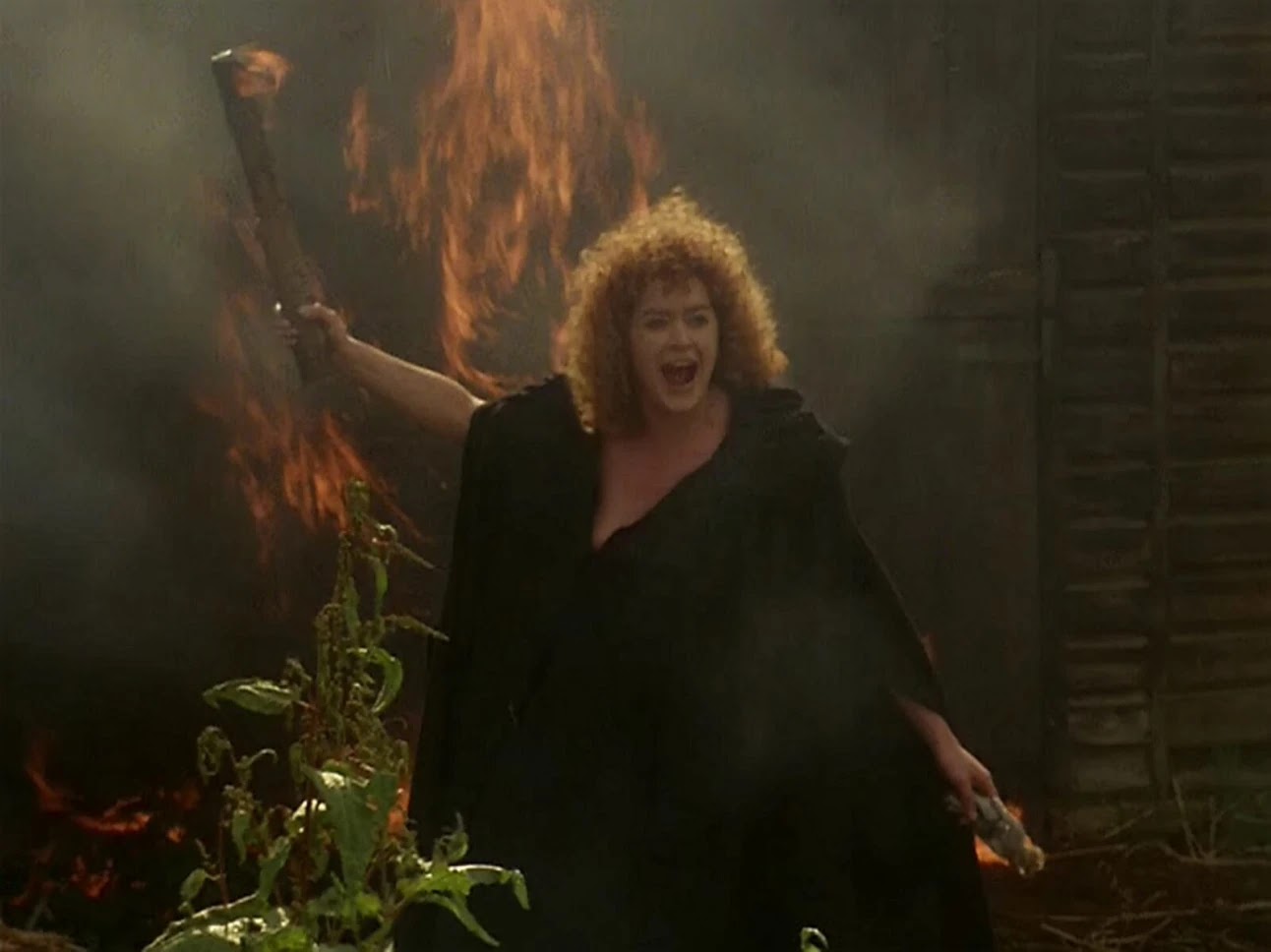
I dunno...If a hot and horny ginger witch suddenly turned up at my house, I probably wouldn't have a problem with it...

In rural England of 1980, a lonely film composer realizes his wife is having an affair, but before he can do anything about it an unnaturally localized thunderstorm breaks out, and when it is over an attractive redhead wearing nothing but a medieval shift turns up in the property's horse stable (much to the consternation of the resident horse). She identifies herself as Lucinda Jessop, a 16th century witch who has magicked herself across the centuries and out of being burned at the stake, and she immediately sets about enthralling and sexually enslaving the composer. When the wife returns home, she at first dismisses her husband's tales of a hot redhead who practically fucked him to death as mere fantasies induced by overuse of prescription drugs, but upon seeing the scratches on his back — Lucinda's mark of claim — and witnessing poltergeist-like activity around the house, the battle for the husband is on...

This initial episode of HAMMER HOUSE OF HORROR is a lot of fun, and it appealed to me because I have a fondness for witch stories. It also helps that Lucinda is portrayed by Patricia Quinn, who is best known as Magenta in THE ROCKY HORROR PICTURE SHOW (1975). She's a sexy lady who just exudes an earthy Celtic sensuality, so she was perfectly cast in this role. Plus, she sells the part of a saucy sorceress by merrily parading around nude, which may come as a surprise to those who only know her as Magenta and never saw her hilarious sex ed demo with an equally nekkid John Cleese in MONTY PYTHON'S THE MEANING OF LIFE (1983). That said, she's quite sinister here, and this episode was the perfect way to launch this anthology.

Sunday, October 03, 2021

31 DAYS OF HORROR 2021 - Day 3: HAMMER HOUSE OF HORROR "Children of the Full Moon" (1980)

                                                                  Daddy's little carnivore.  

With a title like this, the main thrust of the story is given away from the get-go, but what makes it interesting is the how and why of the proceedings. In a nutshell:

While on their way to visit at a friend's country house, a couple's car breaks down in the middle of nowhere, so they seek the nearest house so they can call for help. They happen upon a big house run by a kindly old woman (Diana Dors) who states that she and her husband are Hungarian immigrants, and that they have eight kids — eight very eerie kids — all fathered by her husband via different mothers. There's the expected strange behavior by all of the residents, and when the couple are locked in for the night (so they "don't get a scare"), the wife sees the face of what is obviously a werewolf at the bedroom window (which is two stories up). The husband attempts to climb down and investigate (???) but he falls, rendering himself unconscious. Meanwhile, the old lady and the kids open the bedroom door and let in the werewolf, much to the terror of the wife, and they patiently wait outside while the wife is raped by the lycanthrope. Fade to black... We then see the husband in the hospital, just waking from a concussion and with a broken wrist. The wife remembers nothing after the car breaking down, but she is now sexually voracious and enjoys eating fillets of raw meat. 

The husband goes away for a few weeks on a business trip, and when he returns his wife tells him she's pregnant. Once that news is conveyed, she refuses all further advances from her husband while the fetus grows and an unnatural rate. Not long after, she leaves without notice, and her husband, who remembers that weird night at the house but had written it off as a concussion dream, tails her in the direction of the house, but cannot find the secluded off-road. While looking for it, he encounters a friendly woodsman who mentions that he is originally from Hungary. The husband grills him about the house and the weird family, and too late he realizes just who he's chatting with. The woodsman explains that make wolves mate with many females and sire many cubs, and that's what's happened to the wife. Unfortunately, human women who are used as broodmares for werewolves do not survive the birth, but the cubs live on... 

Anyway, it was the first time I've seen a werewolf transform and kill a victim with a woodsman's axe.

Not something one sees every day.

Saturday, October 02, 2021

31 DAYS OF HORROR 2021 -Day 2: HAMMER HOUSE OF HORROR "The Silent Scream" (1980)

When Peter Cushing offers you a job, look for a slot on the overnight shift at a 24-hour While Castle in the South Bronx instead.

Safe-cracker Chuck Spillers (Brian Cox) is released from prison after serving two years, a sentence that would have been shorter had he not attempted to escape. When he returns to his home, Chuck finds that his wife, Annie (Elaine Donnelly), has been living in abject poverty, having given up all but the most vital of necessities in order to survive and keep the house in her husband's absence. With no job prospects, Chuck tells Annie that a "strange" old man would come to visit him in prison, giving him an envelope of cash and a contact address. Chuck visits the old man, one Martin Blueck (Peter Cushing), who survived imprisonment in a Nazi concentration camp during WWII, so he feels that he and Chuck are kindred spirits. Blueck now runs a pet shop, but in its basement he conducts secret behavioral experiments on wild animals, including some apex predators, in which he trains them not to leave their open cages, training reinforced by potentially lethal electric shock. His goal, or so he claims, is to train animals for cageless zoos, so he enlists Chuck to care for and feed his menagerie while he is away for an unspecified time. Chuck is not at all comfortable with the animals' situation, as he had been disciplined during childhood by being locked in confined spaces for extended periods of time, hence his pathological hatred of captivity. Nonetheless, desperate for employment and income, Chuck accepts Blueck's offer and the old man leaves him to his tasks. But while handling the animal chores, Chuck notices a wall safe in the basement, and he begins to contemplate robbing the old man who had done him a kindness. Bad idea...

By the time HAMMER HOUSE OF HORROR began airing in 1980, the once-groundbreaking studio whose horror output redefined the landscape of cinematic horror and brought it kicking and screaming out of the fog-enshrouded fever dream of the Universal horror cycle had run its course. The visceral and more explicit shocks provided by the likes of THE LAST HOUSE ON THE LEFT, THE EXORCIST, and THE TEXAS CHAIN SAW MASSACRE had rendered Hammer's colorful, atmospheric costume Gothics quaint, though Hammer's fan base remained despite the dwindling box office returns. Thus it was that ITC Television — the company that gave the world THUNDERBIRDS — revived the Hammer brand and transferred it to British television, complete with the brand's signature humor, nudity, and splatter intact, though setting its tales in the then-present day of 1980. 

Like any horror anthology series, its entries were very much hit and miss, and "The Silent Scream" is often hailed as the very best of the lot. Brian Cox stars as Chuck, and he provides a terrific nervous performance, some six years before he became cinema's first Hannibal Lecter in MANHUNTER (1986). But it is the always-welcome presence of Hammer icon Peter Cushing that makes this a must-see. He had lost not one step in being able to convey a clam, steely madness, and his performance only adds to the power of the story's taut suspense and "Oh, my god!!!" moments. Definitely worth watching, the entire 13-episode run can be had on Amazon Prime and Tubi, though unfortunately not without frequent and often haphazardly-placed interruptions by ads.

Friday, October 01, 2021

31 DAYS OF HORROR 2021 - Day 1: DOCTOR WHO "The Brain of Morbius" (1976)

A blinded Sarah Jane Smith (Elizabeth Sladen) stumbles upon the brain of criminal Timelord Morbius, a baleful entity awaiting a new body with which to continue his campaign of evil.

At an unspecified time, The Doctor (Tom Baker) and staunch companion Sarah Jane Smith (Elizabeth Sladen) unexpectedly find themselves in the planet Karn, diverted there for an unstated purpose by the Timelords, but the Doctor is certain that he has been brought there to do some "dirty work" for his overlords, a hunch that proves right. The landscape it littered with crashed spaceships from dozens of worlds, but no survivors are evident. It turns out that the lack of survivors is due to them being killed and their body parts harvested by Condo (Colin Fay), the hulking dimwitted slave/assistant to Dr. Solon (Philip Madoc), a madman who was once considered the galaxy's greatest surgeon. He is obsessed with crafting a viable body for the evil Timelord Morbius, of whom all that remains is his sentient brain in a life-sustaining tank, ands all he needs is a suitable head. The Doctor's curly-topped noggin happens to be both a perfect match in terms of species and also convenient, but while fending off the machinations of Solon, the Doctor must put a stop to the threat of Morbius before he is resurrected, he must also prevent the Sisterhood of Karn — basically a cabal of science-fictional witches — from sentencing him to death, as they are convinced that he has been sent by the Timelords to steal the sacred flame that grants them near-immortality. 


The Sisterhood of Karn gets its chant on.

During this era of DOCTOR WHO'S classic 1970's run, the program, which had initially been conceived as a means by which to educate children about history, truly found its groove (and immense popularity and relevance withing its native British culture) once it began exploring its conceit of being able to have its protagonist and his companions freely travel throughout the boundless reaches of time and space, where they often ran afoul of assorted evil life forms that could be categorized as "monsters," though always with a scientific/biological explanation for their existence.  

By the mid-1970's, the children that had watched DOCTOR WHO since its debut in 1963 had grown up with the program, and it's more kiddie-oriented aspects began to wane as the show hit its adolescence at the same time as its audience. The stories became darker and were front-loaded with elements that kept its fans terrified, with a common experiential marker of British youth of the era being "watching DOCTOR WHO from behind the setee." Though still often quite shonky thanks to the BBC's notoriously tight-fisted budgets, the series more than compensated for its lack of funds with scary scripts and solid performances from the cast. 

Once under the control of producer Philip Hinchcliffe and with actor Tom Baker taking over as the Fourth Doctor, becoming arguably the most iconic actor to essay the role as of this writing, the stories embarked on a two-year (1975-1977) streak of serials that went as far as possible in providing scares allowable under the auspices of the BBC's censors, material that would set DOCTOR WHO firmly in the sights of hardline Christian conservative Mary Whitehouse, an opponent to what she considered changes to "traditional" British values, and self-appointed arbiter of good taste and decency in media.

Mary Whitehouse (1910-2001), arch-enemy of fun.

While wielding no officially appointed position for weighing in on such matters, damned near any aspect of change that began during the 1960's, be it the sexual revolution and feminism, hit records like Alice Cooper's "School's Out" and Chuck Berry's cover of Dave Bartholomew's "My Ding-a-Ling," sitcom TILL DEATH US DO PART (upon which ALL IN THE FAMILY was based), and THE BENNY HILL SHOW (for obvious reasons),  were vehemently opposed by Whitehouse, so it was only a matter of time before the BBC would pussy-out and cave to Whitehouse's criticisms, toning down the material to an insulting degree in the name of children, but in actuality to serve her own ultra-conservative agenda. Fortunately, "The Brain of Morbius" went out before Whitehouse's baleful influence would neuter DOCTOR WHO for the remainder of its original run.

"The Brain of Morbius" is of interest to horror buffs because it is unabashedly meant to evoke the look and feel of Hammer films, the flavor that dominated U.K. horror for almost two decades at the time of its airing. It has all of the elements of a Hammer Frankenstein entry, including mad scientist, hulking lab assistant of questionable intelligence, an atmospheric landscape, an moody lab stocked with all manner of bubbling vials and sparking electrical ephemera, and, of course, a creature crudely assembled from whatever body parts were available, in this case items savagely stolen from murdered survivors of crash-landings on Karn.

  Dr. Solon (Philip Madoc) contends with the impatient Morbius, whose brain resides in a makeshift bubble atop a hideous patchwork body. The stuff of nightmares.

The Morbius creature is a piecemeal horror of mismatched biological elements — a hulking, hairy body, one arm a massive crustacean claw while the other is the flesh and bone of a human, surmounted with a bubble sporting artificial eye stalks — and it must have been terrifying to younger viewers at the time. Hell, it's still unnerving, with its threadbare look actually adding to its effectiveness. 

In short, "The Brain of Morbius" is simply an old school family-friendly creature feature of the type made for saving an otherwise boring Saturday afternoon, and it's also probably the closest that classic DOCTOR WHO got to crafting a straight-up horror yarn (science-fictional aspects notwithstanding).

 Packaging for the DVD release.

31 DAYS OF HORROR 2021 -Introduction

Sooooo...

Here we are, with the United States about to enter Year 2 of the COVID-19 pandemic,  a run that shows no sign of slowing down, thanks to the utter willful stupidity of the North American public. With such a real-life Reaper upping its score every day, how can mere works of entertainment even serve to scare us anymore? I can't answer that one, but at least I can provide looks at horror confections that will remove us from the threat of a real-world microscopic monster and instead place us firmly within the imagination's landscape of strange creatures, legendary beasts, unkillable slashers, malevolent aliens, you name it. Anything with which to escape from the real thing, even if only for a little while. 

Enjoy, fellow Cine-Miscreants. Enjoy.

-Yer Bunche